Hubble Space Telescope: The Flawed Mirror and Its Rescue
Hubble launched in 1990 with a mirror ground 2.2 microns too flat. How astronauts fixed it in 1993, what it has discovered since, and how long it can last.
Key takeaways
- Hubble's 2.4-metre mirror was ground 2.2 microns too flat toward its edge, about a fiftieth of a hair's width, because a test instrument's lens sat 1.3 mm out of place.
- Astronauts fixed the blur in December 1993 on shuttle mission STS-61, installing the COSTAR corrective optics and a new camera, WFPC2, over five spacewalks.
- Hubble pinned down the universe's expansion rate to just over 1 percent precision, and that value does not sit comfortably with other estimates.
- In 2001 Hubble made the first direct detection of an exoplanet's atmosphere, finding sodium around a gas giant orbiting the star HD 209458.
- Hubble now points using a single gyroscope, with two spares in reserve, and NASA does not expect it to re-enter the atmosphere before the mid-2030s.
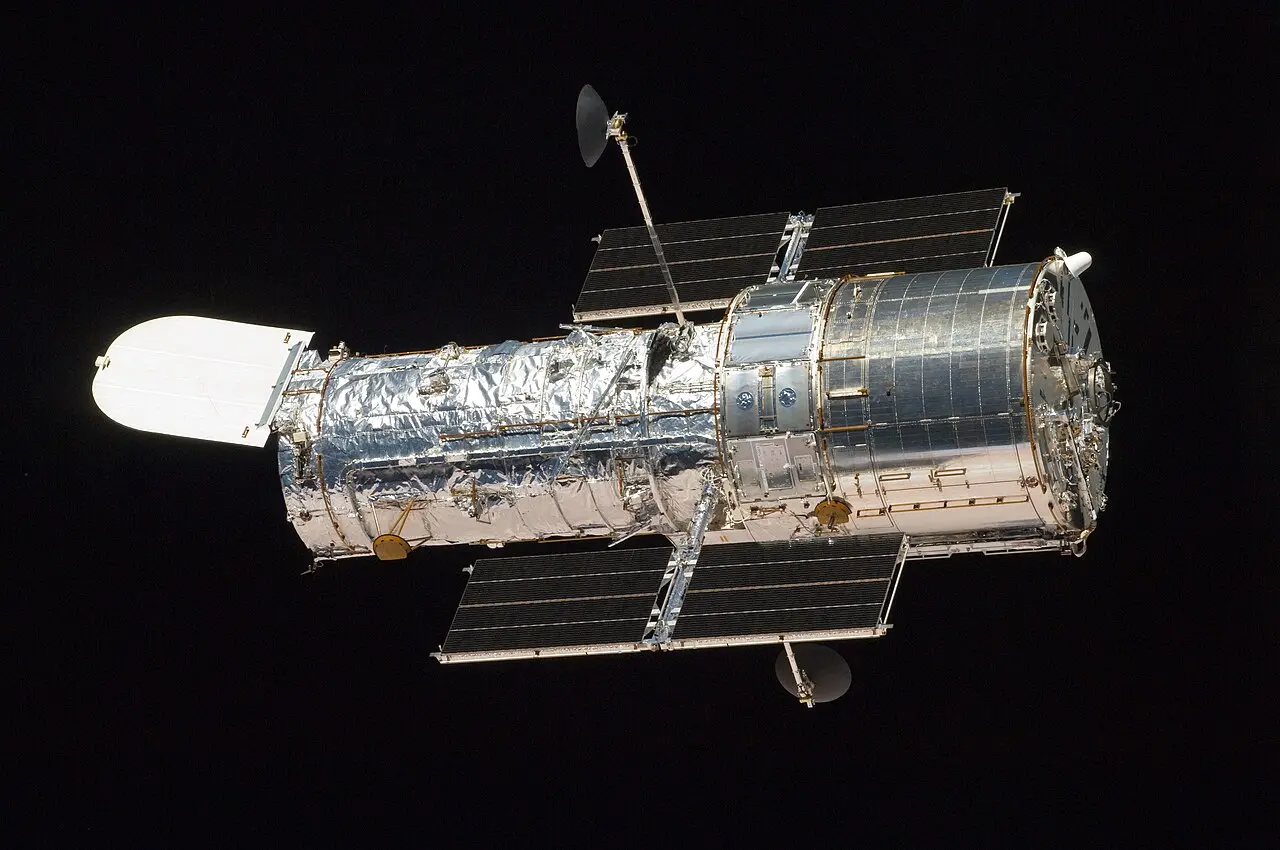
Hubble was rescued by a set of corrective optics installed in orbit. Its 2.4-metre main mirror had been ground to the wrong shape, too flat toward the edge by 2.2 microns, roughly a fiftieth of the thickness of a human hair, so every picture it took came back blurred. In December 1993, spacewalking astronauts fitted what amounted to spectacles for its instruments, and the telescope went on to make more than 1.7 million observations, time the expansion of the universe and detect the first known atmosphere on a planet beyond the solar system. The strange part of the story is that the mirror makers were not careless with the glass. They polished it to exactly the shape their test equipment said was right, and the test equipment was wrong.
What went wrong with Hubble's mirror?
Hubble rode into orbit aboard the space shuttle Discovery, on mission STS-31, launching on 24 April 1990. The crew released it the next day, about 610 kilometres up. On 27 June 1990, two months after launch, NASA announced that the telescope was flawed. The problem was spherical aberration. The primary mirror was slightly too flat away from its centre, so light striking its outer zone came to a focus at a different point from light reflecting near the middle. The depth of the error was 2.2 microns, ten times larger than the design could tolerate. A NASA board of investigation, formed on 2 July 1990, had the cause by November. The mirror's maker, Perkin-Elmer, had shaped and checked it against a single test instrument called a reflective null corrector, a template made of two small mirrors and a lens. That lens sat 1.3 millimetres out of position, and the board calculated that this one displacement explained the blur in detail. Worse, other optical tests during manufacture had pointed to the problem, but each warning was dismissed as a fault in the test itself. The board noted that no independent checks had been planned, and that worries about cost and schedule had discouraged anyone from adding them.
How did astronauts fix Hubble in 1993?
Nobody tried to touch the mirror. Because the error had been measured so exactly, engineers could do what an optician does for a patient with poor eyesight: design new optics whose errors cancelled the mirror's.
Servicing Mission 1 launched on 2 December 1993 aboard the shuttle Endeavour, mission STS-61. Over five back-to-back spacewalks totalling 35 hours and 28 minutes, the crew installed two fixes. The first was COSTAR, a device that swung five pairs of small corrective mirrors, some no bigger than a US nickel, into the light path on deployable arms, feeding sharpened light to three of Hubble's original instruments. NASA likens it to a pair of eyeglasses. The second was a new main camera, Wide Field and Planetary Camera 2 (WFPC2), redesigned with internal optics that brought the light into focus. While they were there, the astronauts also replaced the solar arrays and parts of the gyroscope electronics. It worked. Before-and-after images of a single star, Melnick 34, helped show that Hubble had been restored to its planned optical performance. Every instrument installed afterwards had its correction built in, and in May 2009 astronauts removed COSTAR to make room for a new spectrograph. Four more servicing missions followed, in 1997, 1999, 2002 and 2009, swapping in new cameras and spectrographs, fresh solar panels and a full set of gyroscopes. Altogether six shuttle flights deployed and serviced Hubble, carrying 32 astronauts who spent 171 hours on spacewalks.
What has Hubble discovered?
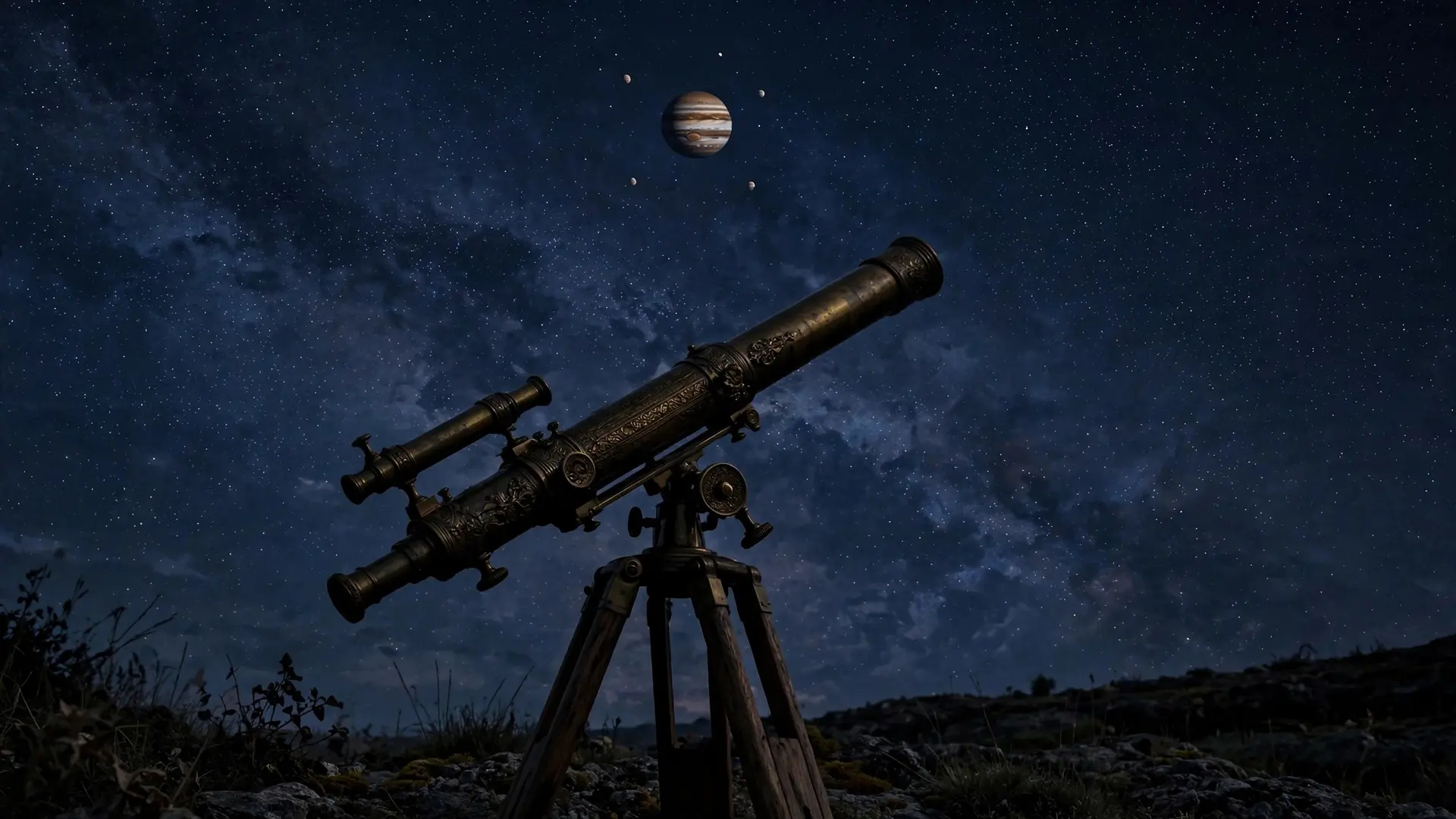
With sharp eyes above the atmosphere, Hubble became the best-known heir of the spyglass Galileo turned on the night sky. In 1995 it spent ten days staring at one tiny patch of sky and found roughly 3,000 galaxies: the Hubble Deep Field. Its later Ultra Deep Field, a speck of sky that NASA compares to the view through the eye of a needle held out at arm's length, contains an estimated 10,000.
It also measured how fast the universe is expanding. Using Cepheid variable stars and Type Ia supernovae as distance markers, teams working with Hubble pinned down the expansion rate to just over 1 percent precision, about eight times better than originally hoped. Hubble's supernova observations, together with ground-based work, helped show that the expansion is speeding up, a finding that won the 2011 Nobel Prize in Physics. That precision has opened a puzzle of its own, because Hubble's rate does not sit comfortably with other estimates. In 2023 the James Webb Space Telescope, now busy finding galaxies that look too mature for their age, confirmed Hubble's numbers, leaving some scientists to suspect that something other than measurement error is at work. Then came planets around other stars. In November 2001, astronomers announced that Hubble's imaging spectrograph, watching a gas giant cross the face of HD 209458, a Sun-like star about 150 light-years away in Pegasus, had found the fingerprint of sodium in starlight filtering through the planet's air. It was the first direct detection of an atmosphere on a world beyond the solar system. Demand has never slackened. On 19 September 2026 Hubble completed its 200,000th orbit, and astronomers still request about seven times more observing time each year than it can give.
How much longer can Hubble last?
At launch, Hubble was expected to last about 15 years. It is now in its 37th, and since the shuttle's retirement nobody can service it. Its age shows in its gyroscopes, the sensors that tell it how fast it is turning. Astronauts replaced all six in 2009, but the hair-thin wires inside them corrode and break over time. Hubble now has three working gyros and flies on just one, keeping the other two in reserve. One-gyro mode fills the gap with magnetometers, Sun sensors and star trackers. NASA says it costs roughly 12 percent in efficiency, because turning to a target and locking on take longer, and it means Hubble can no longer track moving objects closer to Earth than Mars. The orbit is the other clock. Hubble circles about 480 kilometres up, and even there faint atmospheric drag is slowly lowering it. NASA does not expect a re-entry before the mid-2030s at the earliest, and says a propulsion module will eventually be attached, either to steer the telescope into a controlled plunge over the South Pacific or to boost it higher. Hubble's most lasting lesson may be the rescue itself. A telescope that launched with a flaw exposed in every image was diagnosed down to a 1.3-millimetre error in a piece of test equipment, corrected with optics designed on the ground and fitted by hand in orbit, then upgraded four more times. The mistake taught engineers to test their tests. The repair turned an embarrassment into a telescope astronomers still queue for, asking for seven hours of its time for every hour it can give.
Frequently asked questions
What was wrong with the Hubble telescope's mirror?
Its main mirror was ground slightly too flat toward the edge, by 2.2 microns, because the instrument used to test its shape had a lens 1.3 millimetres out of position. The error blurred every image.
How was Hubble's mirror fixed?
The mirror itself was never touched. On the December 1993 shuttle mission STS-61, astronauts installed COSTAR, which fed corrected light to three instruments through small mirrors, and a new camera, WFPC2, with corrective optics built in.
How long will Hubble keep working?
NASA's current outlook is that Hubble will not fall back into the atmosphere before the mid-2030s. It now operates on one gyroscope, keeping two working spares in reserve.