Pheasant Island: Ruled by France and Spain in Turns
A tiny island in the Bidasoa river swaps between Spain and France every six months. Inside the world's oldest condominium and the 1659 peace deal behind it.
Key takeaways
- Pheasant Island in the Bidasoa river alternates between Spanish and French administration every six months, the world's oldest and only rotating condominium.
- Spain governs from 1 February to 31 July; France takes over from 1 August to 31 January.
- The arrangement began with the Treaty of the Pyrenees, signed on the island itself on 7 November 1659 to end the Franco-Spanish War.
- The island is uninhabited, closed to visitors except on rare heritage days, and is slowly shrinking through erosion.
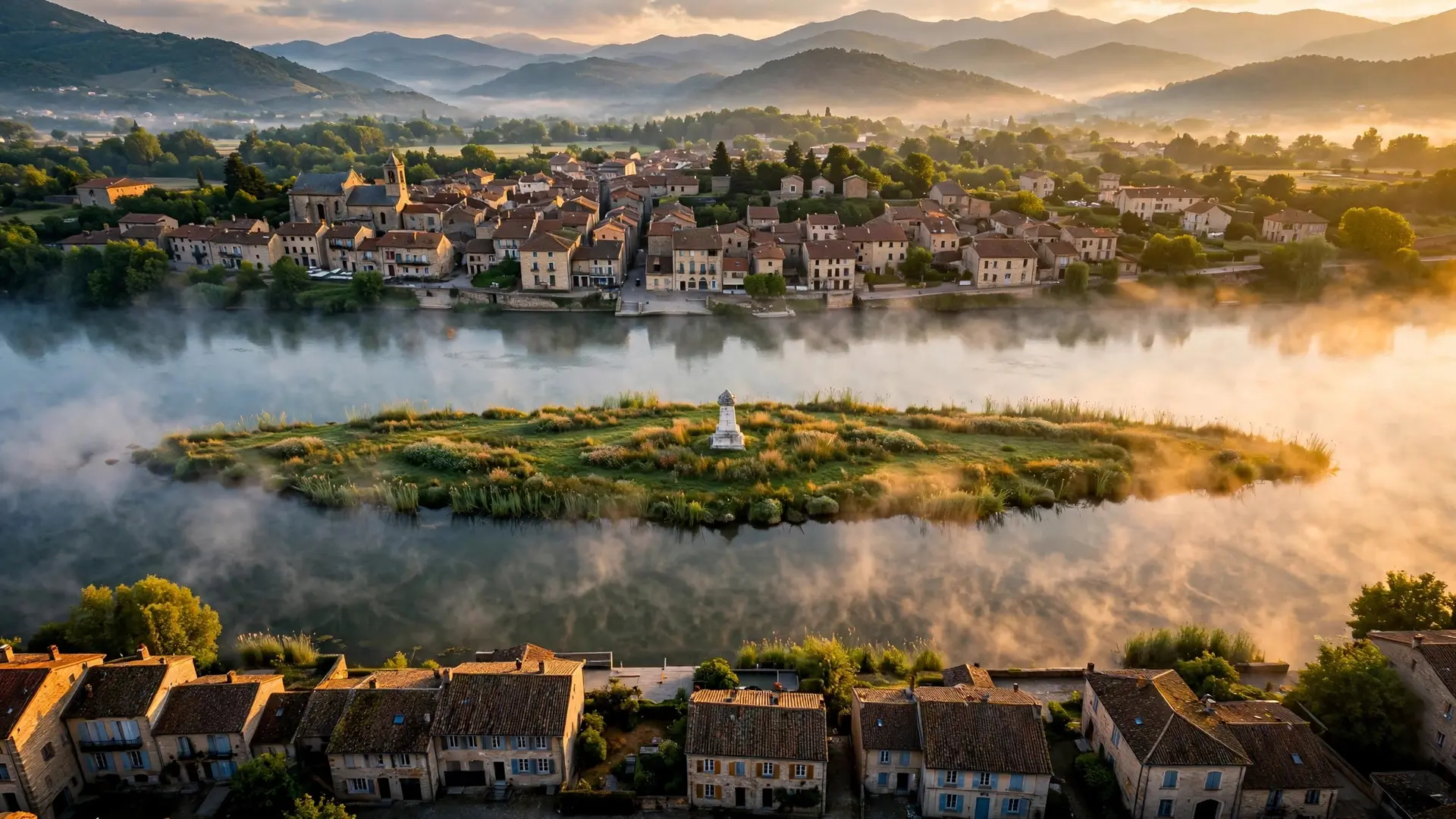
In the middle of the Bidasoa river, between the Spanish town of Irun and the French town of Hendaye, sits an island barely 200 meters long and 40 wide. It has no residents, no buildings, and no pheasants — yet every six months it officially changes nationality. From 1 February to 31 July it is administered by Spain; from 1 August to 31 January it answers to France. This is the world's oldest surviving condominium, and the only one anywhere where sovereignty rotates on a calendar. A condominium in international law is a territory over which several states share equal sovereignty without splitting it into national zones. Other examples exist — Antarctica's shared claims are the famous one — but Pheasant Island stands alone in swapping its administrator twice a year like a timeshare. The deal was sealed in 1659, and it has now been honored for more than three and a half centuries without a single interruption.
How does a six-month handover actually work?
The swap is almost aggressively undramatic. There are no flag-raising ceremonies and no parades. Twice a year, representatives of the two countries meet on the island to exchange official papers, and responsibility passes quietly from one side to the other. On paper, the island's governors are naval commanders: Spain's commander at San Sebastián and his French counterpart at Bayonne each take turns as the island's viceroy. In practice, there is little governing to do, so day-to-day care falls to the mayors of Irun and Hendaye, the two towns facing each other across the water. The full annual maintenance program amounts to sending a small crew by boat once a year to cut the grass and prune the trees — a routine that has barely changed across the centuries.
That modesty suits the place. The island is uninhabited and ordinary visitors are banned — it can only be reached legally during rare heritage open days, when people arrive by boat to see the white monolith erected in memory of the treaty. At extreme low tides, it is sometimes possible to walk to it from the Spanish side, which is exactly why the authorities keep an eye out for unauthorized campers.
Why did a tiny island host a peace treaty?
The island's strange status is the aftereffect of a war. The Thirty Years' War ended in 1648, but France and Spain kept fighting until Spain was defeated by an Anglo-French alliance in 1658. The following year, the two kingdoms needed a place to negotiate peace — and they chose the neutral ground floating exactly between them. The talks were an elaborate affair. Cardinal Mazarin, chief minister of France, and Don Luis Méndez de Haro, the grandee representing Spain, negotiated for months while engineers built wooden bridges from both riverbanks and the opposing armies faced each other across the water, just in case the negotiations collapsed. After some three months, the Treaty of the Pyrenees was signed on the island on 7 November 1659. France gained territory including Catalonia north of the Pyrenees and the Cerdanya region, the Franco-Spanish border was redrawn, and the deal was sealed with a royal wedding when Louis XIV of France married the daughter of Spain's King Philip IV. Here is the curious part: nobody had thought about the island itself during the negotiations. Only after the treaty was settled did anyone ask who owned the patch of ground where the peace had been made. Rather than divide it, the two crowns agreed to share it, alternating control every six months — a living symbol of the peace the treaty had created. From then on, the island became a favorite stage for royal diplomacy, hosting meetings between French kings and their Spanish brides.
What does a condominium actually mean?
It is worth pausing on a misconception. Saying the island "changes country" is the popular version, but the reality is closer to shared custody. The island never stops being jointly owned; what rotates is who exercises jurisdiction and takes responsibility for its upkeep. The underlying co-sovereignty runs continuously, all year, while the administration passes back and forth on the February and August handover dates. That is what makes the island such a diplomatic curiosity. Most straight-line borders were drawn by rulers on maps; this one was drawn by a peace treaty, and instead of splitting the prize it kept the prize whole. The arrangement was later confirmed by the Treaty of Bayonne in 1856, and it has survived every war, regime, and government since — more than 700 handovers and counting. For context on how odd borders get, the same 1659 treaty produced another anomaly nearby. When the Cerdanya was ceded to France, the agreement mentioned only "villages" — and the Spanish successfully argued that the historic town of Llívia was a "ville", exempting it from the handover. It remains a Spanish enclave inside France to this day. Europe's border map is full of such leftovers, from enclaves like Baarle to unclaimed land like Bir Tawil — but none of them alternate their sovereignty on a schedule.
Can you visit? And how long will it last?
For now, visitors can only admire the island from the riverbanks of Irun or Hendaye, where the commemorative monolith is visible in the island's center. And there is a quiet threat to the whole arrangement: the Bidasoa's snowmelt-fed currents have been shrinking the island for centuries — it is believed to be roughly half its 1659 extent. Both countries have shored up the banks with rocks and vegetation to slow the loss. The handover still happens like clockwork, twice a year, but each time the territory being handed over is a fraction smaller. Whether the island eventually washes away or keeps shrinking into the river, its political experiment is already the longest-running of its kind in the world. Few diplomats today would resolve a border dispute by inventing a six-month timeshare — but 365 years ago, on a tiny island in a border river, it worked.
Frequently asked questions
Which country does Pheasant Island belong to right now?
It depends on the month. The island is under Spanish administration from 1 February to 31 July and under French administration from 1 August to 31 January. Underneath, both countries share sovereignty year-round.
Can you visit Pheasant Island?
No, not normally. The island is uninhabited and off-limits, except very occasionally on special heritage open days when visitors may come by boat. At extreme low tides it can also be reached on foot from the Spanish side.
What is a condominium in international law?
A condominium is a territory over which two or more states share sovereignty equally, without dividing it into national zones. Pheasant Island is unusual because its two co-owners take turns exercising jurisdiction every six months.
Sources
- Pheasant Island in France / Spain, Atlas Obscura
- The pheasant with a foot in both camps, Inntravel
- What island changes hands between France and Spain every 6 months?, Curious Expeditions