The Great Game: Britain vs Russia in Central Asia
Britain and Russia fought a century-long shadow war across Central Asia with spies, subsidies and proxy wars, but never a direct battle between them.
Key takeaways
- The Great Game was the 19th-century rivalry between Britain and Russia over Central Asia, fought with spies, diplomacy and proxy wars.
- Britain sought to shield India from Russia; Russia pushed southward toward warm-water ports and influence.
- Afghanistan served as the buffer state — two British invasions ended in retreat or pyrrhic victory.
- The rivalry never produced a direct Anglo-Russian war; it ended with the 1907 Anglo-Russian Convention.
- Borders drawn during the Game — including the Durand Line — are still disputed today.
The Great Game was the nineteenth century's longest shadow war: a contest between the British and Russian empires for control of Central Asia and the approaches to India. It was fought with spies, bribes, boundary commissions, and proxy armies — but never with a direct war between the two powers themselves. It drew borders that are still disputed today and ended only when a new threat in Europe forced the rivals to shake hands.
Why were two empires colliding over Central Asia?
By the early 1800s, two enormous empires were expanding toward each other across Asia. Britain had consolidated control of the Indian subcontinent, which it regarded as the most valuable possession in its empire. Russia was pushing steadily southward and eastward: into the Caucasus, across the steppe, and toward the ancient khanates of Central Asia — the caravan cities of the old Silk Road that had grown rich on trade for centuries. British strategists watched Russian outposts advance from thousands of miles away to the shores of the Aral Sea by mid-century, and then toward Afghanistan's borders by the 1880s. The fear was that Russia might use Afghanistan as a staging post for an invasion of India, or at least stir enough trouble on the frontier to threaten British rule. Lord Palmerston captured the mood in 1835: "Here we are, just as we were, snarling at each other, hating each other, but neither wishing for war." Russia's own motives were layered. There was commerce — the cotton-growing khanates were valuable markets. There was strategy — securing a southern flank, and dreams among some officials of reaching warm-water ports on the Indian Ocean. And there was the self-reinforcing logic of frontiers: each advance created new, insecure borders that seemed to require the next advance. Britain responded with a simple doctrine: build buffer states — Persia, the khanates, and above all Afghanistan — between India and the tsar's armies.
What did this rivalry actually look like on the ground?
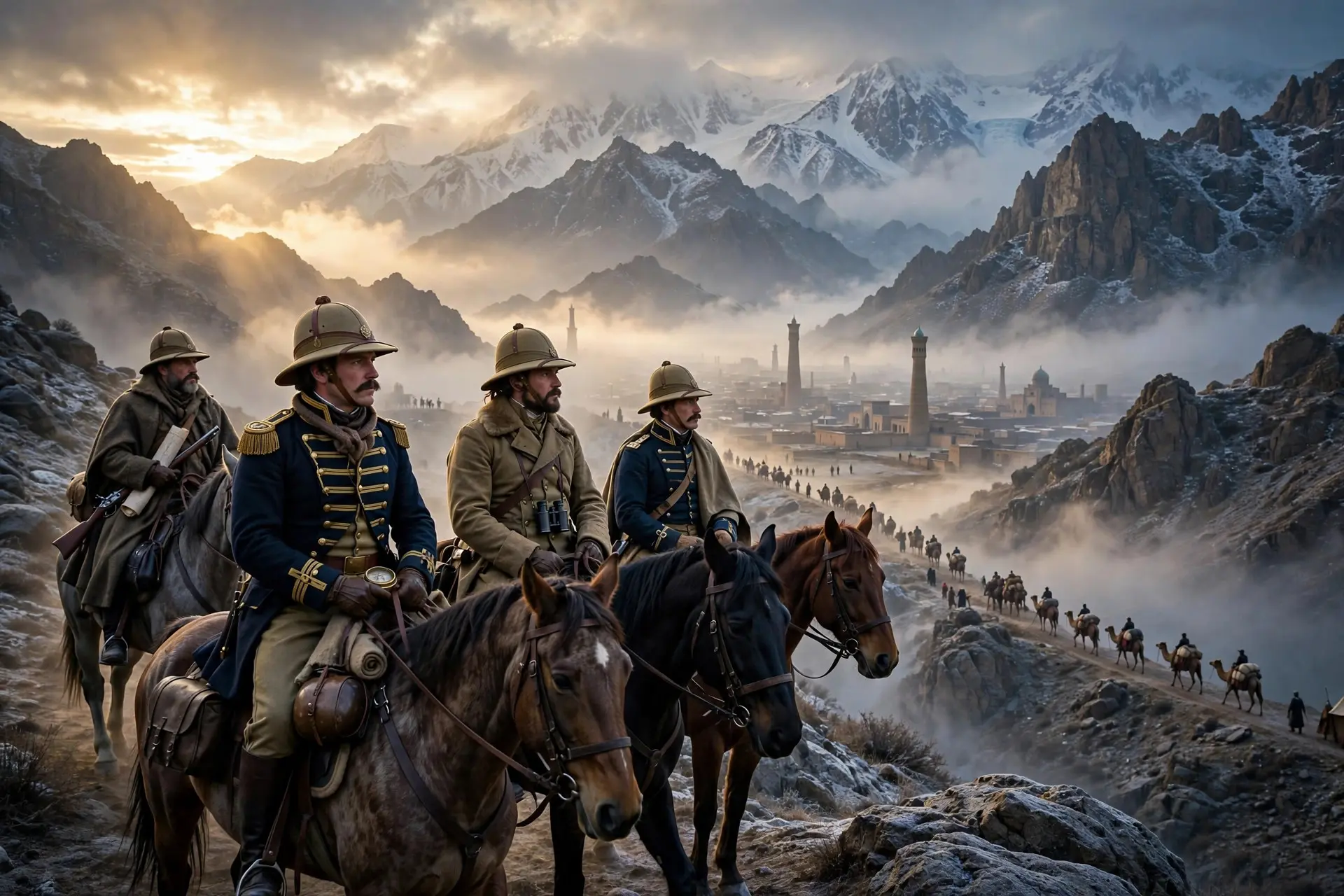
Almost nothing like a conventional war. No British and Russian armies ever met in pitched battle over Central Asia. Instead the contest ran on intelligence, money, and maneuver. Britain built a remarkable covert apparatus: Indian surveyors called the Pundits mapped vast stretches of Central Asia and Tibet in disguise, hiding their instruments in prayer beads and walking staffs. Officers like Alexander Burnes combined diplomacy with spying — and paid the price, murdered in Kabul during the 1841 uprising. Russia's officers explored in even harsher conditions, sending home reports across impossible distances.
Both sides courted local rulers with subsidies, guarantees, and the occasional threat. Russia tended to absorb territory outright: Tashkent fell in 1865 after General Cherniaev exceeded his orders, Bukhara became a protectorate in 1868, Khiva was conquered in 1873, and Kokand was annexed in 1876. Britain preferred indirect control — money, advisers, and frontier expeditions, keeping local rulers in place as long as they looked toward London rather than St. Petersburg. Historians have described it as a nineteenth-century version of what modern strategists call gray-zone competition: vigorous, sometimes reckless, but carefully kept below the threshold of great-power war.
Why did Britain keep invading Afghanistan?
Afghanistan sat squarely in the middle, guarding the mountain passes between Russian Central Asia and British India. Britain tried twice to settle the question by force, and both times paid for it. The First Anglo-Afghan War (1838–1842) began with a British invasion to replace the Afghan ruler Dost Mohammad Khan with a more compliant candidate, Shah Shuja. The invasion worked at first — then the occupation of Kabul provoked a ferocious uprising, and the retreat from the city in January 1842 became one of the worst disasters in British imperial history. Of roughly 16,500 soldiers and camp followers who marched out of Kabul through snow-filled passes under constant attack, only a handful survived. London then tried restraint — Lord Lawrence's "policy of masterly inactivity" from 1864, watching Afghanistan's foreign policy while leaving its internal affairs alone. It held until 1878, when the Afghan ruler Sher Ali Khan received a Russian diplomatic mission in Kabul and turned a British mission back at the Khyber Pass. Britain sent some 40,000 troops across the border, opening the Second Anglo-Afghan War (1878–1880). The Treaty of Gandamak in May 1879 looked like a settlement — until the British mission in Kabul was massacred that September. The fighting dragged on, including the annihilation of a British brigade at Maiwand in July 1880, before Britain installed Abdur Rahman Khan, who accepted British direction of Afghanistan's foreign policy in exchange for subsidies and a protection guarantee. Afghanistan stayed formally independent; Britain got its buffer. The near-miss came in March 1885 at Panjdeh, where Russian troops clashed with Afghan forces over a disputed oasis and occupied it. War between the two empires suddenly looked imminent — Parliament voted war credits — before both governments drew back and sent a joint boundary commission to demarcate the frontier along the Amu Darya instead. The scramble to fix borders then produced the Durand Line in 1893, drawn by agreement between Abdur Rahman Khan and the British administrator Mortimer Durand, splitting Pashtun tribal lands — a boundary Afghanistan has never fully accepted. In 1895, the Pamir Boundary Commission defined the Afghan–Russian frontier, carving out the narrow Wakhan Corridor as a final buffer strip.
How did a century of rivalry end without a war?
The Game ended not because the disputes were resolved, but because a bigger threat appeared. By the early twentieth century, Germany's rising power was rearranging European alliances, and Russia was badly weakened by its defeat in the Russo-Japanese War of 1904–1905 and the 1905 Revolution. Fighting Britain over Central Asia no longer looked affordable. On 31 August 1907, in St. Petersburg, the two empires signed the Anglo-Russian Convention, which formally ended the classic Great Game. Persia was divided into three zones — a Russian sphere in the north, a British sphere in the south, and a neutral belt between them. Afghanistan was acknowledged as outside Russian influence; Russia would conduct all political relations with Kabul through Britain, while Britain pledged not to occupy or annex Afghan territory. Tibet, where both powers had intrigued, was placed under Chinese suzerainty with both sides agreeing to stay out. Within a decade the old rivals were wartime allies against Germany.
Was it really a "game"?
The playful name hides how contested the story remains. Historians do not even agree on when it began: some trace it to Russia's victory over Persia and the Treaty of Gulistan of 1813, which handed Russia much of the Caucasus; others start with a British trade mission to Bukhara in 1830, or with Conolly's 1840 coinage. The Russians reportedly had their own term — the "Tournament of Shadows" — and their own mirror-image grievances about British commercial and military inroads into Central Asia. And the "players" were not only empires. Afghan rulers spent decades exploiting the rivalry, and as the former ambassador Sergio Romano later wrote: "The Afghans spent a good part of the nineteenth century playing a diplomatic and military game with the great powers — the so-called 'Great Game' the main rule of which was to use the Russians against the Brits and the Brits against the Russians." The Russian historian Evgeny Sergeev has called it a proto-Cold War — a century of distrust, espionage, and proxy struggle short of direct combat. The afterlife of the Game is everywhere. Its borders still cut through living communities — the Durand Line remains contested, and the frontiers of the Central Asian republics trace back to imperial conquests. Its geography seeded modern geopolitics: Halford Mackinder's 1904 "Geographical Pivot of History," which named Central Asia the Heartland of world power, drew directly on Great Game experience. And commentators still reach for the "New Great Game" to describe today's competition for influence in Central Asia between the United States, Russia, and China — though today's Central Asian states are sovereign actors with their own interests, not prizes on a board. The original Great Game was never formally declared and never ended in victory or defeat. It demonstrated both the logic and the limits of imperial rivalry: a century of maneuvering that redrew the map of Asia, preserved Afghanistan's independence at the cost of its development, and dissolved the moment both empires found a more dangerous enemy.
Frequently asked questions
What was the Great Game?
A roughly century-long contest between the British and Russian empires for influence across Central Asia, centered on Afghanistan, Persia, and Tibet. The phrase was coined in 1840 by British intelligence officer Arthur Conolly and popularized by Rudyard Kipling's 1901 novel Kim.
Why did Britain care about Central Asia?
Britain's chief motive was defending India, the most valuable possession in its empire. British strategists feared that Russian expansion through Central Asia could destabilize the frontier or even stage an invasion of India, so they tried to keep Russia at a distance behind buffer states.
How many Anglo-Afghan wars were there during the Great Game?
Two major ones: the First Anglo-Afghan War (1838–1842), which ended in a catastrophic British retreat from Kabul, and the Second (1878–1880), which left a Britain-friendly ruler accepting British control of Afghan foreign policy.
How did the Great Game end?
It ended with the Anglo-Russian Convention of 31 August 1907, driven by the rise of Germany and Russia's exhaustion after the Russo-Japanese War. The two empires divided Persia into spheres of influence, neutralized Afghanistan, and agreed to leave Tibet alone.