How Did the Sumerians Build Ziggurats From Mud Brick?
The Sumerians built ziggurats from millions of mud bricks wrapped in fired brick, engineered terraces that have survived 4,000 years of desert weather.
Key takeaways
- The Ziggurat of Ur was begun around 2100 BCE by King Ur-Nammu of the Third Dynasty of Ur, whose name is stamped on its bricks.
- Its first stage used roughly 7 million sun-dried mud bricks for the core and 720,000 fired bricks for the weatherproof shell.
- Fired bricks were set in bitumen, a natural tar, while 'weeper holes' vented moisture so the core never softened and collapsed.
- A Babylonian king added four more tiers in the 6th century BCE, turning the original three-tier platform into a seven-story structure.
- Excavated in 1922 and partly reconstructed in the 1980s, the ziggurat became a UNESCO World Heritage site in 2016.
Sumerian builders raised ziggurats from millions of sun-dried mud bricks, then sealed the whole mountain inside a shell of fired bricks set in bitumen, a natural tar that waterproofed it against rain. Small "weeper holes" vented trapped moisture so the core never softened, and stamped bricks name the builder: King Ur-Nammu, around 2100 BCE.
- About 25 ziggurats survive, and the Ziggurat of Ur in southern Iraq is one of the best preserved. (Encyclopædia Britannica)
- Ur-Nammu, founder of the Third Dynasty of Ur, reigned 2112-2095 BCE; the first construction stage used roughly 7 million mud bricks and 720,000 fired bricks. (Encyclopædia Britannica, Alberti's Window)
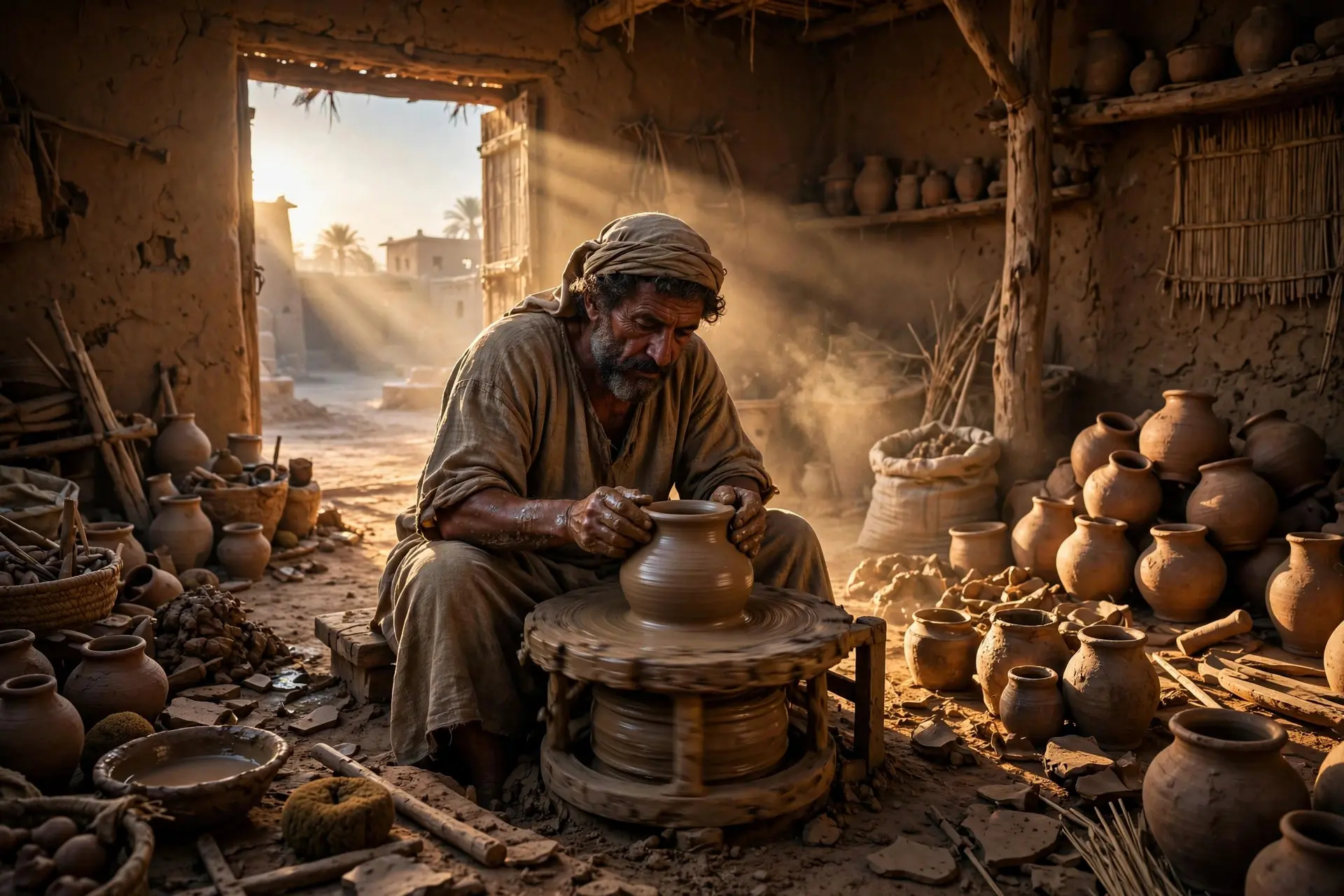
- The mud-brick core was pressed from clay and reeds in molds, then dried in the sun, with reed matting and sandy soil sandwiched between every six layers of brick. (Encyclopædia Britannica)
- The facing bricks were mortared with bitumen to form a waterproof surface, pierced by weeper holes that let water evaporate from the center of the core. (Encyclopædia Britannica, Alberti's Window)
- In the 6th century BCE four more tiers were added to make a seven-story structure; excavation began in 1922, partial reconstruction followed in the 1980s, and UNESCO listed it in 2016. (Encyclopædia Britannica)
- Some fired bricks weighed up to 33 pounds (15 kg), light beside the 2.5-ton stones of the Great Pyramid, but numerous enough to armor a whole mountain. (Alberti's Window)
Why did the Sumerians build with mud brick at all?
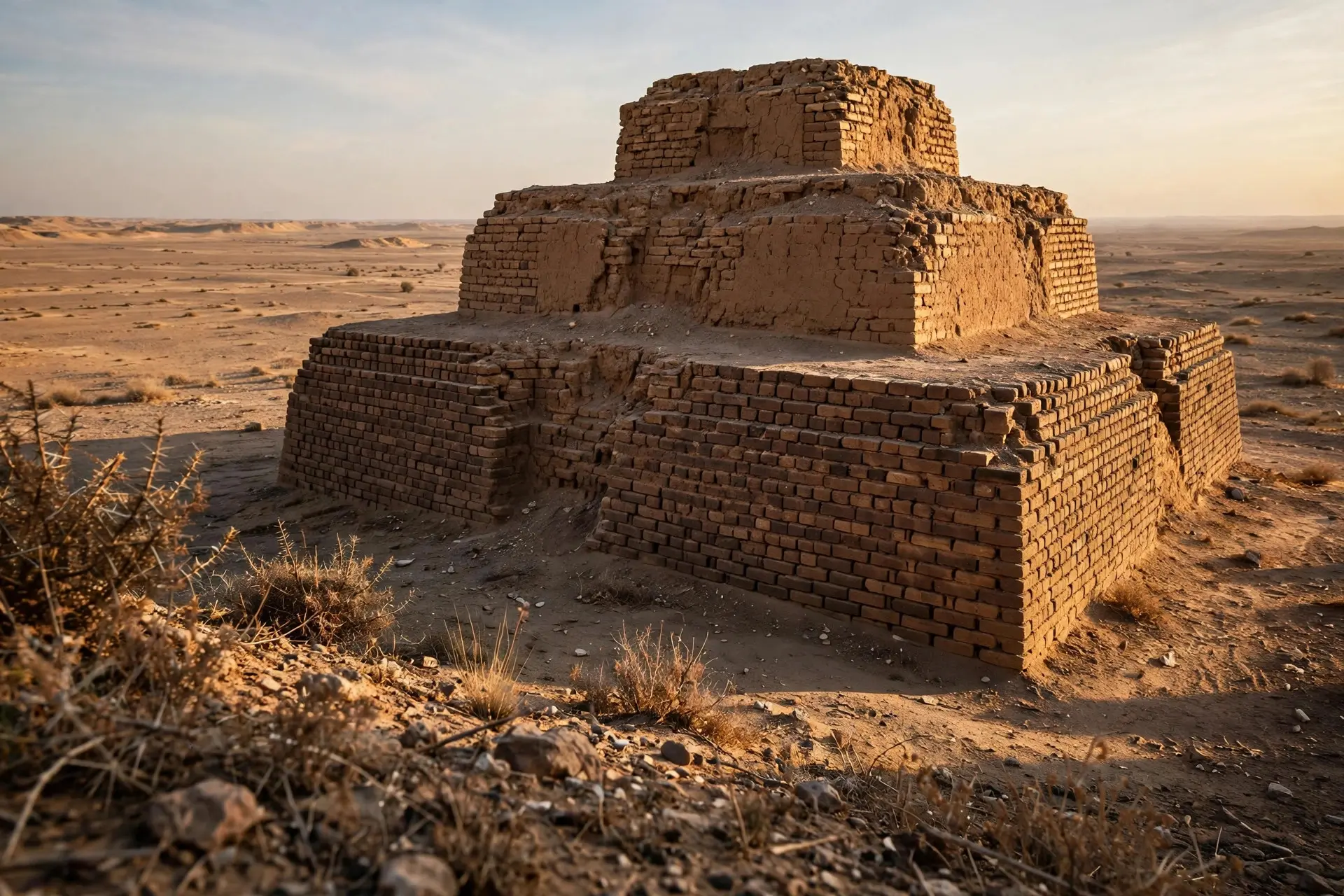
Southern Mesopotamia is a flat river plain with almost no stone, timber, or metal. What it has in enormous supply is river silt from the Tigris and Euphrates. So the Sumerians built their mountains out of mud: clay mixed with chopped reeds, pressed into rectangular molds, and left to bake in the sun. A ziggurat is a solid stepped platform with no rooms inside, crowned by a small temple that lifted the god's house above the city. The original Ziggurat of Ur rose in three tiers. Three buttressed staircases climbed to a flat top, where a temple honored Nanna, the moon god and divine patron of Ur. Each terrace may even have been planted with vegetation, a green crown on a brick mountain.
How did mud survive 4,100 years of rain?
Rain is the great enemy of mud brick: water turns the brick back into mud. The Sumerians answered with layers. The solid core of sun-dried bricks was wrapped in a thick outer skin of fired bricks, the kiln-baked kind that resists moisture and wind. Those facing bricks were laid in bitumen, a naturally occurring tar, so the joints themselves were waterproof. The result was a raincoat for a building. But a raincoat traps sweat, so the engineers added vents. Narrow "weeper holes" pierced the inward-sloping walls, lined with fired brick rather than sun-dried. Water soaking into the core could drain and evaporate instead of swelling the structure from within. Between the brick courses, layers of crisscrossed reeds and sandy soil acted like flexible joints, keeping the mass from sagging when floods soaked the ground. There was even an optical trick. The excavator Leonard Woolley noticed that no line on the ziggurat is truly straight: the faces bulge very slightly, an entasis that keeps a long wall from looking as if it sags. (The Art Newbie)
Who built the Ziggurat of Ur, and how do we know?
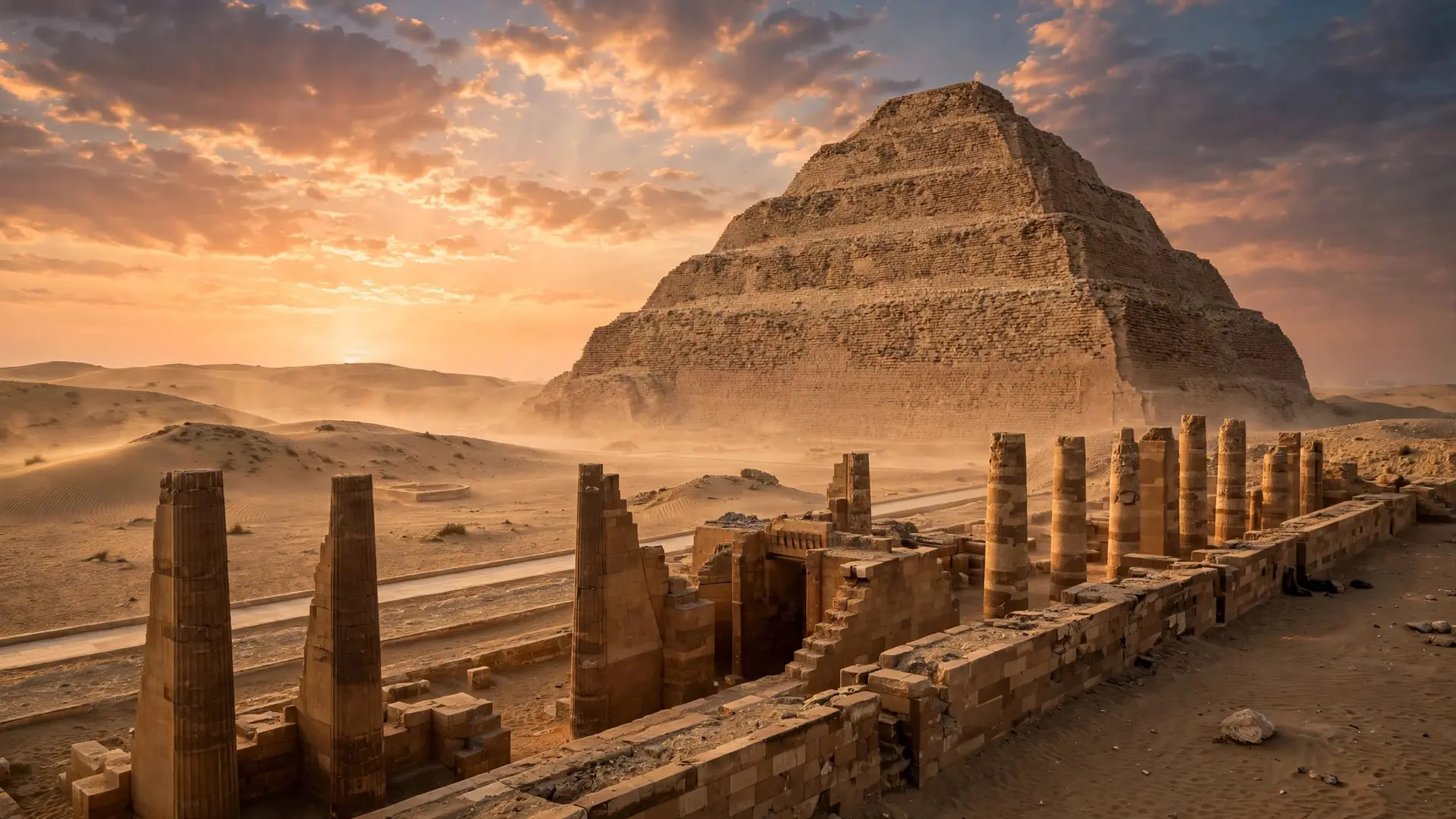
The building signed its own work. Many facing bricks are stamped with the name of Ur-Nammu, the first king of the Third Dynasty of Ur, who began the platform around 2100 BCE. His son Shulgi probably finished it. This was not a monument to one ruler's vanity in the Egyptian sense; it was a dynastic signature on the city's sacred mountain, much as Imhotep's Step Pyramid at Saqqara stamped one architect's name on Egypt's first great stone pyramid. Maintenance never stopped. Evidence shows continuous repair for at least 2,000 years. Around 1,500 years after Ur-Nammu, the Babylonian king Nabonidus restored the ziggurat in the 6th century BCE and added four more tiers, making it a seven-story structure. He also left inscriptions naming the original builder, ancient quality control confirming what the bricks already said.
Modern history added its own layers. Woolley's excavation began in 1922, sparking a brief architectural craze for tiered buildings. Iraq's president Saddam Hussein partially reconstructed the ziggurat in the 1980s, and it suffered damage during the Persian Gulf War in 1991. In 2016 it was designated a UNESCO World Heritage site, part of "The Ahwar of Southern Iraq" listing. Only the first two tiers of the original survive, but they are enough.
Timeline: 4,100 years of one building
| When | What happened |
|---|---|
| c. 2100 BCE | Ur-Nammu begins the ziggurat; son Shulgi completes it with three tiers and three staircases |
| 6th century BCE | Nabonidus restores it and adds four more tiers, leaving inscriptions naming Ur-Nammu |
| 1922 CE | Woolley's excavation begins; tiered architecture briefly becomes fashionable worldwide |
| 1980s CE | Saddam Hussein partially reconstructs the ziggurat |
| 1991 CE | The site is damaged during the Persian Gulf War |
| 2016 CE | UNESCO designates it a World Heritage site as part of the Ahwar of Southern Iraq |
What do people get wrong about ziggurats?
Three mistakes are common. First, calling them pyramids. Egyptian pyramids are tombs of cut stone; ziggurats are solid brick platforms built to lift a temple closer to the gods. The engineering challenges overlap (moving enormous loads without modern machines), but the purpose and materials are different. Second, assuming mud brick means primitive. The Ur builders understood waterproofing, drainage, flexible joints, and optical correction. A mud-brick core behind a fired-brick skin is a composite structure, closer to a modern engineered wall than a pile of dirt. Third, thinking the building we see is the original. The present Ziggurat of Ur is a collage: 21st-century-BCE core, 6th-century-BCE additions, 20th-century reconstruction, and 21st-century conservation. Like every ancient monument that survives, it is a collaboration across four millennia. The lesson of the ziggurat is that durability is mostly water management. Mud brick is cheap, fast to make, and a good insulator; its only flaw is rain. The Sumerians wrapped their weakness in a waterproof shell, gave it vents, and aimed it at the sky. Four thousand years later, the mountain is still standing. How we made this article: FactSpire researched and drafted it with AI assistance and checked every fact against the sources listed above.
Frequently asked questions
What were ziggurats made of?
Mostly mud: Sumerian builders pressed clay and reeds into molds and dried the bricks in the sun for the massive core, then faced the structure with fired bricks set in bitumen to waterproof it. Reed matting and sandy soil were layered between the bricks every few courses, and small 'weeper holes' let trapped moisture escape.
Who built the Ziggurat of Ur?
King Ur-Nammu, founder of the Third Dynasty of Ur, began it around 2100 BCE, and his son Shulgi likely finished it. We know this because the facing bricks are stamped with Ur-Nammu's name. The Babylonian king Nabonidus later restored and enlarged it in the 6th century BCE, leaving inscriptions naming the first builder.
Is the Ziggurat of Ur a pyramid?
No. It is a solid stepped platform with no rooms inside, built to lift a temple above the city, not to bury a ruler. The closest family resemblance is to other Mesopotamian temple platforms, not Egyptian pyramids. Unlike Egypt's smooth stone pyramids, ziggurats were brick mountains wrapped in a waterproof skin.
How many ziggurats survive today?
About 25 survive, and the Ziggurat of Ur is one of the best preserved. Most are eroded stumps, because once the fired-brick skin was stripped away, rain and wind attacked the mud-brick core directly. Ur survived because its casing, restorations, and modern conservation kept the core protected.
Sources
- Ziggurat at Ur | History, Description, & Facts, Encyclopædia Britannica
- The Bricks of the Ziggurat of Ur, Alberti's Window
- Ziggurat of Ur: What Makes It Unique?, The Art Newbie