What the Rosetta Stone Says: A Decree for a Teenage King
The Rosetta Stone is a broken copy of a 196 BC priestly decree for 13-year-old Ptolemy V. What it promised, why it used three scripts and how it reached London.
Key takeaways
- The Rosetta Stone carries a decree agreed by Egyptian priests at Memphis on March 27, 196 BC, honoring 13-year-old Ptolemy V a year after his coronation.
- The decree lists the king's favors, from tax cuts and freed prisoners to gifts for temples, and in return orders his statue and worship in temples across Egypt.
- Hieroglyphs suited a priestly decree, demotic was Egypt's everyday script and Greek was the language of the Greco-Macedonian rulers, so the decree demanded all three.
- The stone is a broken piece of a taller granodiorite stela; 29 similar decree stelae have been found in Egypt, including three almost exact copies of this decree.
- It became British property under the 1801 surrender terms at Alexandria and has been on show in the British Museum since 1802, apart from two years underground in the First World War.
The Rosetta Stone is a broken copy of a public thank-you to a teenage king, with the terms of the deal attached. Its text is a decree agreed by a council of Egyptian priests at Memphis on March 27, 196 BC, praising 13-year-old Ptolemy V for cutting taxes, enriching temples and crushing rebels, and in return granting him divine honors in temples throughout Egypt. The three scripts that made the stone famous were not meant to help future code-breakers. They were how a Greek-speaking dynasty and an Egyptian priesthood made sure the agreement reached everyone who mattered. How scholars used the stone to read hieroglyphs, from Thomas Young's work on royal names to the paper Jean-François Champollion presented in Paris on September 27, 1822, is told in our account of the decipherment. This article is about the object itself: what its text says, why it was written that way, and how it reached London.
What does the Rosetta Stone actually say?
The decree opens with a long dating formula, the king's titles and the names of the priests who served the royal cult that year. It then sets the scene. Senior priests from temples in the south and north of Egypt had gathered at Memphis for the festival marking the anniversary of the young king's coronation. What follows reads like a list of campaign promises already kept. The king had given gold and grain to the temples. He had cut or lightened taxes, written off debts owed to the crown and freed prisoners. Temple incomes were to stay at the levels of his father's reign. Priests no longer had to make the yearly boat journey to Alexandria, boatmen were no longer to be seized for the navy, and temples could keep two-thirds of the fine linen they had owed the palace. Rebels who came home could keep their property. Then comes the war. The text describes the king's forces besieging a fortified town held by rebels, blocking the canals that fed it and guarding them through an unusually high Nile flood in his eighth year, then storming the town and slaughtering its defenders. Ringleaders were punished when the king came to Memphis for his coronation. He had also spent lavishly on the sacred Apis and Mnevis bulls, down to the cost of embalming them.
The priests' half of the bargain fills the final third. A statue of the king, hailed as Egypt's savior in one translation, was to stand in every temple and receive worship three times a day. A shrine topped with ten golden double crowns would carry his image in festival processions. His birthday and accession day were to be celebrated every month, along with a five-day festival each year at which people would wear garlands. Priests would add to their own titles one naming them servants of the god who makes himself manifest, and engrave a similar title on their rings, and families could keep a copy of the king's shrine at home. Last of all, the decree itself was to be carved on a stela of hard stone in three scripts, the writing of the gods, the writing of books and the script of the Greeks, and set up in temples of the first, second and third rank beside the king's statue.
Why did the priests use three scripts?
Each script had an audience. Hieroglyphs were the sacred signs fitting for a priestly decree. Demotic was the cursive Egyptian handwriting of everyday business, its name meaning "language of the people." Greek was the language of the Ptolemies, the Greco-Macedonian dynasty installed after Alexander the Great conquered Egypt in 332 BC, whose court sat in Alexandria and whose officials ran the country in Greek. The politics mattered as much as the readership. Ptolemy V, who reigned from 204 to 181 BC, was Macedonian rather than Egyptian, and in the years before the decree his family had lost its grip on parts of the country. Its armies needed time to crush resistance in the Delta, and Thebes in the far south was still outside royal control when the decree was carved. In 2023, archaeologists working at Tell Timai, the ancient city of Thmuis about 102 kilometers north of Cairo, reported burned buildings, siege-engine stones and unburied bodies from this Great Revolt, an uprising that shook Egypt for about two decades. Under the pharaohs, a hieroglyphic decree like this would normally have come from the king. Here it came from the priests, the last people who still wrote hieroglyphs, and the long catalog of royal favors to their temples hints at what their endorsement cost. Even the wording was second-hand. Parts of it copy a model drafted about a century earlier, with some passages updated simply by swapping in new names and dates.
What did the stone originally look like?
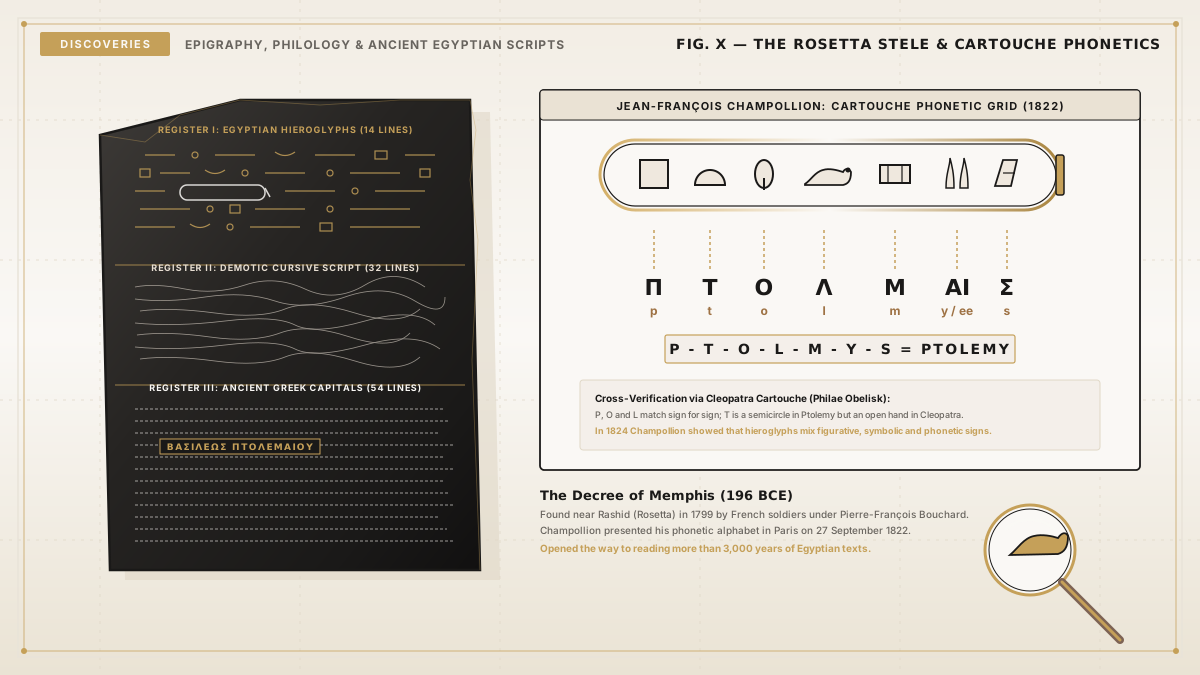
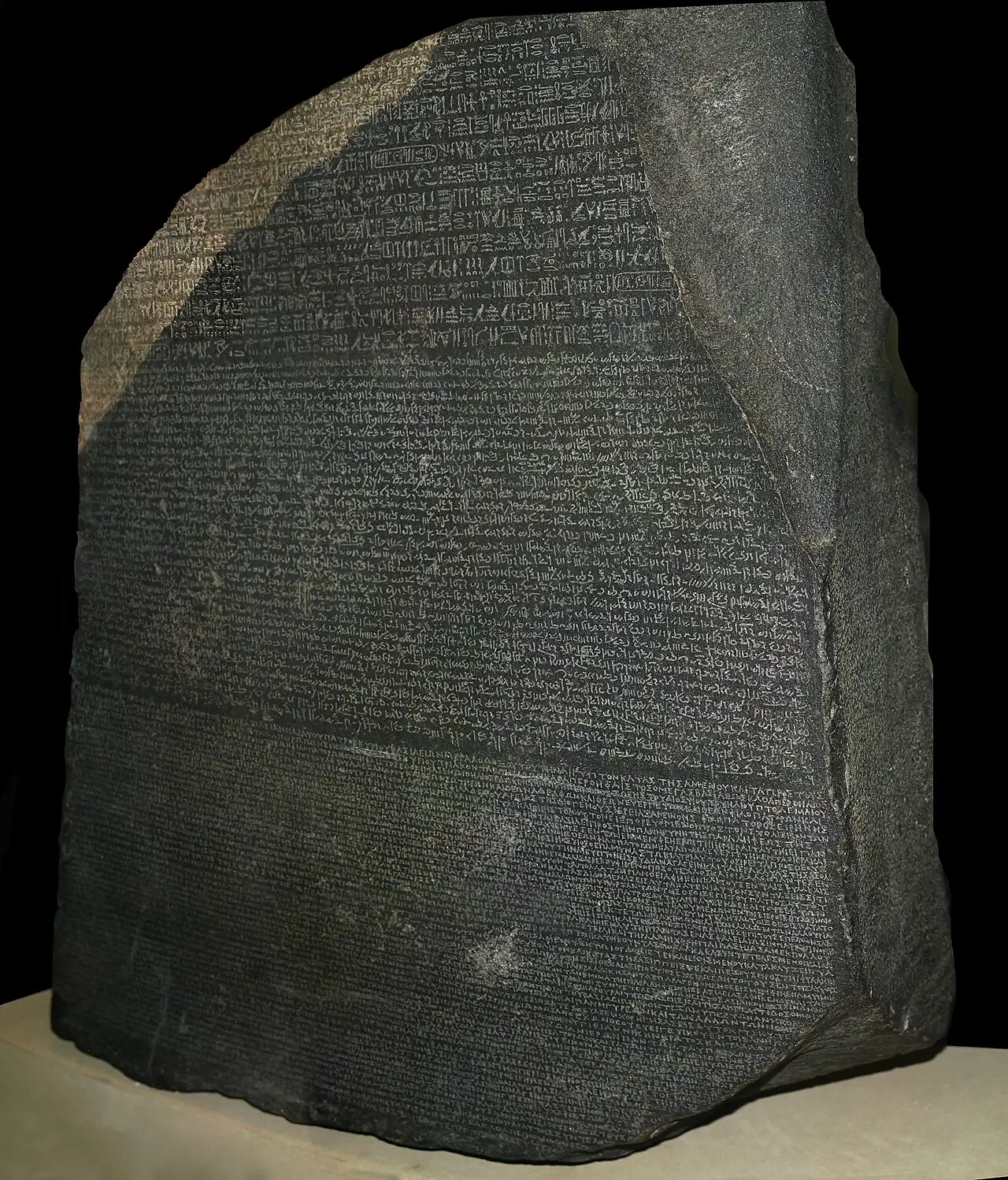
What visitors see is a fragment. The surviving piece of gray and pink granodiorite is 112.3 centimeters tall, 75.7 centimeters wide and 28.4 centimeters thick, and it is only part of a taller stela whose top is missing. That is why the hieroglyphic text, carved in the uppermost band, has suffered most. Just 14 of its lines survive, against 32 lines of demotic and 54 of Greek.
It was never unique, either. Copies were meant to go up in every sizeable temple, though nobody knows whether that happened. The British Museum knows of three near-identical copies of this decree for Ptolemy V, plus similar decrees from the reigns of Ptolemy III, IV and VI. In all, 29 decree stelae of this kind have been found across Egypt, and 22 of them are still there. Some have helped scholars restore the damaged hieroglyphic section; when E. A. Wallis Budge published a translation in 1905, he filled gaps using a copy known as the Damanhur stela. The Rosetta copy survived by being recycled. The usual story is that French soldiers found it on July 15, 1799, apparently built into a very old wall, while digging foundations to enlarge a fort near Rashid, a port 65 kilometers east of Alexandria that the French called Rosetta. Pierre-François Bouchard, the officer overseeing the work, saw at once that it mattered.
How did it end up in London, and will it go back?
Napoleon's army in Egypt surrendered in 1801, and under the terms agreed at Alexandria the stone passed to the British, along with other antiquities the French had collected. It reached Portsmouth in February 1802, and that July George III gave it to the British Museum. Its weight was too much for the museum's floors, so it first stood in a temporary shed in the grounds while the trustees asked Parliament to fund a new gallery. The stone has been on show ever since, with one break. In 1917, fearing heavy bombing, the museum moved it to a station on the Post Office's underground railway, about 15 meters (50 feet) below Holborn, where it stayed for two years. Today it stands in Room 4, free to visit. Whether it should stay there is contested. Egypt's government has not lodged a formal restitution claim, but the former antiquities minister Zahi Hawass has campaigned loudly for its return and used the museum's 2022 exhibition marking two centuries of decipherment to press the point. Egypt's official stance has shifted before. In January 1997, its new antiquities director, Ali Hassan, said the country would drop claims to famous pieces abroad for the time being, because it first needed to be able to display them in conditions at least as good, and he pressed for a huge new museum on the outskirts of Cairo. Egypt now has one: the Grand Egyptian Museum at Giza, first proposed in 1992, held its official opening in November 2025. The British Museum, for its part, quietly dropped the name Rosetta Project from its plans for a full gallery overhaul in 2023. Read as a document rather than a code key, the Rosetta Stone records a bargain: a foreign dynasty buying priestly loyalty with tax breaks in the middle of a civil war, and priests turning that loyalty into ritual carved in stone. Its three scripts were aimed at three audiences in 196 BC. More than two thousand years later the same slab speaks to a fourth, and the argument over where it belongs has become part of what it says.
Frequently asked questions
What does the Rosetta Stone say?
It records a decree passed by Egyptian priests at Memphis in 196 BC. It praises Ptolemy V for tax cuts, temple gifts and defeating rebels, and orders statues, shrines and festivals in his honor in temples across Egypt.
Why is the Rosetta Stone written in three scripts?
Hieroglyphs were the sacred script suited to a priestly decree, demotic was the everyday Egyptian script, and Greek was the language of the ruling Ptolemaic dynasty. The decree itself ordered all three.
Is the Rosetta Stone complete?
No. It is a broken piece of a taller stela, 112.3 centimeters tall today, and only 14 lines of its hieroglyphic text survive. Other copies of the same decree have helped scholars fill the gaps.
Has Egypt asked for the Rosetta Stone back?
Egypt's government has not made a formal restitution claim, but the former antiquities minister Zahi Hawass has campaigned for its return, including during the British Museum's 2022 exhibition on the decipherment.
Sources
- The Rosetta Stone: everything you need to know, British Museum
- Rosetta Stone Translation in English — Budge (1905), sacred-texts.com
- 'Where the swords met bone': Archaeological evidence found of Ancient Egyptian rebellion mentioned on the Rosetta Stone, The Art Newspaper
- British Museum drops reference to the Rosetta Stone from title of major refurbishment plans, The Art Newspaper
- Egyptologists Call on British Museum to Return Rosetta Stone (Again), artnet news
- Egypt renounces claim to the Rosetta stone and other major antiquities, The Art Newspaper