How Long Is the Great Wall of China? One Name, Many Walls
A 2012 survey measured the Great Wall at 21,196 km by adding up walls from many dynasties. Here is who built them, whether they worked, and the space myth.
Key takeaways
- A national survey completed in 2012 measured the Great Wall at 21,196.18 km, counting walls from the Warring States period through the Ming dynasty.
- The Ming-era wall alone measured 8,851.8 km in a 2009 survey, of which about 2,232 km were hills, rivers and other natural barriers.
- In 1644 the Ming general Wu Sangui let the Manchu army through Shanhai Pass, and the Manchus' Qing dynasty went on to rule China.
- NASA says the wall generally cannot be seen with the unaided eye from low Earth orbit, and it is certainly not visible from the Moon.
- Sticky-rice lime mortar is real chemistry, but the famous 2010 analysis used samples from Nanjing's 600-year-old city wall.
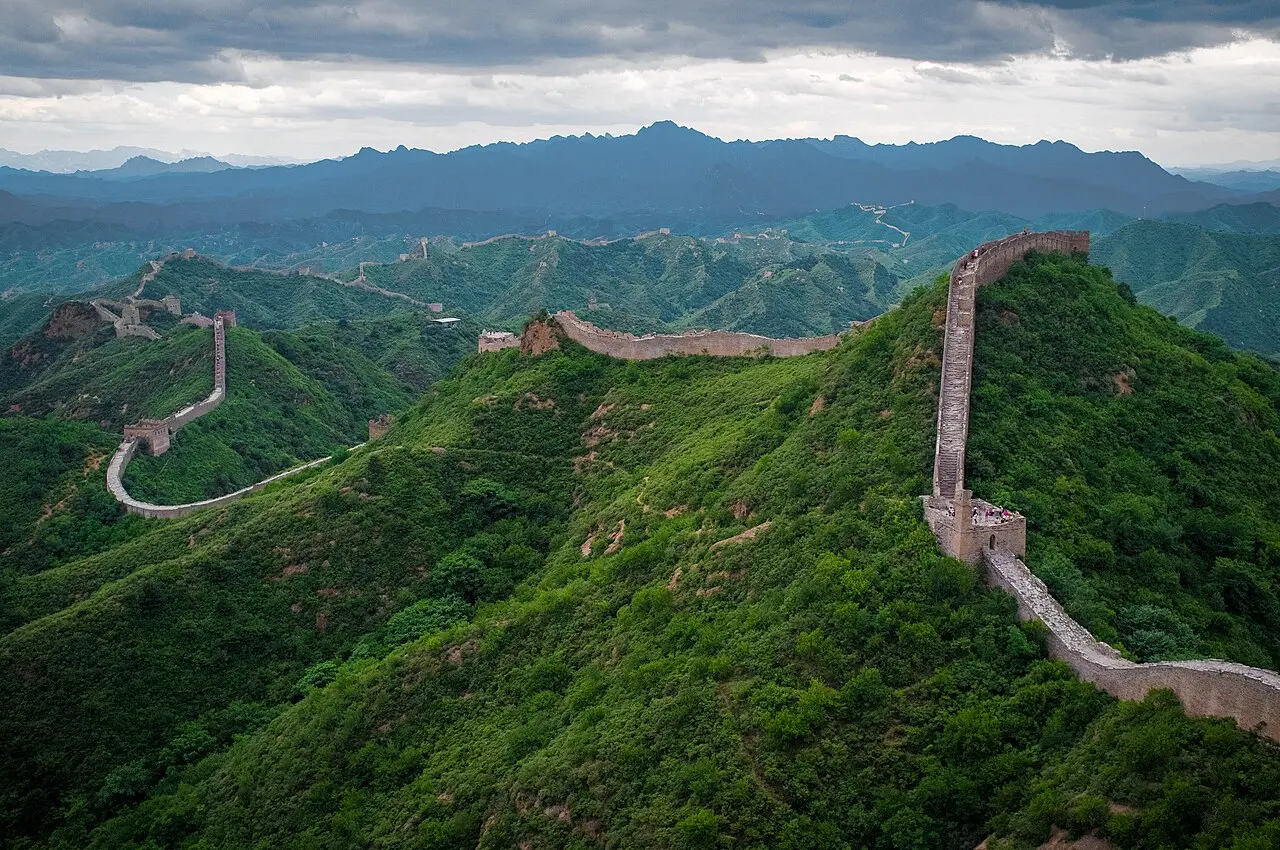
The Great Wall of China has no single length because it is not a single wall. Counting every surviving section from every dynasty, a national survey completed in 2012 arrived at 21,196 kilometres; the Ming defences that most visitors picture account for about 8,850 of them. As for the famous claim, the wall cannot be seen from the Moon and is very hard to spot even from orbit, because what makes it great is its length, not its width. The name covers more than two thousand years of building by rival kingdoms and successive dynasties, which raised, abandoned, rebuilt and sometimes doubled their frontier defences as the threats from the north changed. That layering explains almost everything about the wall, from the arguments over its length to the question of whether it ever worked.
Why is the Great Wall so hard to measure?
Because surveyors first have to decide what counts. In 2009, China's State Administration of Cultural Heritage and the national surveying bureau published a mapping of the Ming-era defences, from Hushan in Liaoning to the Jiayu Pass in Gansu, and came up with 8,851.8 kilometres. Only about 6,259 kilometres of that was built wall. Another 360 kilometres or so were trenches, and 2,232 kilometres were natural barriers, hills and rivers that the planners folded into the defence. Older estimates, drawn largely from historical records, had put the figure nearer 5,000 kilometres. The 2012 total, the result of a survey begun in 2007, cast a wider net. It took in walls from the Warring States period through the Ming, spread across 15 provinces and regions, and logged 43,721 heritage sites along the way, from wall segments to forts and beacon towers. Some of those sections run side by side or sit on top of one another, built centuries apart along the same frontier. Added together they make an impressive 21,196.18 kilometres, but the number describes a network, not a line you could walk from end to end. The figure is also a snapshot. Surveyors have warned that the wall is in danger of disappearing in many places because of road construction and other forms of development, as well as extreme weather, and the 2012 survey found that only 8.2 percent of the Ming wall remains intact. The wall that can still be measured is shrinking even as researchers find more of it.
Who built the Great Wall, and when?
Long before China was a single empire, rival kingdoms of the Warring States period were already building frontier walls. After Qin Shi Huang unified China in 221 BC, the new empire stitched the older northern ramparts together into one frontier facing the steppe. He is the same ruler whose terracotta army still guards his tomb. The Han dynasty pushed the defences far to the west. Under Emperor Wu, in the late second century BC, garrisons and beacon towers reached out through the Gansu corridor toward Dunhuang and the Yumen Pass, protecting the routes that tied China to the oasis cities of the Silk Road. Where soil allowed, Han builders pounded earth into solid walls. Across the desert they made do with what lay at hand, stacking layers of gravel bound with reeds and tamarisk branches. Beacon towers relayed warnings with smoke and fire. The wall most visitors see is far younger. The Ming dynasty (1368–1644) rebuilt and extended the frontier on a vast scale, and its showpiece sections near Beijing are brick and stone masonry. One ingredient has become famous: Chinese builders sometimes stirred sticky-rice soup into lime mortar, a technique at least 1,500 years old. In 2010, a team led by Zhang Bingjian of Zhejiang University showed that amylopectin, a carbohydrate in the rice, controls how calcium carbonate crystals grow, producing a denser and more water-resistant mortar than lime alone. The trick is often credited to the Great Wall, but the samples behind that result came from a 600-year-old city wall in Nanjing.
Did the wall actually keep invaders out?
Sometimes, and rarely on its own. A wall could slow raiders and its towers could pass warnings down the line, but it worked only with soldiers, supplies and competent commanders behind it. The Ming learned this the hard way. In 1550, Mongol forces under Altan Khan came through a pass northeast of Beijing, laid siege to the capital and spent days looting its suburbs before withdrawing with their plunder. The capital's garrison, which had spent its time as a building workforce, could not meet them in the field. Raids followed almost every year for more than a decade, and the crisis ended only in 1571, with a treaty that opened frontier markets and horse fairs. Trade, not masonry, bought the peace.
The most famous failure came in 1644. Rebels under Li Zicheng had already taken Beijing when Wu Sangui, the Ming general holding Shanhai Pass on the main road from Manchuria, made a fateful choice. He let the Manchu army through, and together they drove the rebels from the capital. The Manchus then claimed the throne for themselves, and their Qing dynasty went on to rule China. One of the most important gates on the frontier was never stormed. It was opened from the inside.
Can you really see the Great Wall from space?
Not in the way the legend claims, which in its boldest form made the wall the only human-made structure visible from the Moon. The idea is older than spaceflight; a Ripley's Believe It or Not! cartoon of 1932 helped popularise it, and it later found its way into Chinese schoolbooks. In October 2003, China's first astronaut, Yang Liwei, returned from his Shenzhou 5 flight and said he had not seen the wall, and the education ministry moved to revise the textbooks. NASA's verdict is that the wall generally cannot be seen with the unaided eye from low Earth orbit, a few hundred kilometres up, and certainly not from the Moon, nearly 400,000 kilometres away. The problem is shape and colour. The wall is thousands of kilometres long but only a few metres wide, and its stone and earth blend into the hills it crosses. Jeffrey Hoffman, who flew five Space Shuttle missions, said he never saw it, though he could make out roads, runways and irrigation ditches. A handful of astronauts, Eugene Cernan and Ed Lu among them, have reported glimpsing it, apparently when a low sun threw long shadows. In 2004, Leroy Chiao photographed Inner Mongolia from the International Space Station, and NASA specialists later said the image appears to show stretches of the wall, but Chiao himself was not sure what he had seen. He was falling around the planet at about 28,000 km/h, looking down at a thin, earth-coloured line drawn across mountains of the same colour. The space myth misses the wall's real achievement. The Great Wall is not one monument but a record of frontier policy written in earth, gravel, brick and stone by states that kept deciding the north was worth fortifying. Count only the Ming works and it runs about 8,850 kilometres; count every layer and it passes 21,000. Both numbers describe the same thing: a civilisation building, abandoning and rebuilding one idea, dynasty after dynasty.
Frequently asked questions
How long is the Great Wall of China?
A survey completed in 2012 put all surviving sections from every dynasty at 21,196.18 km. The Ming-era wall that most visitors see measured about 8,850 km in a 2009 survey, including trenches and natural barriers.
Can you see the Great Wall of China from space?
Generally not with the naked eye. NASA says it usually cannot be seen unaided from low Earth orbit and is certainly not visible from the Moon, because it is only a few metres wide and blends into the landscape.
Did the Great Wall stop invaders?
Not reliably. Mongol raiders reached the outskirts of Beijing in 1550, and in 1644 a Ming general opened Shanhai Pass to the Manchu army, whose Qing dynasty went on to rule China.
Sources
- Great Wall of China, Britannica
- The Great Wall, UNESCO World Heritage Centre
- Is China’s Great Wall Visible from Space?, Scientific American
- China’s Great Wall is 21,196 km long: survey, Xinhua
- China’s Great Wall far longer than thought: survey, AFP via phys.org
- Ancient Chinese Buildings Are Held Together With Rice, Sugar, and Blood, Atlas Obscura