How Did Ancient China Build Its 1,800 km Grand Canal?
In five years, Sui China dug about 1,800 km of canals linking the Yangtze to the north. Here is how Emperor Yang's engineers actually built the Grand Canal.
Key takeaways
- Sui China built the Grand Canal in sections between 605 and 610, linking the Yangtze basin to the northern frontier.
- Up to 5 million laborers were mobilized; one section, 1,100 km of 60-m-wide canal, was dug in five months.
- The original Sui canal formed a Y around Luoyang, not the straight Beijing-Hangzhou line seen today.
- Pound locks came about 370 years later under the Song dynasty, not during Sui construction.
- The canal was inscribed on the UNESCO World Heritage List in 2014.
In just five years, from 605 to 610, Sui-dynasty China dug a canal system of about 1,800 km (1,100 miles), mobilizing up to 5 million laborers. The surprise is what it looked like: not the straight Beijing-to-Hangzhou line you see on maps today, but a giant Y centered on the city of Luoyang. The straight northern line came only in the 1280s, some 670 years later.
Key facts
- The main Sui construction ran 605 to 610 under Emperor Yang (Yang Guang), who reigned from 604 to 618 (Britannica; EBSCO).
- The Tongji Qu, a 1,100-km (684-mile) canal about 60 m (197 ft) wide, was dug in just five months in 605 (Boulder Library).
- As many as 5 million men and women were mobilized across the works, according to EBSCO and the engineering history sources (EBSCO).
- Britannica (updated October 2026) gives the Beijing-Hangzhou main stem at 1,100 miles, roughly 1,800 km; the section inscribed by UNESCO covers about 1,011 km (628 miles) (Britannica; People's Daily).
- The canal was inscribed on the UNESCO World Heritage List in 2014, at the 38th session of the World Heritage Committee in Doha (UNESCO).
How was it built so fast?
The Sui did not dig one canal. They built three sections in rapid succession and stitched them into a system:
| Section | Built | Length | Purpose |
|---|---|---|---|
| Tongji Qu | 605 | 1,100 km (684 miles) | Link Luoyang to the Yangtze |
| Yongji Qu | finished 608-609 | ~998-1,000 km (620 miles) | Supply the northern and northeastern frontier |
| Jiangnan He | completed 610 | 435 km (270 miles) | Extend south of the Yangtze to Hangzhou |
The method was less about inventing new technology and more about ruthless organization. Builders reused and rerouted existing waterways, including the older Han Gou and the Bian and Hong canals, instead of starting from scratch. Where the canal met the great rivers, they fitted gates at the outlets; at vulnerable points they built dikes and laid rockfill to protect the banks; and an imperial road ran along the canal for couriers and troops (EBSCO; Boulder Library). The canal cut across the basins of five river systems: the Hai, the Yellow (Huang), the Huai, the Yangtze, and the Qiantang (Britannica). That is the core engineering feat. Rivers run east and west in China; the canal runs north and south, crossing them all.
Why did Emperor Yang order the canal?
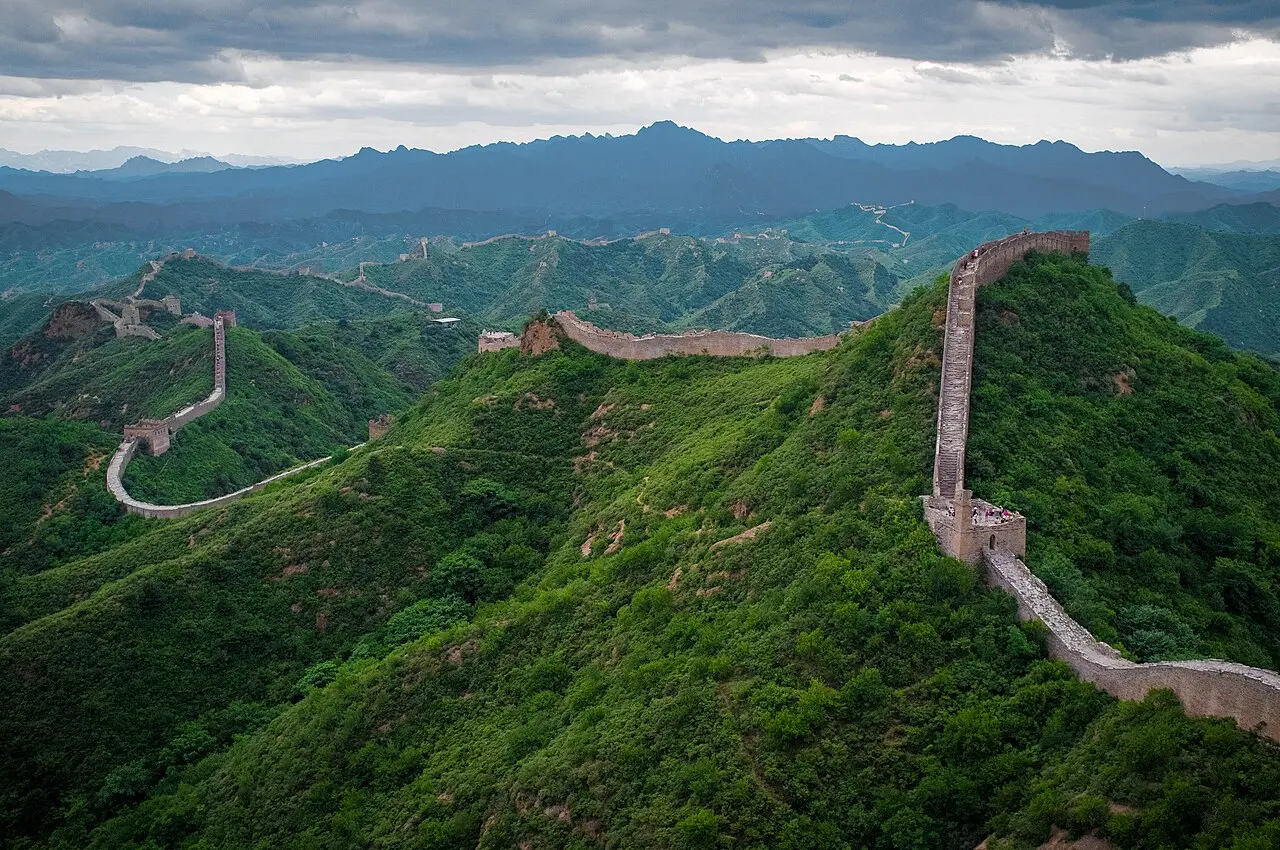
Grain was the first reason. The Sui capital region in the north could not feed itself, while the Yangtze basin in the south was fertile. Moving grain overland by cart was slow and ate the profit, and the sea route along the East China Sea coast was risky. A protected inland waterway solved all three problems at once (EBSCO; Britannica). The second reason was war. The northern canal was largely a military project, built to supply armies on the northeastern frontier, the same frontier guarded by the Great Wall of China. Emperor Yang launched repeated campaigns against the Korean kingdom of Goguryeo, and the canal was part of the logistics machine behind them. The third reason was political: the Sui had just reunified a divided China, and a waterway that physically tied the empire together was a statement of control. The human cost was staggering. The 7th-century text Kaihe zhi reports that more than 2 million people died during construction. Historians treat ancient figures like this with caution, but there is no dispute that conscription on this scale caused enormous suffering, and resentment of the labor levies helped fuel the rebellions that toppled the Sui soon after.
What did the original canal actually look like?
Picture a Y, not a straight line. Luoyang, Emperor Yang's new eastern capital, sat at the base. The Tongji Qu ran east from Luoyang to the Yangtze. The Yongji Qu ran north from Luoyang toward the Beijing region and the frontier. The Jiangnan He ran south from the Yangtze to Hangzhou. By 611, the year after the Jiangnan He was finished, boats could travel from the Yangtze delta to the northern frontier (EBSCO). The modern image of a single straight Beijing-to-Hangzhou canal is a Yuan-dynasty creation. In the 1280s, the Yuan rerouted the canal into the straighter north-south line still used today. The original historical waterway, at its greatest extent, exceeded 2,500 km (1,553 miles), well beyond the main stem usually quoted now (People's Daily). For other ancient water engineering built on the same principle of patient surveying and earthwork, see China's older Dujiangyan irrigation system and the qanats of Persia, underground water tunnels from the same engineering tradition.
What do people get wrong about the Grand Canal?
| What people assume | What the evidence shows |
|---|---|
| The Sui invented pound locks for the canal | The pound lock came about 370 years later, invented by the Song official Qiao Weiyue in the 10th century to replace dangerous flash locks |
| It has always run Beijing to Hangzhou | The Sui version was a Y around Luoyang; the straight Beijing line is a Yuan rerouting from the 1280s |
| It was dug all at once as one project | It was built in three named sections between 605 and 610, reusing older canals |
| The pound-lock myth matters because it inflates what the Sui actually accomplished. Sui engineers used simpler technology: gates where the canal met rivers, weirs, dikes, and rockfill. That is still impressive given the scale and the five-year timeline. The lock technology that made later canal traffic smooth and safe was a Song achievement, credited to Qiao Weiyue (also written Chiao Wei-yo) (Water Tech of the Ancients). | |
| Modern canal projects dwarf the ancient works in machinery, but not always in audacity. Compare the Panama Canal's engineering for a modern take on the same problem: moving ships across a land barrier with locks. | |
| Twelve centuries later, the canal still functions. That is the real takeaway: Emperor Yang built for grain shipments and Korean wars, and the system outlived his dynasty by fourteen hundred years. | |
| How we made this article: FactSpire researched and drafted it with AI assistance and checked every fact against the sources listed above. |
Frequently asked questions
How long did it take to build the Grand Canal?
The main Sui-dynasty construction ran from 605 to 610, just five years. The Tongji Qu section was dug in 605, the northern Yongji Qu was finished around 608 to 609, and the Jiangnan He reached Hangzhou in 610. Later dynasties kept extending and reworking it for another 1,400 years.
How many people built the Grand Canal?
As many as 5 million men and women were mobilized for the Sui construction. A 7th-century text, the Kaihe zhi, reports that more than 2 million people died during the work, a figure historians treat with caution because it comes from an ancient chronicle rather than verifiable records.
Did the Sui Grand Canal run from Beijing to Hangzhou?
No. The Sui canal formed a giant Y centered on Luoyang, linking it to the Yangtze in the south and to the northeastern frontier in the north. The straighter Beijing-to-Hangzhou alignment people picture today was created later, when the Yuan dynasty rerouted the canal in the 1280s.
Who invented the pound lock on the Grand Canal?
The pound lock was invented in the 10th century AD by the Song-dynasty official Qiao Weiyue (also written Chiao Wei-yo), who replaced the dangerous flash locks used until then. Sui builders used simpler gates and weirs where the canal met the great rivers.
Sources
- China - Sui Dynasty, Grand Canal, Reunification, Britannica
- China - Rivers, Canals, Lakes, Britannica
- Grand Canal, EBSCO
- The Grand Canal - Listing Documents, UNESCO World Heritage Centre
- Grand Canal, Beijing Municipal Government
- Conservation worries after UNESCO Grand Canal honor, People's Daily Online
- The Grand Canal, Boulder Library
- Chinese Canal Systems, Water Tech of the Ancients