What Is a Glory, the Rainbow Ring Around a Plane's Shadow?
A glory is the rainbow ring around an airplane’s shadow on clouds, made by sunlight diffracting in tiny droplets. Each passenger sees their own ring.

Key takeaways
- A glory is a set of small, concentric rainbow-colored rings around the shadow of the observer, centered on the antisolar point.
- It is caused by sunlight backscattering off tiny water droplets in cloud or fog, with diffraction and interference painting the rings.
- Two things must line up: you must look exactly away from the sun, and there must be a bank of droplets below you.
- Passengers most often see it around their plane's shadow; the ring's center even reveals where they sat on the aircraft.
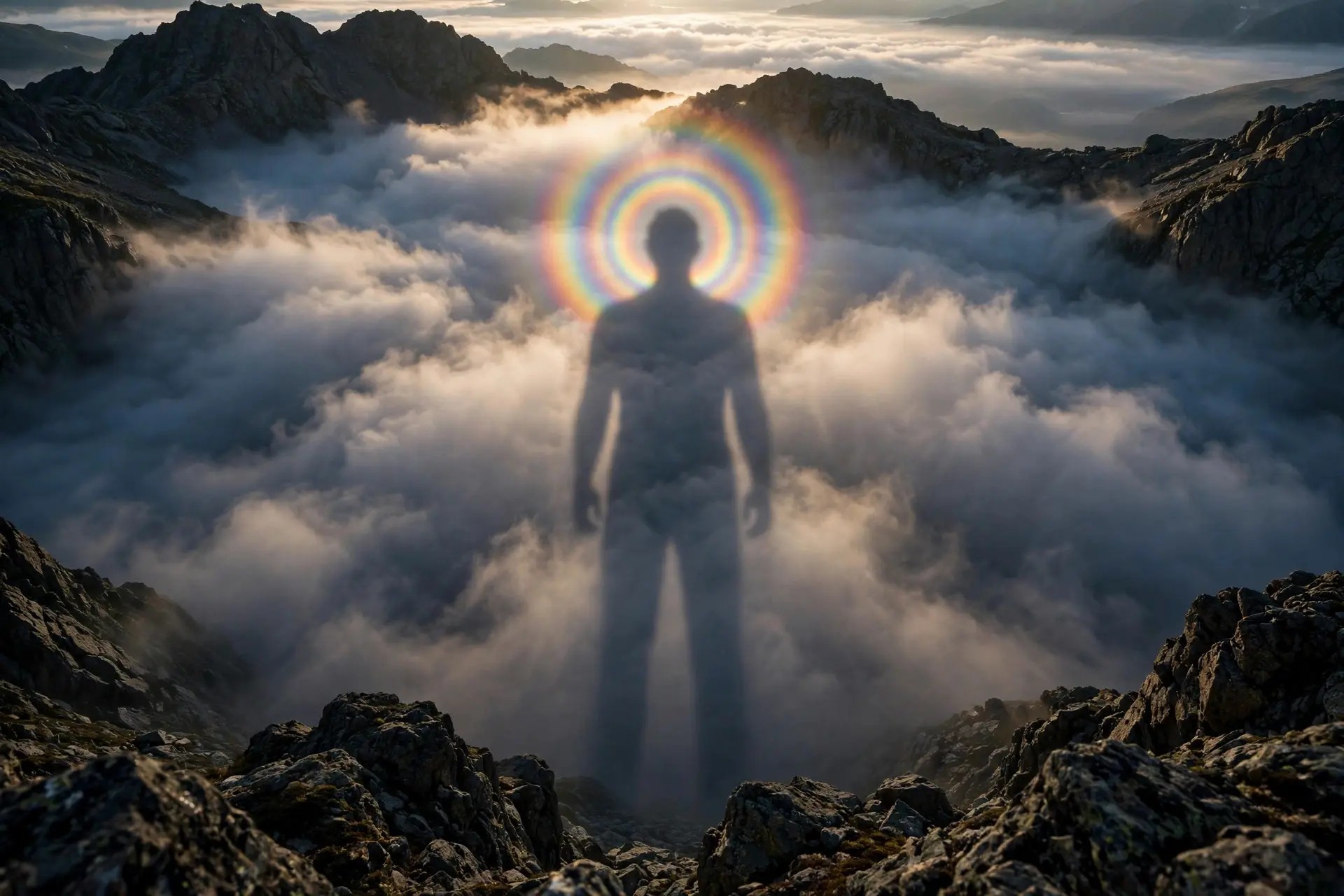
- On a mountain, your own magnified shadow inside the rings is called the Brocken Spectre, named for Germany's Brocken peak.
A glory is a set of small, concentric rainbow-colored rings that appear around the shadow of the observer, projected onto clouds or fog below. Sunlight scatters off tiny water droplets and interferes with itself to paint the rings, which is why a glory only ever appears at one precise spot in the sky: the antisolar point, exactly opposite the sun.
- Most air travelers have seen glories around their aircraft's shadow on the clouds below; mountaineers know the same phenomenon as the Brocken Spectre. (University of Alaska Fairbanks)
- Two requirements must be met: you must look exactly in the anti-solar direction, and there must be many water droplets where the glory is to appear. (University of Alaska Fairbanks)
- The rings come from diffraction: sunlight penetrates individual droplets, reflects off their backs, and the returning light interferes with itself to create circular zones of brightness, red always outermost. (University of Alaska Fairbanks)
- In 2011 a passenger flying from Hong Kong to Hangzhou photographed her plane's shadow tightly ringed by colored concentric circles; the Observatory identified it as a glory from the geometry alone. (Hong Kong Observatory)
- Most glories are made by spherical droplets with radii between 4 and 25 micrometers; for 10-micrometer droplets the innermost red ring sits about 2.4 degrees from the antisolar point. (Hong Kong Observatory)
- The Brocken Spectre is named for the Brocken, the tallest peak of Germany's Harz Mountains, where fog and low sun make the effect frequent. (University of Alaska Fairbanks)
How do you actually see one?
There is a recipe, and window seats help. First, the sun must be behind you and clouds or fog must be below you, because the antisolar point always lies below the horizon when the sun is up. Second, the clouds need to be made of tiny, fairly uniform droplets; the more uniform the droplets, the brighter the rings and the purer the colors. Third, you look down at the shadow side of the aircraft. If the plane is low enough for its shadow to fall on the clouds, the glory always surrounds it. Here is the neat part: the glory's center marks your antisolar point, which is your own head's shadow. In the 2011 Hong Kong case, the position of the rings showed that the passenger sat in front of the middle seats, and she later confirmed it. To center the whole airplane inside the glory, you would have to sit exactly midway between its nose and tail. Each passenger sees their own glory, centered on their own shadow; two people at adjacent windows get two different rings. The 2011 sighting was not even her first. The Hong Kong Observatory notes that the passenger had seen the phenomenon once before, which is typical: once you know what to look for, a frequent flyer on the shadow side of the plane starts spotting glories on cloud decks regularly. They are common enough that most air travelers have seen one without knowing its name; they are simply outshone, literally, by the view out the window.
Why is it not just a small rainbow?
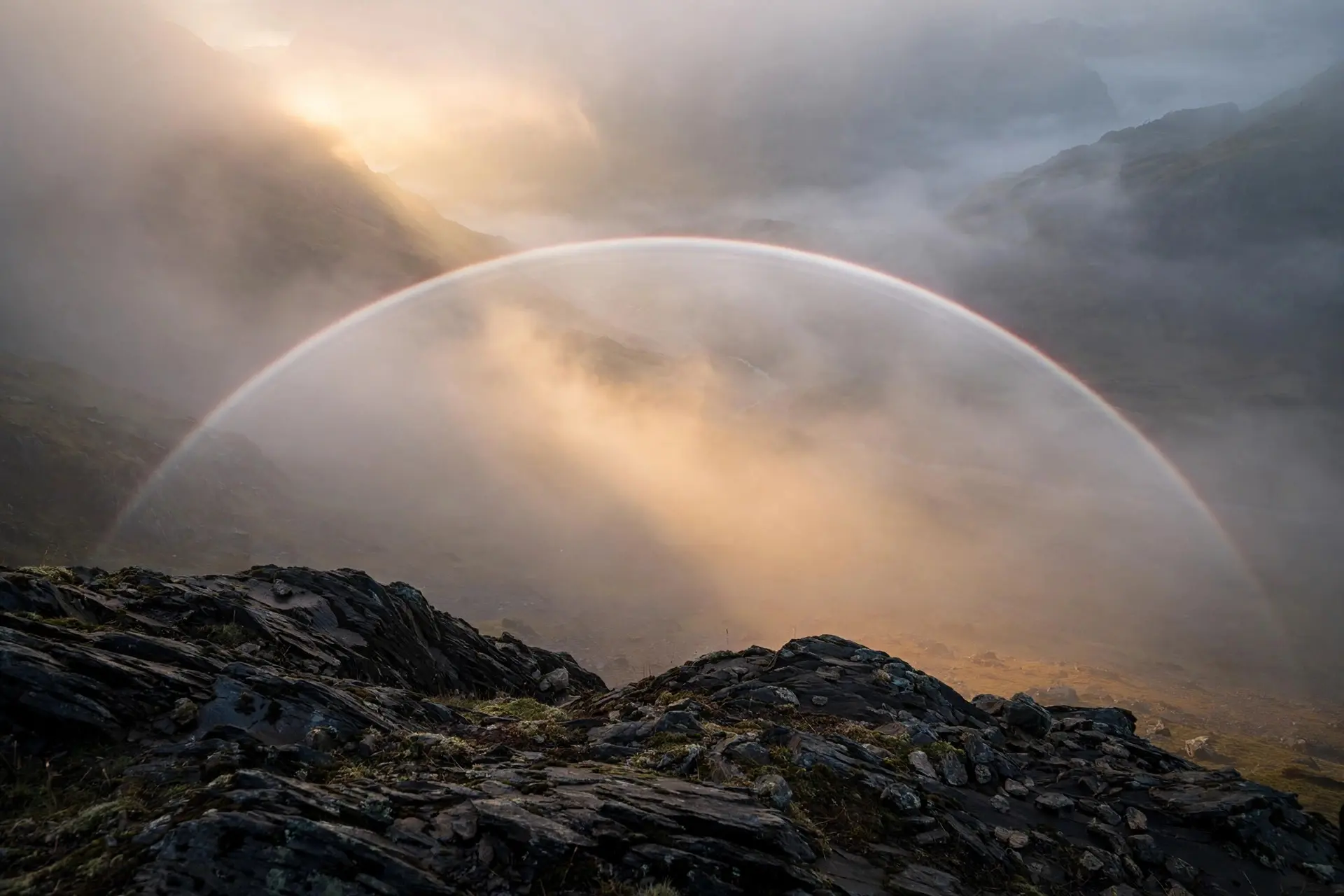
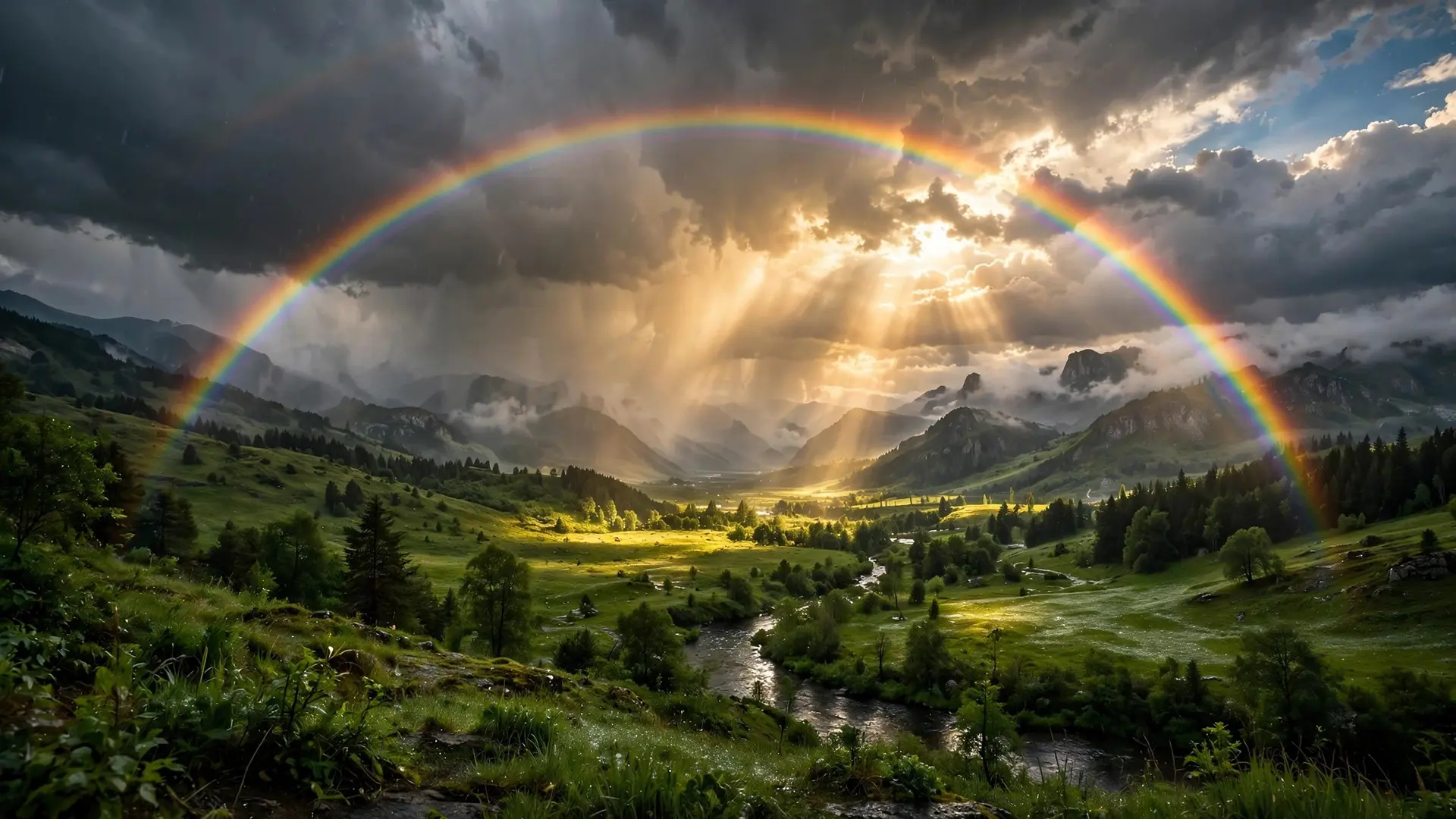
Rainbows and glories share the raw materials, sunlight and water, but little else. A rainbow is made by refraction and reflection inside raindrops, spans about 42 degrees, and appears opposite the sun but above the horizon in rain. A glory is made by diffraction and interference in much smaller cloud droplets, spans only a few degrees, and appears below you on the cloud deck. The colors also run red on the outside to blue-violet toward the center, and the pattern can repeat: a second, dimmer set of rings outside the first, then a third.
The physics stayed puzzling for a long time. Geometric optics, which explains the rainbow, cannot explain the glory. In 1947 the Dutch astronomer H. C. van de Hulst proposed surface waves traveling around each droplet; in 2005 Philip Laven refined the picture to interference between two sets of rays shed from short-path and long-path surface waves. The rainbow had been solved for centuries; the glory needed wave theory and computers.
| Feature | Glory | Rainbow | Brocken Spectre |
|---|---|---|---|
| Size | a few degrees | about 42 degrees across | shadow of any size, ringed by a glory |
| Mechanism | diffraction and interference in tiny droplets | refraction and reflection in raindrops | a glory around your magnified shadow |
| Where | on clouds or fog below the observer | in rain, opposite the sun | on fog or clouds below a mountain |
| Center | your head's shadow (antisolar point) | the antisolar point | your head's shadow |
What is the Brocken Spectre, exactly?
Before airplanes, this was how people met the glory. A mountaineer with the sun low behind them and fog in the valley below casts an enormously elongated shadow onto the mist. Around the head's shadow bloom the concentric rings of a glory, and the whole apparition seems to move on its own as the cloud layer shifts. The name comes from the Brocken in the Harz Mountains, a peak often above the cloud level in frequent mist. Legend gives the phenomenon a grim origin story: a climber on the Brocken, crossing a narrow precipice, was startled by a human figure with a ring of light around its head, and fell to his death in fright. If it happened, he saw his own shadow and his own glory. Goethe set the Witches' Sabbath on the Brocken in Faust, and the mountain's reputation as a refuge for witches and spirits may owe something to giant shadows that seemed to move by themselves. For the physics of the ordinary rainbow, see how rainbows work; for another small-scale sun-and-droplet effect, sun pillars show what ice crystals do with the same light. The glory is the smallest of the sky's great optical shows, and the only one that draws a circle around you. How we made this article: FactSpire researched and drafted it with AI assistance and checked every fact against the sources listed above.
Frequently asked questions
Is a glory the same as a circular rainbow?
No. A glory is much smaller and works by different physics: diffraction and interference of light in tiny droplets, not the refraction and reflection that make rainbows. Its rings are red on the outside and fade toward blue-violet at the center, and multiple rings can repeat the pattern outward, each dimmer than the last.
Why can only I see my own glory?
Because a glory is centered on the antisolar point, the spot exactly opposite the sun relative to your eyes, which coincides with the shadow of your own head. On a plane, your seat position determines where the plane's shadow sits inside the rings. A mountaineer next to you would see the rings around their own shadow, not yours.
What is the Brocken Spectre?
It is what happens when your own shadow, enormously elongated by a low sun, falls on fog or clouds below you, with a glory ringing your head's shadow. It is named for the Brocken, the tallest peak of Germany's Harz Mountains, where misty conditions make the effect common. An old legend tells of a climber who saw his own ringed shadow and fell to his death in fright.
Can a glory warn pilots of danger?
Sometimes. A glory seen at high altitude on thick, cold clouds can mean the clouds hold many supercooled water droplets, liquid water below freezing point. If an aircraft flies into such a cloud, the droplets freeze instantly on contact with the surface, causing icing. In that sense a glory can double as a natural warning sign.
Sources
- The Brocken Spectre, Geophysical Institute, University of Alaska Fairbanks
- The mysterious glory, Hong Kong Observatory
- Spectre of the Brocken and Glory, AKM e.V.