What Is a Brocken Spectre, the Giant Mountain Shadow?
What is a Brocken spectre? Your own shadow cast huge onto mountain fog, ringed by a rainbow glory. The physics and history of the giant mountain shadow.
Key takeaways
- A Brocken spectre is your own shadow, magnified by perspective, cast onto fog or cloud below you.
- It only appears when the sun is directly behind you, at the point exactly opposite the sun.
- The rainbow rings around its head are a separate phenomenon called a glory, made by diffraction in tiny droplets.
- The name comes from the Brocken, northern Germany's 1,141 m peak, which sees more than 300 foggy days a year.
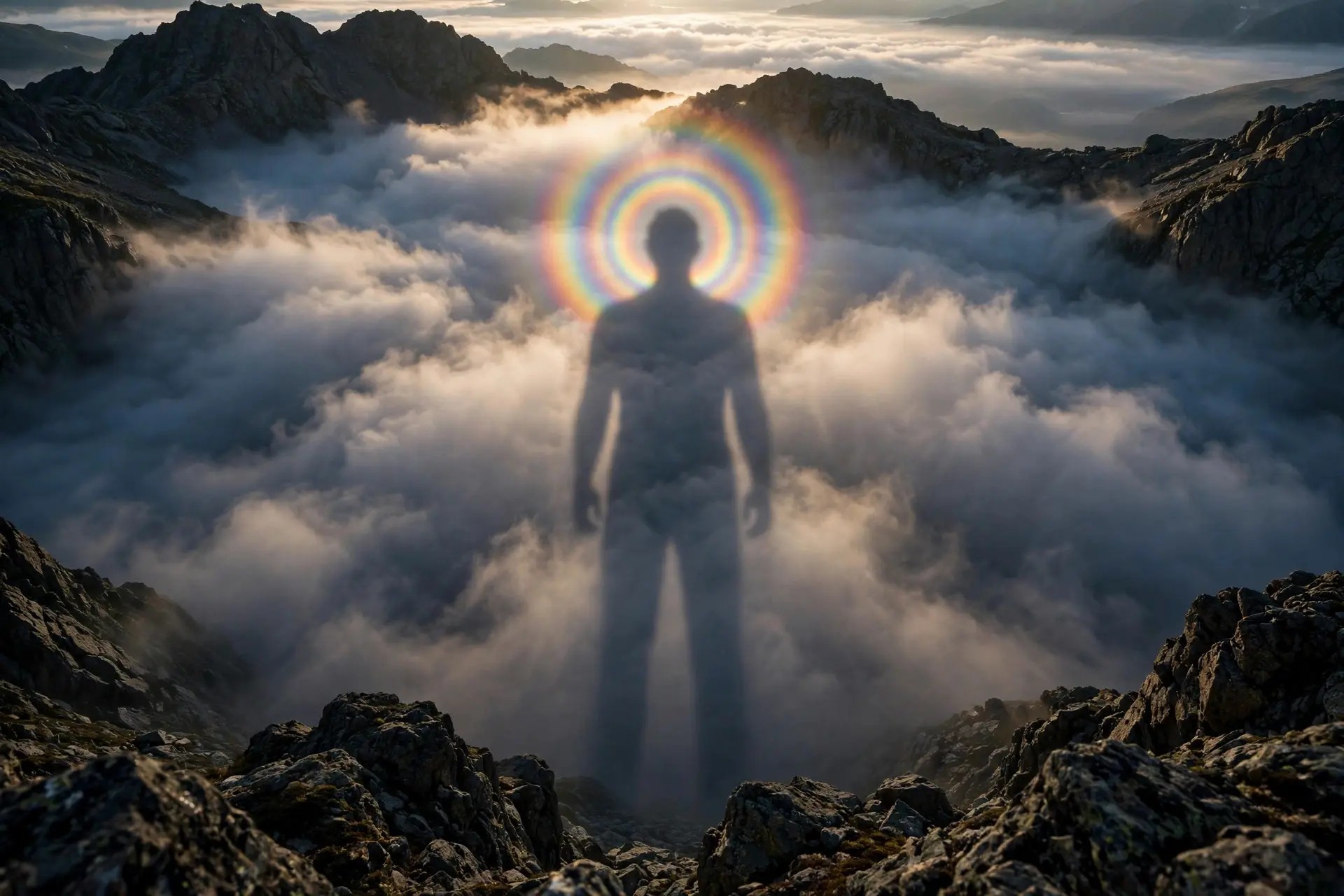
A Brocken spectre is your own shadow, cast huge onto the fog below you and crowned with rainbow light. The giant figure that once sent a climber tumbling off a precipice in terror was never a ghost: it was the climber himself, seen from exactly the one spot where the illusion works.
What is a Brocken spectre?
Stand on a peak above a sea of fog with the sun at your back, and look down into the mist. A colossal human silhouette looms back at you, its head ringed with colored light. That is the Brocken spectre: the magnified shadow of the observer, projected onto clouds or fog at the point directly opposite the sun. The World Meteorological Organization's International Cloud Atlas describes the phenomenon precisely. The glory is a sequence of one or more colored rings seen around the observer's own shadow on a cloud of small water droplets or on fog, produced by the refraction, reflection and diffraction of sunlight within the drops. The phenomenon occurs only directly opposite the sun, centered on the antisolar point, and is normally seen looking down from a high vantage point onto low cloud. When the fog is near the observer, the shadow appears very large and distorted by perspective, and that is the Brocken spectre (WMO International Cloud Atlas). Two things must line up: you must look exactly in the anti-solar direction, and there must be plenty of water droplets in the fog or cloud where the shadow falls. Both conditions are ordinary on a misty summit, which is why mountaineers kept meeting their own shadows (University of Alaska Fairbanks Geophysical Institute). The name comes from the Brocken, the highest peak of Germany's Harz Mountains at 1,141 meters (3,743 feet), where the apparition appeared so often it entered local legend. Germany's AKM atmospheric-phenomena society notes that the Brocken sees more than 300 foggy days a year, with fog sometimes so thick that visibility drops to a few meters, making it the best place on Earth to meet the spectre (AKM e.V., ExplorersWeb).
How does it form?
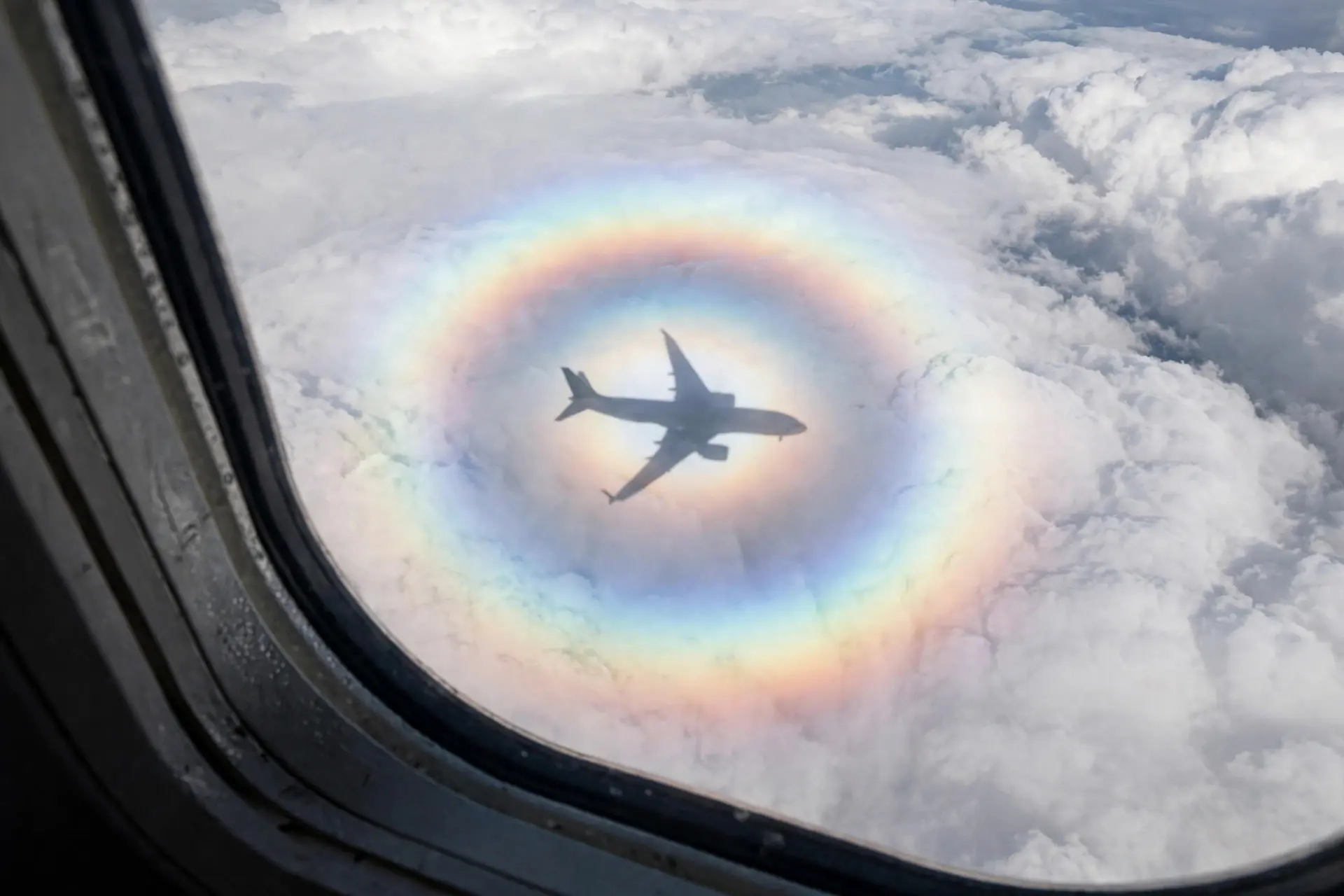
The recipe has three ingredients. First, the sun must be low and behind you. Second, you must be above a layer of fog or cloud: a ridge, a summit, the shadow side of an airplane. Third, the mist must be thin enough for your shadow to be cast onto it. When all three hold, the fog acts like a cinema screen: your shadow is projected onto it, magnified several times, but on a screen with no flat surface, so the shadow ripples and sways with the drifting fog even when you stand still (AKM e.V.). The gigantic size is an illusion. The brain judges size by comparing objects to nearby references, and fog deletes every reference. With nothing to measure against, your visual system reads the shadow as far larger than it is, the same trick that makes the moon look enormous near the horizon (ExplorersWeb). The colored rings are a separate trick called the glory. Sunlight penetrates the tiny droplets, reflects off their back sides, and returns toward the sun; waves from different droplets interfere with each other to create circular zones of brightness and darkness. The diameter of the zone differs for each color of light, which is why the glory an airplane passenger sees is red on the outside, just like a primary rainbow (University of Alaska Fairbanks Geophysical Institute). All three phenomena can share one frame. A photograph from the 2,962-meter (9,718-foot) summit of the Zugspitze on the German-Austrian border shows a glory, a Brocken spectre, a fog bow and supernumerary bows together: the full family portrait (WMO International Cloud Atlas). Fog bows are the white, color-drained cousins of rainbows; what a fog bow is explains that side of the family.
| Phenomenon | What you see | What causes it | Where it appears |
|---|---|---|---|
| Brocken spectre | Your own shadow, enlarged and distorted | Perspective on a fog screen | On fog or cloud below the observer |
| Glory | Colored rings around the shadow's head | Diffraction and interference in tiny droplets | Centered on the antisolar point |
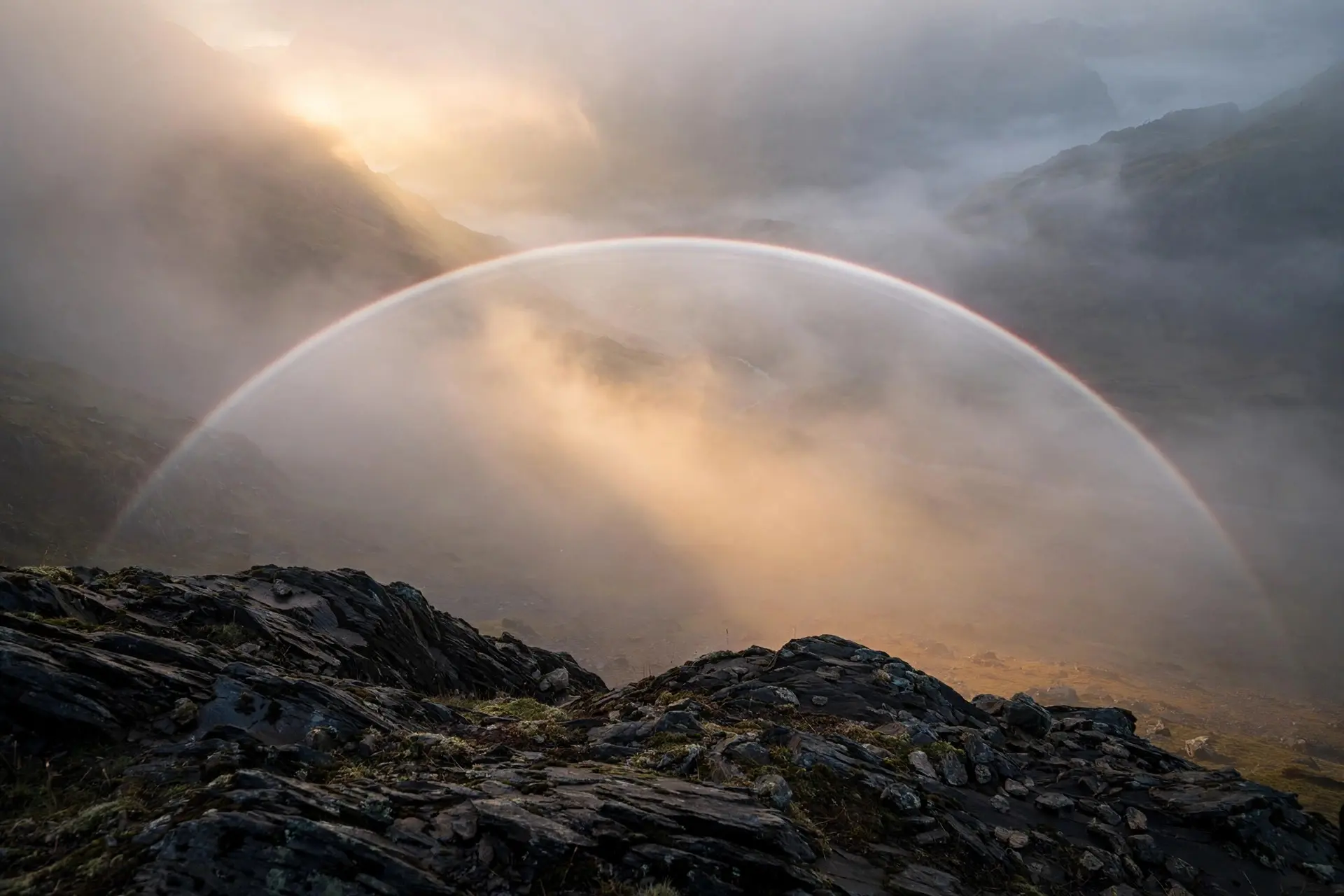
| Fog bow | A pale, colorless arc | Diffraction smearing rainbow colors together | Outside the glory, in fog or mist |
Why did it terrify mountain climbers?
Before physics explained it, the spectre looked like an omen. According to legend, the name came from a climber on northern Germany's highest mountain who, crossing a narrow precipice, was startled by a haloed human figure in the nearby mists, and fell to his death. If the story happened at all, the figure was his own shadow and the ring was his own glory (University of Alaska Fairbanks Geophysical Institute).
In German legend the apparition suggested demons and witches, and writers including Johann Wolfgang von Goethe, Lewis Carroll, Carl Jung and Charles Dickens folded it into their works as an omen. In China's misty Huangshan Mountains it was called Buddha's Light, and seeing it meant the viewer was enlightened. Spanish settlers in 18th-century California called the figures Los Vigilantes Oscuros, the dark watchers (ExplorersWeb). The first detailed scientific description came earlier than most people think. Spanish scientist and naval captain Ulloa described the spectre and the glory while crossing the Andes in 1735, and the name "Ring of Ulloa" stayed in international use until the end of the 18th century, when Goethe's studies of the Brocken took over and the phenomenon became the "Spectre of the Brocken" (AKM e.V.). The phenomenon even helped make a Nobel Prize. Scottish physicist Charles Thomson Rees Wilson saw a Brocken spectre from the summit of Ben Nevis, Scotland's highest peak, in 1894 and became fascinated. Years later he built a cloud chamber at the Cavendish Laboratory in Cambridge to recreate atmospheric conditions; the chamber did not reproduce the spectre, but its ability to detect radiation earned Wilson the Nobel Prize in Physics in 1927 (ExplorersWeb).
What do people get wrong about Brocken spectres?
The oldest error is the supernatural one: ghosts, demons, omens. The second oldest is thinking the figure is a real, separate being standing in the mist. It is neither. It is your own silhouette, and nobody else can see your version of it; the Royal Meteorological Society notes that the shadow-and-glory combination can only be seen from the perspective of the witness. Another mistake is assuming the glory is part of the shadow. It is light, not shade: diffraction rings centered on the antisolar point, sitting where your head's shadow happens to be. That is why the rings always hug the head and never, say, the feet. A final misconception is that the spectre requires a mountain. Mountains help, because you need to be above the fog, but airplane passengers see the same rings around their plane's shadow on clouds, and the effect has even been photographed from orbit: in 2003, astronauts aboard the space shuttle Columbia captured a glory from space, later nicknamed the Astronaut's Glory (ExplorersWeb). The Brocken spectre is one of nature's best optical illusions: a shadow mistaken for a giant, a ring of light mistaken for a halo of sanctity. All it asks is that you climb above the fog on a sunny day and look down. The ghost you see there is you. How we made this article: FactSpire researched and drafted it with AI assistance and checked every fact against the sources listed above.
Frequently asked questions
Can you photograph a Brocken spectre?
Yes, and many photographers have, from the Bavarian Alps to San Francisco. But there is a catch: the spectre is personal. The magnified shadow and its glory only line up for the person standing in exactly the right spot. Your photo will show your own shadow; a companion standing a few feet away sees a different one.
Do you have to be on a mountain to see one?
Mountains are the classic stage, but any high position works. Airline passengers regularly see glory rings around the plane's shadow on clouds below, and the effect has been photographed from airport control towers. What matters is being above a bank of fog or cloud with the sun at your back.
Why does the shadow look so enormous?
Perspective, not magic. When fog swallows all nearby reference points, your brain has nothing to judge size against, so it reads the shadow as far bigger than it is. The effect is an illusion built by your visual system, the same way the moon looks huge near the horizon.
Is the glory part of the spectre?
They are separate phenomena that often share the sky. The spectre is simply your enlarged shadow on the mist. The glory is a set of colored rings caused by diffraction, centered on the antisolar point. Together they make the famous haloed-giant image, and all three (spectre, glory and even a fog bow) have been photographed in a single frame.
Sources
- Glory and Brocken spectre, WMO International Cloud Atlas
- The Brocken Spectre, University of Alaska Fairbanks Geophysical Institute
- Natural Wonders: Brocken Spectre, ExplorersWeb
- Spectre of the Brocken and Glory, AKM e.V.