Dmanisi Hominins: Humans Left Africa Earlier Than Thought
Beneath a medieval Georgian village, fossils show hominins reached Eurasia 1.8 million years ago — far earlier than thought. The story of the Dmanisi people.

Key takeaways
- Dmanisi fossils in Georgia, dated to 1.85–1.77 million years old, are the earliest well-dated hominin remains outside Africa.
- The five Dmanisi skulls had brains of just 546–775 cubic centimeters — less than half the size of modern human brains.
- Skull 4 belonged to an elderly male who had lost all but one tooth, suggesting the group cared for vulnerable members.
- The site holds over 100 postcranial fossils, five skulls, and 1,000+ stone tools, but no traces of fire.
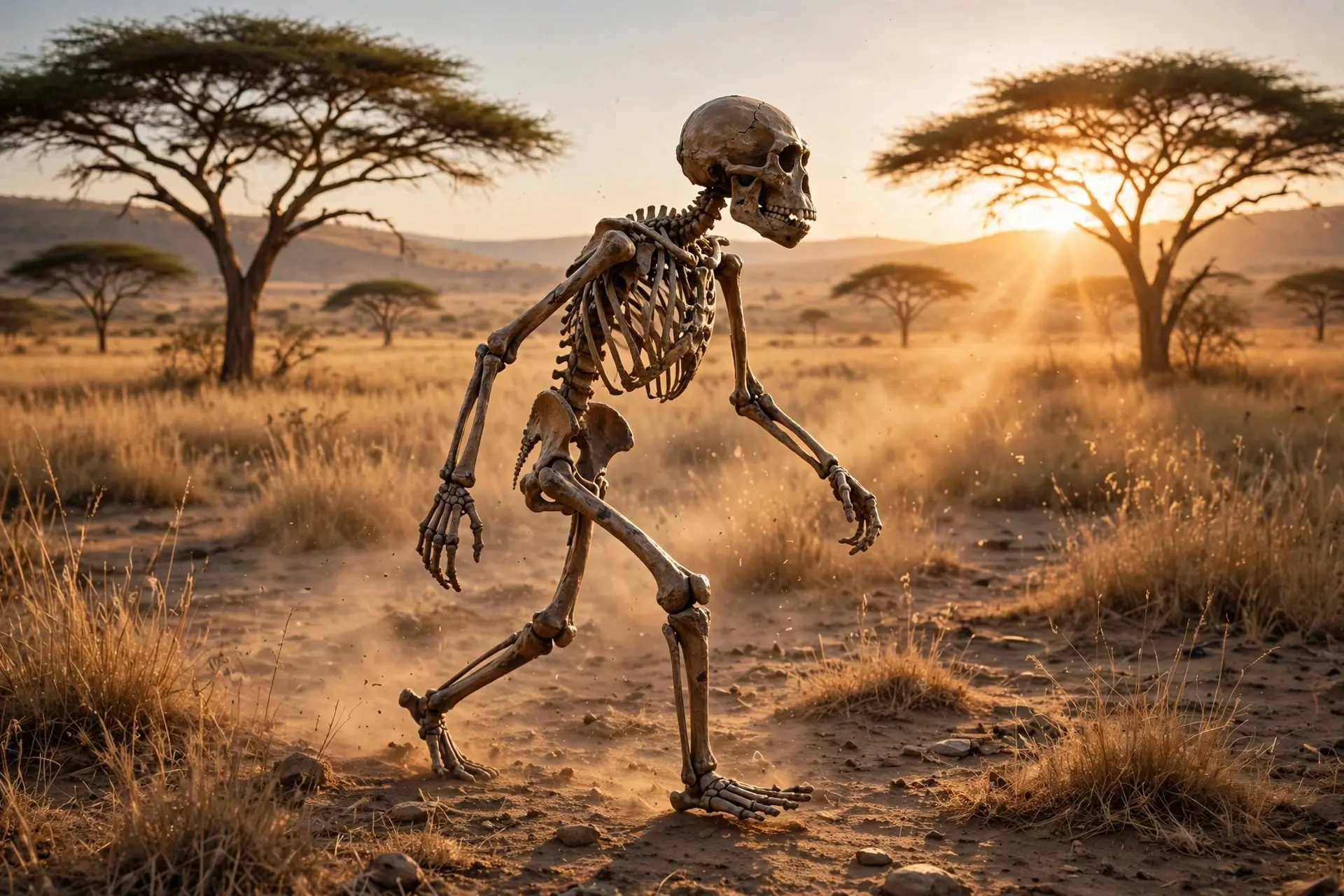
Beneath the ruins of a medieval fortress in the Caucasus, in soil that has also yielded stone choppers and the bones of saber-toothed tigers, lie five skulls that quietly demolished one of paleoanthropology's most confident assumptions. They are about 1.8 million years old, and they prove that humans — or something very close to human — were living in Eurasia roughly a million years earlier than textbooks once said. The Dmanisi hominins had brains barely half our size, carried crude stone tools, and had never mastered fire. Their existence rewrote the schedule of our species' greatest journey: out of Africa.
How did a medieval village end up sitting on 1.8-million-year-old humans?
The village of Dmanisi sits about 85 kilometers southwest of Tbilisi, Georgia, near the junction of the Masavera and Pinezaouri rivers, in the shadow of a medieval castle. In 1983, archaeologists excavating the medieval town noticed bones mixed into the deposits — bones of species they knew had been extinct for ages. A year later, ancient stone tools turned up in the same layers. The site, it turned out, was not just a medieval town. It was a Lower Paleolithic time capsule, with fossils buried in about four and a half meters of alluvium. The human story emerged slowly. In 1991, workers found a fossilized mandible — a lower jaw that looked strikingly unlike a modern human's but familiar to anyone who had studied early African fossils of the genus Homo. In 1997 came a metatarsal, a foot bone. Then, in 1999, two nearly complete skulls emerged from an excavation area of just four square meters. A third skull followed in 2001, and the discoveries continued until five famous skulls — Dmanisi Skulls 1 through 5 — had been recovered, along with more than a hundred postcranial fossils, thousands of extinct animal bones, and over a thousand stone tools. The dating was the shock. The Pleistocene layers at Dmanisi are securely dated to between 1.85 and 1.77 million years old. Before the 1980s, the standard view held that early humans were confined to Africa until roughly 800,000 years ago. Dmanisi pushed the first departure back by a full million years. As researchers put it, the site is a snapshot in time — a time capsule from 1.8 million years ago — capturing early human evolution on the move.
What were these small-brained wanderers like?
Everything about the Dmanisi hominins argues against the image of early humans as big-brained conquerors. The five skulls held brains of just 546 to 775 cubic centimeters — Skull 5, the most complete, measured a mere 546 cc — compared with roughly 1,250 cc for modern humans. One of the first skulls described, a petite individual with a small brain, thin brow ridge, and short nose, was published in Science precisely because its ~600-cc brain challenged the prevailing idea that migration out of Africa required enlarged intelligence. The Dmanisi people were lightly built, with long faces and large teeth. Their technology was equally unassuming: the stone artifacts, made mostly of basalt, volcanic tuff, and andesite, belong to the Oldowan chopping-tool tradition — simple flakes and choppers, comparable to tools from Olduvai Gorge in Tanzania and Ubeidiya in Israel. And there were no traces of fire at the site. Whatever carried these hominins across continents, it was not controlled flame, sophisticated weapons, or large brains. The environment they survived was not gentle. Around 1.8 million years ago, Dmanisi was a savannah-like grassland, home to saber-toothed tigers and early elephants. These small, simple-tooled hominins — probably traveling through the Levantine corridor, the natural land bridge between Africa and Eurasia — established themselves in a landscape full of predators larger than anything they could have fought. Their success suggests that something other than brains or blades kept them alive.
What does a toothless old man tell us about early humanity?
The most haunting fossil at Dmanisi is Skull 4. It belonged to an elderly male who, by the time he died, had lost all but one of his teeth. The jaw shows extensive bone loss and resorption — and analysis suggested he had been effectively toothless for about two years before his death.
Consider what that means. This was a 1.8-million-year-old hominin who could not chew his own food, living in a world of saber-toothed tigers, without fire or large brains to compensate. Survival under those conditions implies that someone was feeding him — that his group provisioned a vulnerable member, perhaps with soft food, for months or years. Long before the deliberate burials of Neanderthals or the art of Chauvet Cave, before Lucy's famous skeleton even fossilized (she died earlier, around 3.2 million years ago, in Africa), there is evidence at Dmanisi that care for the vulnerable may be among humanity's oldest behaviors. Care, in other words, may predate cognition as we usually define it. The Dmanisi hominins were not clever in the modern sense, but they may have been compassionate — and compassion may have been the technology that let them walk out of Africa.
Why do scientists still argue about them?
For all their clarity on the timeline, the Dmanisi fossils have generated some of paleoanthropology's fiercest taxonomy debates. The five skulls vary considerably: one is petite and gracile, another massively built, one toothless, one adolescent. Are they one species or several? The initial description classified them near African Homo ergaster; the discovery of a massive jaw in 2000 led to a proposal for an entirely new species, Homo georgicus; later work favored folding them into Homo erectus as the subspecies Homo erectus georgicus. The nomenclature is still debated today. In 2013, the Dmanisi team made the boldest claim yet. Skull 5 — the first completely preserved adult Early Pleistocene hominid skull ever found — was analyzed alongside the other four, and the researchers concluded that the variation across all five was no greater than the variation among five random modern humans or bonobos. If so, many fossils currently split into separate species might actually belong to a single, variable species — Homo erectus — collapsing several branches of the human family tree into one. The team's lead researcher illustrated the point by noting that wildly different-looking modern people are the same species. Critics, including prominent proponents of a busier family tree, pushed back, while still calling the skull discovery itself critical and beautiful. The debate matters because it is not just about names. If the Dmanisi team is right, early human evolution was less about branching species and more about one adaptable lineage spreading — small-brained, simple-tooled, but mobile and cooperative. The first people to leave Africa did not wait until they were ready. They went with what they had: stone choppers, each other, and apparently, someone to chew dinner for the old man who could not chew it himself. The Dmanisi fossils suggest the defining human trait was never raw intelligence. It was the willingness to leave — and to bring everyone along.
Frequently asked questions
How old are the Dmanisi hominins?
The fossils and stone tools at Dmanisi, Georgia, are securely dated between 1.85 and 1.77 million years old. They are the earliest well-dated hominin fossils in Eurasia — nearly a million years older than the date scientists once assumed for the first migration out of Africa.
Did the Dmanisi hominins have small brains?
Yes. The five famous Dmanisi skulls held brains of just 546 to 775 cubic centimeters, less than half of a modern human's roughly 1,250 cubic centimeters. This challenged the idea that larger brains were required before humans could leave Africa.
Why are the Dmanisi fossils still controversial?
Scientists disagree on how to classify them: some favor Homo erectus georgicus, others the separate species Homo georgicus, and still others link them to African Homo ergaster. A 2013 study also argued all five skulls belong to one species, a claim some experts still dispute.