Chauvet Cave: Art Twice as Old as Lascaux
Discovered by chance in 1994, France's Chauvet Cave holds 36,000-year-old paintings experts once doubted were real. One sealed cavern rewrote art's history.
Key takeaways
- Chauvet Cave was discovered on December 18, 1994 by three French cavers and had been sealed by a rockfall about 23,000 years ago.
- Radiocarbon dating of charcoal put the paintings at roughly 30,000 to 32,000 years old, nearly twice the age of Lascaux's 12,000 to 17,000 years.
- Aurignacian artists used shading, perspective, and the rock's natural relief, with staggered horse legs implying galloping motion.
- Over half the figures are dangerous predators like lions, hyenas, and mammoths, a subject matter rare in other Paleolithic art.
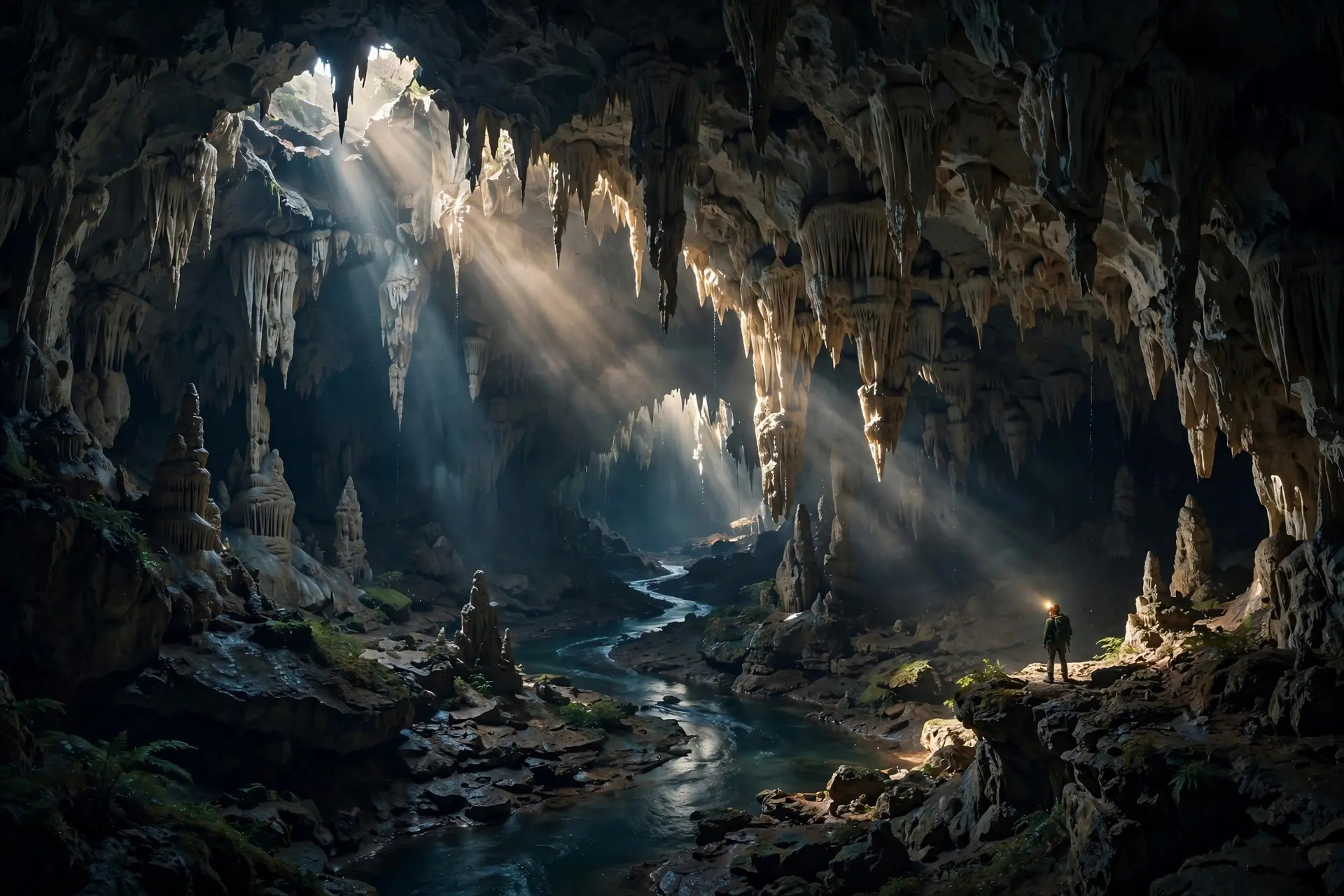
On December 18, 1994, three French cavers pried aside a pile of fallen rocks in the Ardèche gorges and dropped into a chamber that no human had entered for more than 20,000 years. Their headlamps swept across walls covered in lions, rhinoceroses, mammoths, and horses — art of staggering sophistication. Radiocarbon dating would later show these paintings were around 36,000 years old: nearly twice the age of the celebrated Lascaux murals. Chauvet Cave didn't just add a chapter to the history of art. It demolished the assumption that art had to start crude and improve slowly.
The Day the Rockfall Gave Up Its Secret
Jean-Marie Chauvet, Éliette Brunel Deschamps, and Christian Hillaire had spent the day exploring the Pont d'Arc cave systems in southeastern France. Near a collapsed cliff face, they felt a gentle current of air rising from beneath a mound of rubble — the signature of a hidden cavity. They dug through the stones, squeezed down a narrow passage, and emerged into a vast chamber with a high ceiling branching into galleries. There, in the beam of their headlamps, were handprints and a red-ochre mammoth. They had stumbled into what would be called the Chauvet-Pont d'Arc Cave, one of the oldest decorated caves ever found. The timing was almost geological in its neatness. A rockfall had sealed the cave's entrance some 23,000 years ago, freezing the interior like a time capsule: cave bear skeletons, preserved footprints, the blackened remains of ancient fires — and more than 1,000 drawings spanning over 8,500 square meters of wall. Nothing had disturbed it. Nothing had faded it. It was, as UNESCO would later declare when inscribing it as a World Heritage site in 2014, an exceptional testimony to prehistoric creation preserved by 23 millennia of concealment.
Why 36,000 Years Broke Archaeology's Brain
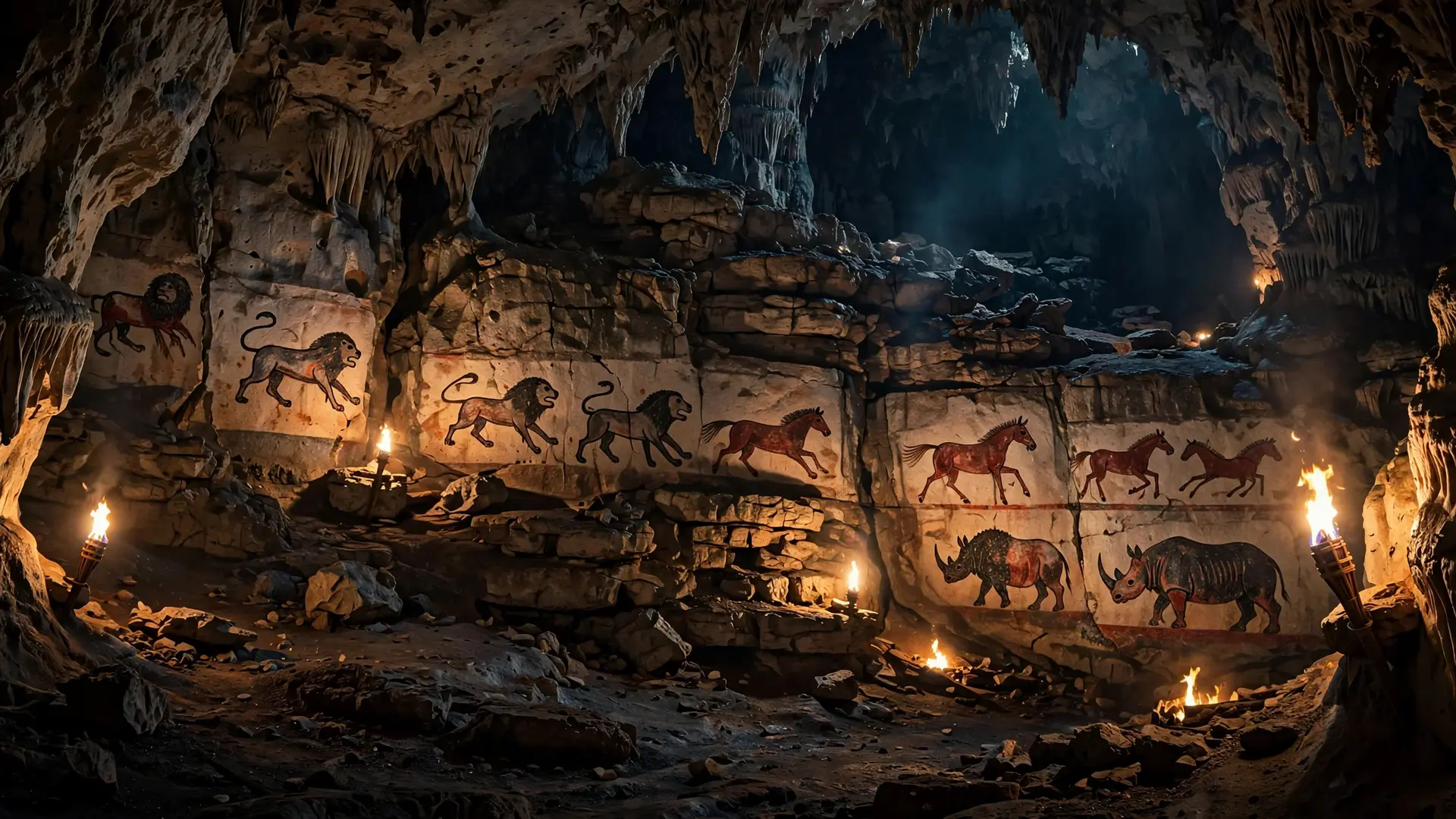
The shock wasn't the age alone — it was the age combined with the quality. Within a year of the discovery, radiocarbon dating suggested the paintings were 30,000 to 32,000 years old, making them almost twice as old as Lascaux, whose Magdalenian-era art dates to roughly 12,000–17,000 years ago. The dating came not from guesswork but from charcoal: researcher Hélène Valladas and colleagues radiocarbon-dated charcoal from the paintings themselves in a comprehensive 2001 study published in Nature, with most samples clustering between 29,000 and 32,000 years. And the art itself looked far too advanced for that date. The Aurignacian artists — among the first modern humans in Europe — used shading, perspective, and the natural relief of the rock to give their figures volume and depth. Animals overlap to suggest motion; horses' legs are staggered to imply galloping. Over half the figures are dangerous predators — cave lions, hyenas, woolly rhinoceroses, mammoths, bears — a subject matter rare in other Paleolithic art, where horses and bison dominate. One stunning triptych shows some 50 drawings of horses, lions, and reindeer cavorting across 49 feet of limestone. As France's Ministry of Culture put it, the find "overturned the accepted notion about the first appearance of art and its development."
A Sealed Time Capsule
Chauvet is more than a gallery; it's a frozen Upper Paleolithic campsite. The cave holds the fossilized remains of extinct cave bears that hibernated there, and one of its most haunting traces is a set of small footprints — believed to belong to a child — preserved in the soft ground. Some researchers have even suggested the child may have been accompanied by a dog. Ancient humans visited in two distinct periods, Aurignacian and Gravettian, across millennia, before the rockfall closed the door.
That pristine sealing is precisely why the cave is closed to almost everyone. Fewer than 200 researchers a year are permitted inside, and its more remote chambers remain unexplored — even human breath could threaten the fragile atmosphere. Instead, the public visits Chauvet Cave 2, an enormous full-scale replica opened in April 2015 a few kilometers from the original, built with millimeter precision across some 3,000 square meters on an eight-hectare site with a discovery center and exhibitions. It was designed to welcome 300,000 to 400,000 visitors a year — proof that even a copy of wonder is worth the trip. And curiosity about what these early humans saw isn't over: researchers analyzing abstract red daubs beside the animal figures proposed in PLoS One that they may depict a volcanic eruption in the Bas-Vivarais region — potentially the oldest known depiction of a natural disaster.
The Nuance: Not Everyone Believed the Dates
The most instructive part of the Chauvet story is the argument it caused. When the radiocarbon results arrived, archaeologist Paul Pettitt and others balked: the art looked too sophisticated to be Aurignacian. To claim otherwise, one critic said, was like claiming to have found a Renaissance painting in a Roman villa. Some argued the cave walls were still chemically active, so the radiocarbon dates on pigments could have been contaminated. The rebuttal — more samples, more methods, a 2001 Nature study that seemed to confirm the antiquity — mostly carried the day, but the dispute exposes something important: we expected art to evolve in a straight line from crude to refined, because that is how our own history looks. Chauvet suggests otherwise. Archaeologist Jean Clottes, who led research at the site, argued that prehistoric art developed "in spurts, with lots of apogees and lots of declines." Mastery arrived early; it simply didn't survive everywhere, and we mistook survival for progress.
The Artists Were Ready Before We Were
Chauvet Cave reminds us that the past is mostly a preservation lottery. A sealed rockfall gave us 36,000-year-old masterpieces from people whose artistic sophistication we refused to believe until the charcoal itself testified. Like Lucy's bones, which reset our timeline of humanity, and like the ancient scripts we're still teaching machines to read, Chauvet keeps humbling our sense of when genius began. The art didn't need millennia to get good. It was good the moment it started — and it took a lucky cave-in, three curious explorers, and a radiocarbon lab to finally admit it.
Frequently asked questions
Why did some archaeologists doubt the Chauvet dates?
The art looked too sophisticated to be Aurignacian; one critic likened it to finding a Renaissance painting in a Roman villa. Some argued the cave walls were still chemically active, which could have contaminated the radiocarbon dates.
Can the public visit Chauvet Cave?
Almost no one is admitted: fewer than 200 researchers a year, since even human breath could threaten the fragile atmosphere. The public visits Chauvet Cave 2, a full-scale replica opened in April 2015 a few kilometers away.
How did Chauvet change our view of art history?
It overturned the notion that art evolved in a straight line from crude to refined. Mastery arrived early, developing in spurts with apogees and declines, and we mistook survival of evidence for progress.