Where Is the Coldest Town Where People Live Year-Round?
Oymyakon, a village of about 500 people in Siberia's Sakha Republic, recorded −67.7°C in 1933 — the lowest temperature ever measured where people live.
Key takeaways
- Oymyakon in Russia's Sakha Republic is the coldest permanently inhabited place on Earth, with an official record of −67.7 °C on 6 February 1933.
- About 500 people live there year-round, in a mountain-ringed valley that traps cold air through the long Siberian winter.
- January's daily mean temperature is −46.4 °C, and schools stay open until the cold passes about −50 °C.
- The village's name means 'unfrozen water,' after a thermal spring that stays liquid through winter and once watered reindeer herders' animals.
- Life runs on coal heat, cars left running overnight, and a meat-and-fish diet, because the ground never thaws enough to farm.
The coldest town where people live year-round is Oymyakon, a village of about 500 people in the Sakha Republic of north-eastern Siberia. On 6 February 1933, its weather station recorded −67.7 °C — the lowest temperature ever officially measured anywhere people permanently live. Colder readings exist, but only in places where nobody makes a home: Antarctica's research stations and the uninhabited Arctic. Oymyakon's record is different because it was measured where families sleep, work, and send their children to school.
Where is Oymyakon, and why is it so cold?
Oymyakon sits at 63°28′N, 142°23′E, in a valley of the Indigirka River region, roughly 350 kilometres south of the Arctic Circle — which is the first surprise. It is not in the far north at all. Its cold comes from geography, not latitude. The village lies in a hollow ringed by mountains, and cold air is heavy: on calm winter nights it slides down the slopes and pools in the valley floor, unable to drain away. Add clear skies that let heat radiate into space, a location far from any moderating ocean, and months of near-darkness, and the valley becomes a natural cold trap. The numbers bear it out. Guinness World Records lists Oymyakon's −67.7 °C reading of 6 February 1933 as the lowest temperature in the northern hemisphere and the lowest ever recorded outside Antarctica, making the village the coldest permanently inhabited place in the world. The daily mean temperature in January is −46.4 °C — meaning an average January day, not an extreme one, sits more than forty-six degrees below freezing. The record is officially shared with Verkhoyansk, another Sakha town, which recorded the same −67.7 °C in February 1892, though climatologists have questioned that older reading because the spirit thermometer used required correction. Oymyakon's 1933 figure stands as the cleaner record.
There is also a number you will see on the village monument that does not count. A Soviet-era monument at the entrance to Oymyakon declares −71.2 °C, recorded in 1924, and calls the village the Pole of Cold. That reading was never accepted as an official station record, so it lives on as local pride rather than meteorological fact — a distinction worth keeping when the two figures appear side by side.
How did a village come to exist in such a place?
The name gives the clue. In the Even language spoken in Siberia, Oymyakon means "unfrozen water," a reference to a thermal spring near the village that stays liquid through the winter. Long before there was a permanent settlement, reindeer herders brought their animals to that spring to drink, returning season after season. The spring was the village's lifeblood and its entire reason for existence: in a landscape where every other water source freezes solid, one patch of open water could keep a herd alive. The settlement grew permanent under the Soviet Union, when the state encouraged workers to move to harsh regions with the promise of higher wages. Today the population hangs at around 500 permanent inhabitants, mostly indigenous Yakuts, along with ethnic Russians and Ukrainians whose families arrived during the Soviet era. Getting there remains an expedition: there is no railway, and the journey from Yakutsk, the Sakha capital some 576 miles away, takes about two days by road along the Kolyma Highway — the infamous Road of Bones, built by gulag labour under Stalin. Photographer Amos Chapple, who documented the village, spent two days stranded at a roadside teahouse on the way, eating reindeer soup while waiting for a lift.
What does everyday life look like at −50 °C?
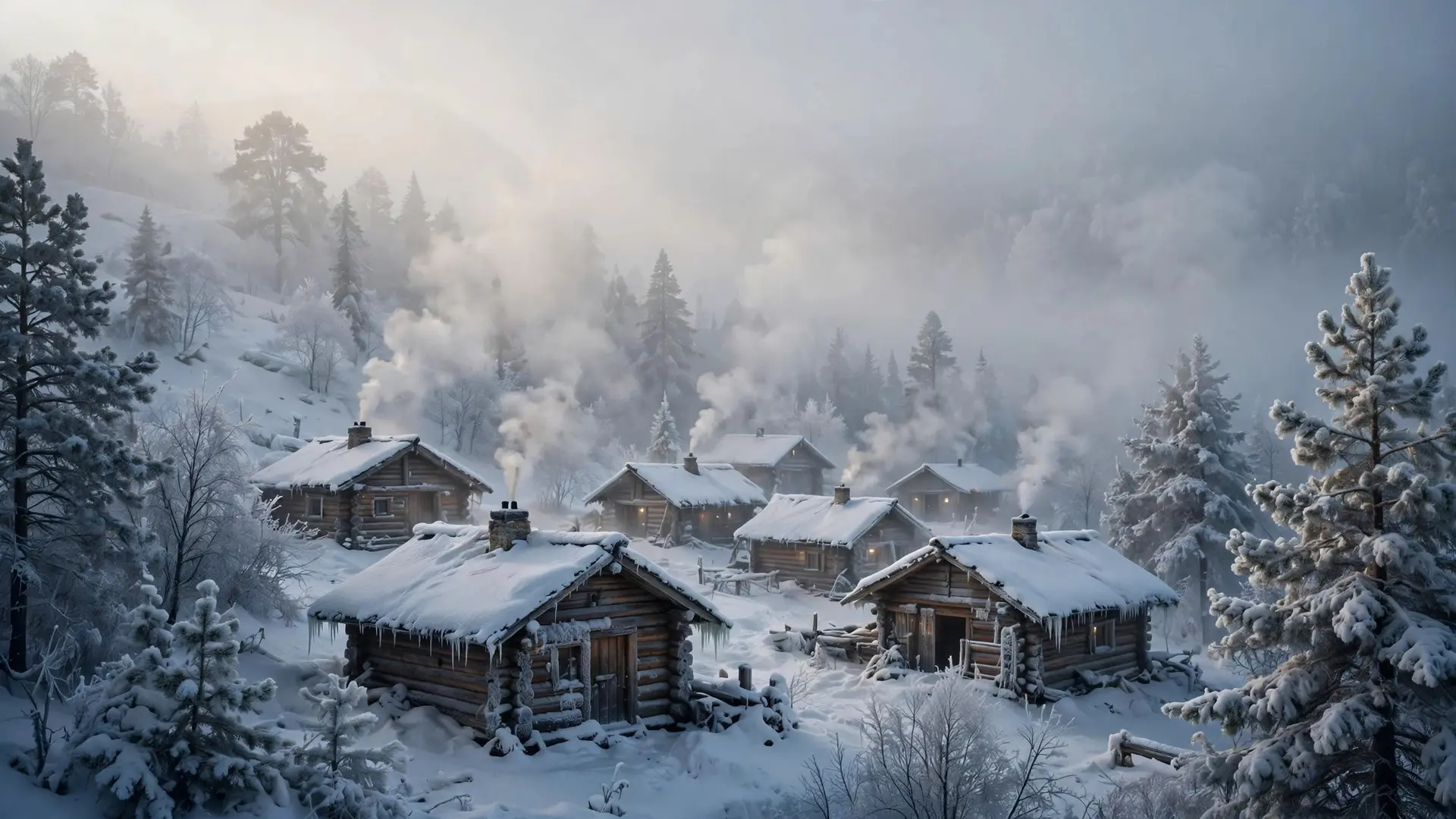
Everything in Oymyakon is organised around one fact: the cold never lets up for months, and a mistake can be dangerous. Heat comes from a coal-fired water heating plant at the edge of the village, and every morning a digger delivers a fresh load of coal and carries away the burnt cinder. Houses are heavily insulated, and buildings stand on stilts driven into the permafrost so their warmth does not thaw the ground beneath them and destabilise the foundations.
Cars are left running outside, sometimes overnight, because a switched-off engine can freeze solid — and drivers have been known to thaw a frozen drive shaft with a small flamethrower. Bathrooms are mostly outdoor long drops, because indoor plumbing struggles against frozen pipes. Schools do not close unless temperatures fall below about −50 °C, a threshold that would shut every school on Earth anywhere else but is simply a cold week here. And the streets, visitors notice, are often empty: people are wary of the cold and do most of life indoors, emerging for quick dashes between heated buildings. Food follows the same logic. Nothing grows in ground that never thaws, so the diet is built on meat and fish: reindeer meat, frozen horse, and stroganina — thinly shaved frozen fish eaten raw, which one visitor described as frozen sashimi. It is a high-calorie diet for a climate that burns calories fast, and it is the same pattern found across the coldest inhabited places on Earth, from Siberian villages to the high Arctic.
Could anywhere inhabited be colder?
The honest answer is: not by the official record, but the margin is thin. Verkhoyansk shares the −67.7 °C figure, and the village of Tomtor nearby hosts its own Pole of Cold festival, but neither has beaten Oymyakon's accepted record. The only colder measurements on the planet come from places without permanent residents — above all Vostok Station in Antarctica, where −89.2 °C was recorded in 1983. At the opposite extreme, Dallol in Ethiopia shows what permanent settlement looks like at the hot end of human endurance, where the year-round average is the highest on Earth. Oymyakon endures because its people adapted rather than merely survived: a spring that never freezes, houses built for permafrost, a heating plant that never stops, and a diet drawn from animals that thrive where crops cannot. The village is sometimes described as a place that proves how far human habitation can stretch. That is almost right — but the real lesson is narrower and more interesting. Oymyakon does not stretch habitation to its limit by accident. It sits in a valley that manufactures cold, beside a spring that refuses to freeze, and its residents built a way of life in the gap between those two facts. As long as the spring flows and the coal arrives, the coldest town on Earth stays inhabited.
Frequently asked questions
Where is the coldest town where people live year-round?
Oymyakon, a village of about 500 people in the Sakha Republic of north-eastern Siberia, Russia. Its official record low is −67.7 °C, measured on 6 February 1933.
Is Oymyakon colder than Antarctica?
No. Antarctica's Vostok Station recorded −89.2 °C in 1983, far colder — but nobody lives at Vostok year-round as a permanent resident. Oymyakon is the coldest place with a permanent, year-round population.
What is the −71.2 °C figure on Oymyakon's monument?
A Soviet-era monument in the village marks −71.2 °C, recorded in 1924, but that reading is not accepted as an official station record. The verified record remains −67.7 °C from 1933.
Why is Oymyakon so much colder than places further north?
Cold air is heavy and sinks, so it pools in the valley where Oymyakon sits, ringed by mountains that stop it draining away. Clear winter skies let heat escape to space, and the village is far from any ocean that could moderate the cold.
Sources
- Lowest temperature - inhabited, Guinness World Records
- Photos From the Coldest City on Earth, Smithsonian Magazine
- 21 Amazing Photos That Show What Life Is Like in The Coldest Inhabited Town on Earth, ScienceAlert