Why Does the Sky Turn Green Before a Tornado?
A green sky does not guarantee a tornado, but it does warn of a severe storm loaded with water and hail. Here is the physics behind the eerie glow.
Key takeaways
- A green sky signals a severe thunderstorm packed with water and ice, and it is most closely tied to large hail rather than to tornadoes alone.
- Scientists do not fully agree on the mechanism, but one leading explanation is that deep water and ice in the storm scatter green light toward the viewer.
- A green sky never guarantees a tornado, yet large hail often forms near the part of a storm where tornadoes are most likely, so shelter is the right response.
- The color is strongest late in the day, when low sunlight passes through more atmosphere and the storm's own depth filters the light.
- Green, hail, and a rotating storm are all signs of a powerful updraft, the engine that makes severe thunderstorms dangerous.
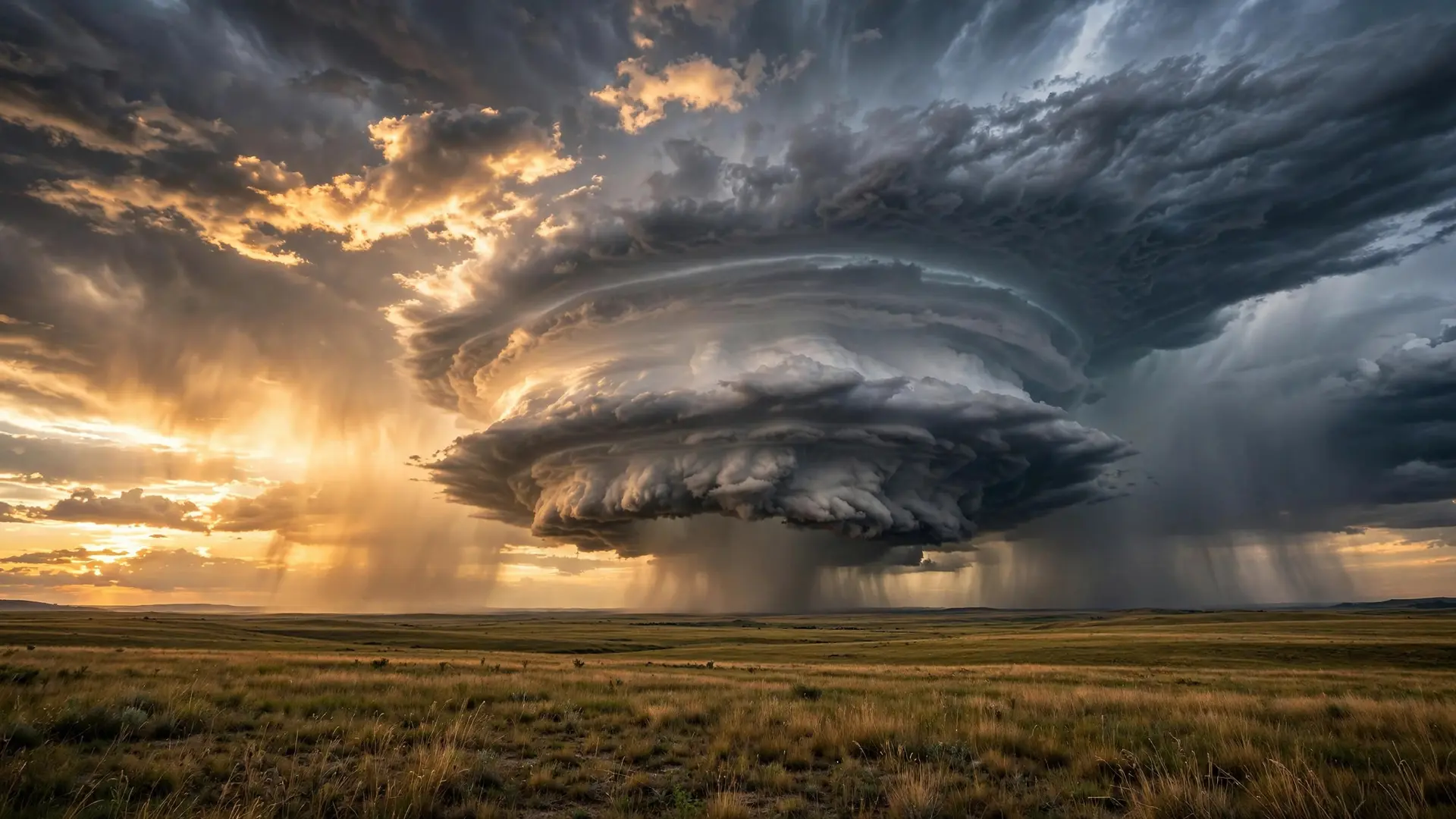
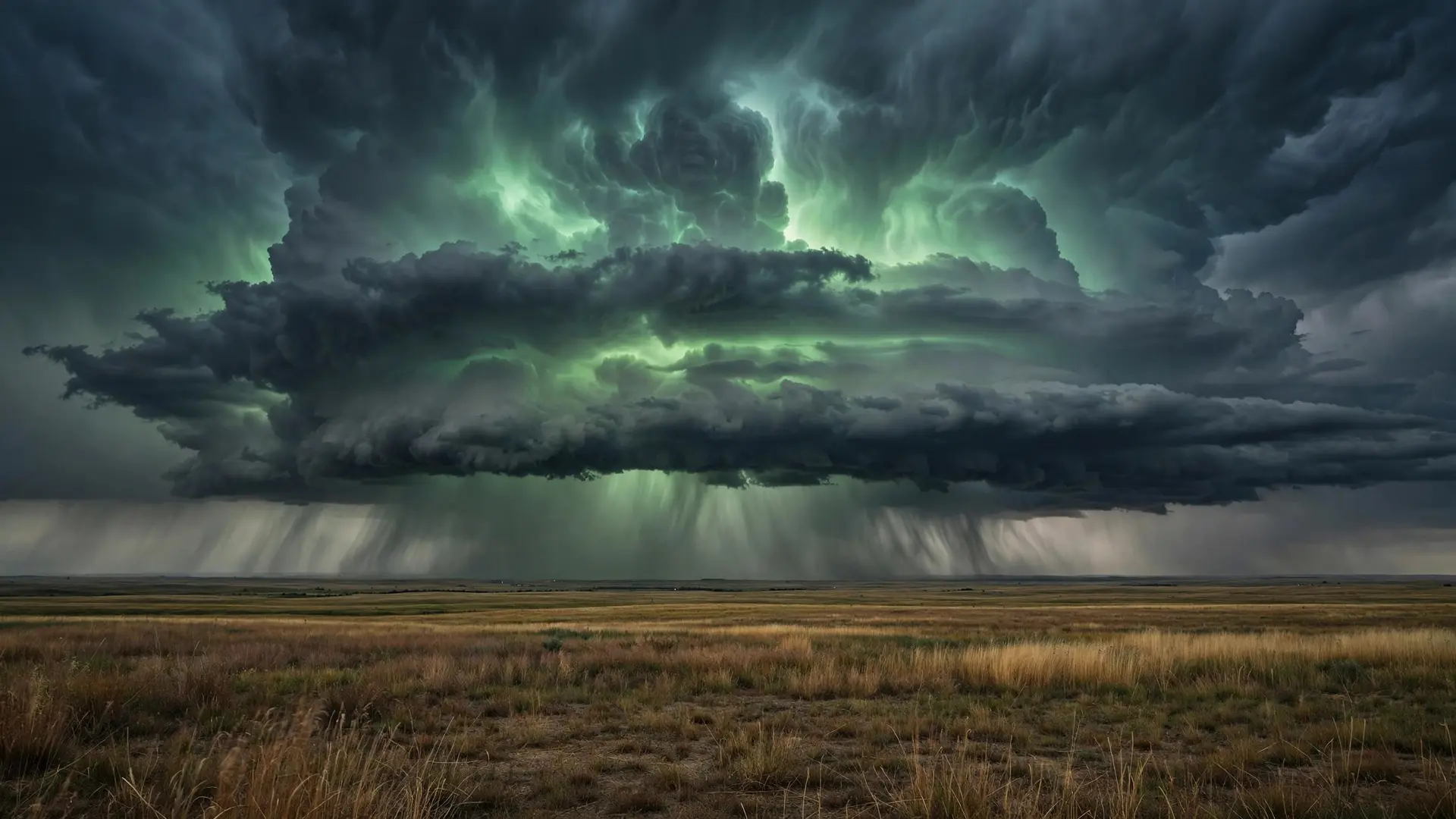
A green sky does not mean a tornado is definitely on its way, but it does mean the storm above you is serious. The color appears when a severe thunderstorm is carrying an enormous load of water and ice, and forecasters treat it as a visual warning sign for very large hail. It is one of the most famous sights in severe weather, and one of the most misunderstood. The first thing to get straight is the link to tornadoes. People associate a green sky with tornadoes because the two often show up together, and that association is not baseless: the same powerful storms that turn the sky green can also spin up tornadoes. But the color itself is not a tornado detector. A sky can glow green and deliver only hail and punishing wind, and some of the most dangerous tornadoes arrive wrapped in rain, hidden from view entirely. The green tells you about the storm's contents, not its exact intentions.
What is actually happening inside the storm?
The color starts with the storm's engine, the updraft. In a severe thunderstorm, rising air carries raindrops high into extremely cold parts of the atmosphere, where they freeze and grow into hailstones by colliding with supercooled water droplets. The stronger the updraft, the larger the hail it can hold aloft, and the longer that water and ice stay suspended in a towering column of cloud. A storm capable of turning the sky green is one that has built up a tremendous amount of that suspended water and ice. That sheer depth of water is the key ingredient. The National Weather Service office in North Platte, Nebraska, has described a green sky as needing a tremendous amount of water content within the cloud, and it calls the color a visual warning sign for very large hail. The connection is direct enough that storm spotters treat green clouds as a cue to expect hail, not merely rain. During one Northern Plains derecho, for example, tennis ball-sized hail was reported in Timber Lake, South Dakota, beneath skies that had turned visibly green.
The precise optics are still debated, which is worth saying plainly. The National Severe Storms Laboratory notes that scientists do not agree on exactly why the sky can appear green during severe weather, even though there is plenty of anecdotal evidence linking the color to hail nearby. One theory it cites is that large amounts of water and ice in the storm's updrafts scatter green light, making the clouds look green. The honest version of the science, then, is not a single settled formula but a strong, well-supported pattern: deep water and ice plus the right light equals green.
Why does the light turn green?
Think of the storm cloud as a filter. Ordinary daylight reaching a cloud is a mix of colors, and a normal, shallow cloud scatters that light more or less evenly, which is why it looks white or gray. A severe storm cloud is different in two ways: it is far deeper, so light travels through much more water and ice before reaching your eyes, and it is lit from a particular angle, often late in the day when the sun sits low. When the sun is low, its light already travels a longer path through the atmosphere, which strips away some colors and leaves the warm yellows and oranges of late-day light. That reddened light then shines into and through a cloud packed with blue-looking water droplets and ice. The combination — warm light scattered by the atmosphere meeting the blue-tinted water and ice of the storm — is what pushes the cloud's appearance toward green. It is the same kind of color mixing you learned as a child, blue and yellow making green, but happening on a scale of kilometers, inside a cloud. Timing matters for another reason. A green sky is most often noticed in the afternoon and evening, when severe storms peak and the sun is sinking. The low sun also lights the storm from the side or from behind, which can make the color stand out against the dark base of the cloud. None of this requires a tornado; it only requires a storm deep and wet enough to filter the light that way.
Does a green sky mean you are in danger?
Yes, in the practical sense that matters. A green sky is a sign of a severe thunderstorm, and severe thunderstorms bring hazards that kill: large hail, destructive straight-line winds, flash flooding, and lightning. Hail alone is far from harmless. Stones the size of grapefruit can fall faster than 100 miles per hour, and during the March 28, 2000 tornado in Fort Worth, one of the people killed was struck by grapefruit-size hail. The storm does not need to produce a funnel to hurt you.
The tornado question deserves a careful answer. The National Severe Storms Laboratory explains that a hailstorm does not always mean a tornado is also present, but it can, because large hail often appears near the area within a thunderstorm where tornadoes are most likely to form. Its advice is blunt: assume a tornado could be nearby and seek appropriate shelter. That is the right way to read a green sky — not as a promise that a tornado will form, but as evidence that you are near the most violent part of a storm system. This is also why chasing the perfect view is a bad idea. Supercell thunderstorms, the rotating storms most associated with both giant hail and tornadoes, can hide their funnels inside curtains of rain, and a green sky can precede the worst of the hail by only minutes. If the sky turns green, the time for watching is over. Move inside, away from windows, to the lowest floor and an interior room, and check warnings rather than the sky.
What are the common myths about green skies?
The biggest myth is the simplest one: green sky equals tornado, full stop. It does not. Green skies have appeared over storms that produced only hail and wind, and tornadoes have struck under skies that never turned green at all. Treating green as a tornado guarantee can make people wait for a funnel that never appears while hail smashes through their roof, or panic unnecessarily when the real threat is the hail itself. A second myth is that the green comes from the tornado, or from something inside the funnel. It does not. The color comes from the storm cloud and its contents, which exist whether or not a funnel ever touches down. A third misconception is that the sky turns green because of pollution, or because the storm is somehow unnatural. It is ordinary physics — sunlight, water, ice, and geometry — acting at an extraordinary scale. There is also a quieter misunderstanding worth correcting: a green sky is not rare magic reserved for one region. It is most famous on the Great Plains, where the flat horizon and the strongest storms make it easiest to see, but any storm with enough water and ice and the right light can produce it. What makes the Plains version famous is not unique physics but ideal viewing conditions and a long storm-chasing tradition. Next time the sky turns that eerie shade, you will know what you are looking at: a storm so loaded with water and ice that it has begun to change the color of daylight itself. That is impressive, and it is a warning. The storm has already told you everything you need to know — get inside, stay informed, and let the hail, wind, and possible tornado be someone else's photograph. For the deeper mechanics of the storms behind the color, the rotating giants known as supercell thunderstorms are the place to start, and why hail can form even in warm weather explains the other half of the danger.
Frequently asked questions
Does a green sky mean a tornado is coming?
Not necessarily. A green sky means a severe thunderstorm is carrying a huge amount of water and ice, which most reliably points to large hail. Because such storms can also produce tornadoes, you should still treat a green sky as a warning and move to shelter.
Why is the sky green instead of blue or gray?
The storm itself changes the light reaching your eyes. Sunlight filtering through a deep, water-loaded cloud loses some colors and keeps others, and the light scattered by the storm's water and ice can shift the cloud's appearance toward green, especially when the sun is low.
What should you do if the sky turns green?
Go indoors to a sturdy building, stay away from windows, and check official warnings from the National Weather Service. Do not stay outside to film the sky, and never assume the danger has passed just because no funnel cloud is visible.
Sources
- Severe Weather 101: Hail FAQ, NOAA National Severe Storms Laboratory
- Green Skies During Thunderstorms, Baron Weather
- Thunderstorm Hazards - Hail, NOAA