Why Do Penguins Huddle Together? Nature's Warmest Team
Emperor penguins breed through the Antarctic winter by packing into tight huddles where the air reaches 37.5°C. The secret is a leaderless wave of movement.
Key takeaways
- Emperor penguins are the only birds that breed during the Antarctic winter, when wind chills can reach -76°F.
- The air inside a tight huddle can reach 20°C to 37.5°C, while outside it may be tens of degrees below zero.
- Each bird simply moves to reduce its own heat loss — yet the whole group ends up sharing warmth fairly.
- The huddle is never still: small rippling movements rotate every bird through the warm center over time.
Penguins huddle together to survive the Antarctic winter, the only birds on Earth that breed through it. Packed shoulder to shoulder, they share body heat and block the wind, turning a colony into a living furnace. The remarkable part is not that they huddle — it is how fairly the warmth gets shared among thousands of birds with no leader at all.
How cold is it out there, exactly?
The breeding grounds of emperor penguins lie on the sea ice of Antarctica, where the winter brings months of near-total darkness and wind chills that can plunge to -76°F. Air temperatures alone can fall to around -40°C, and gusts have been recorded well above 100 km/h. This is the coldest climate any warm-blooded animal routinely endures, and a lone penguin standing in that wind loses body heat faster than its metabolism can replace it. Timing makes everything harder. Emperor penguins lay their single egg in the depth of winter — May to June — so that by the time the chick is ready to fend for itself, the ice has broken up and the sea is full of food. The female hands the egg to the male almost immediately after laying it, then treks as far as 50 miles across the ice to reach open water, where she feeds on fish, squid and krill for roughly two months. The male stays behind. He balances the egg on his feet, tucked under a fold of feathered skin called a brood pouch, and incubates it for just over two months while eating absolutely nothing. From arrival at the colony to hatching, a male can fast for 105 to 115 days, burning through his fat reserves to keep himself — and the egg — alive. No feathers, however dense, can carry a bird through that alone.
What happens inside the huddle?
A huddle looks like a crowd, but thermally it behaves like one big warm animal. Researchers have measured the air between the packed birds at 20°C or more, and it can climb as high as 37.5°C — roughly human body temperature — in the dense center. Outside that same huddle, the air may be tens of degrees below zero.
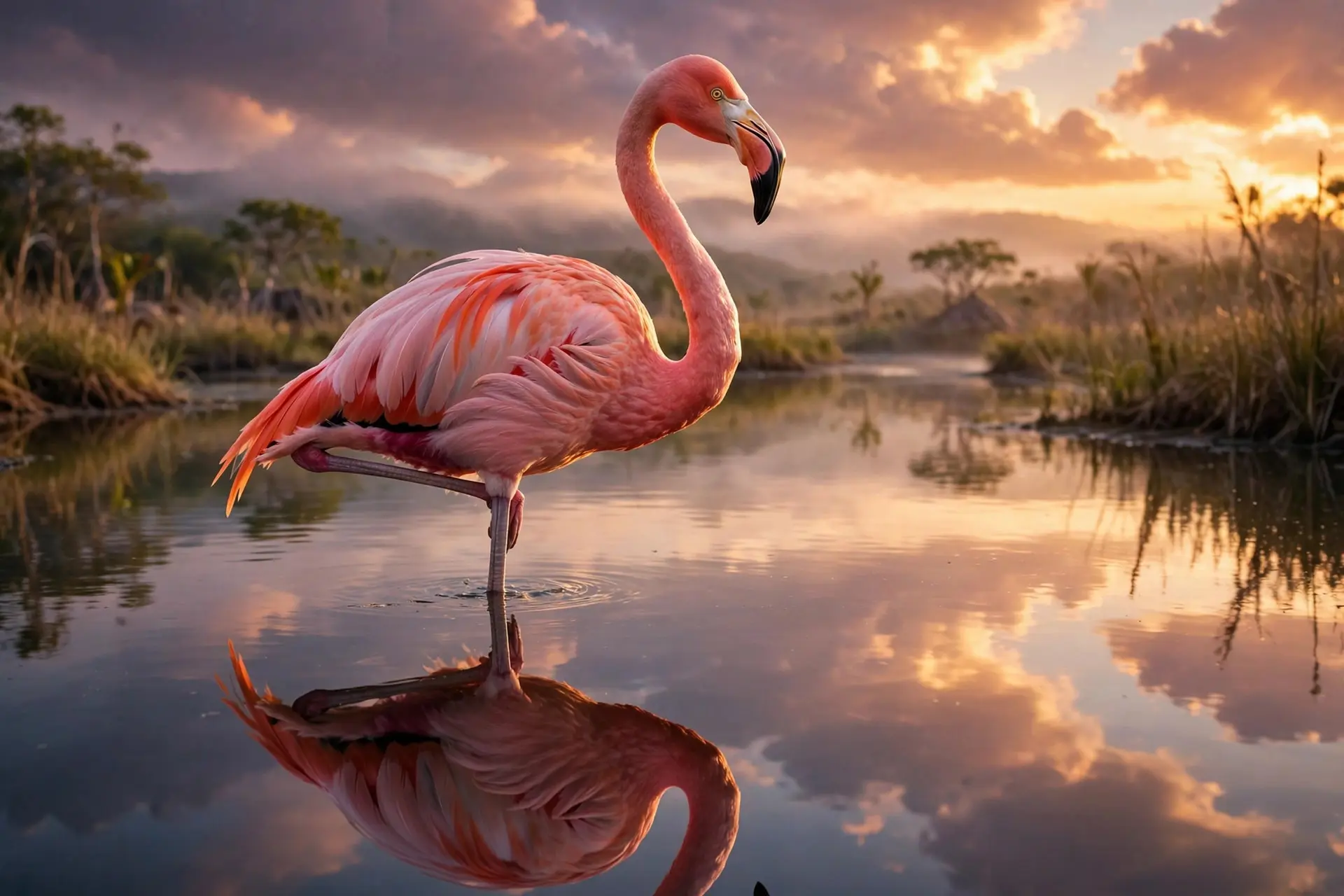
How does it get so warm? Every bird is a small heater, and when hundreds of them press together, the heat has nowhere to escape. The birds on the outer ring take the worst of the wind, shielding everyone inside. But the real saving, according to a 2012 mathematical study of huddling published in PLOS ONE, comes from something simpler: a penguin inside the pack exposes far less of its body to the cold. Each bird's flanks, back and belly are pressed against warm neighbours instead of freezing air, so the total surface losing heat shrinks dramatically. This is the same logic behind why a flamingo stands on one leg to stay warm: exposed surface is the enemy, and anything that hides it saves energy. On the frozen continent these birds call home, that saving is the difference between a hatched chick and a failed breeding season.
How does everyone get a turn in the warm middle?
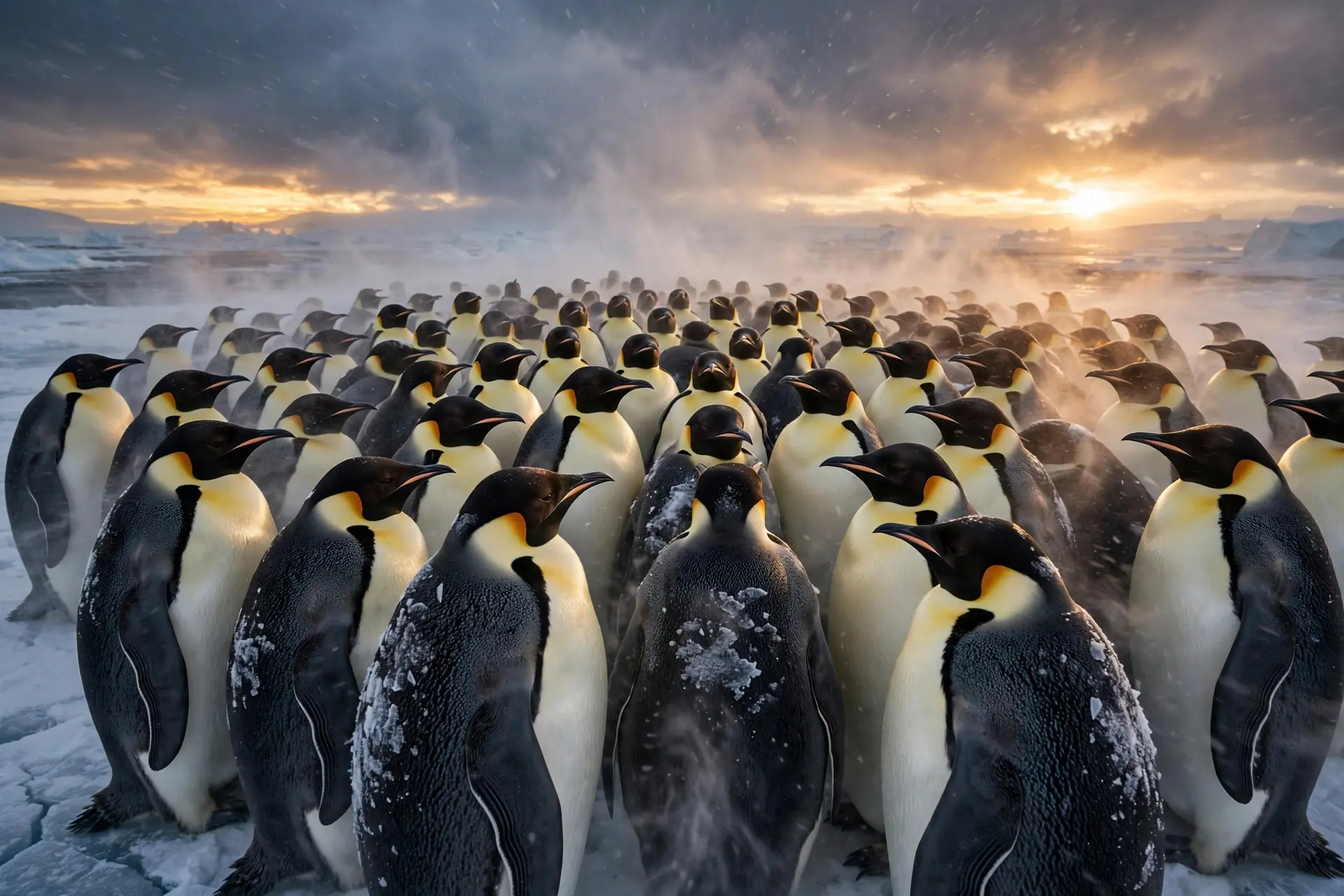
For years, scientists assumed the huddle was a static blob with lucky birds in the center. Time-lapse infrared footage filmed by physicist Daniel Zitterbart and colleagues proved otherwise. The colony mostly stands still — but every 30 to 60 seconds, one bird or a small group shifts slightly, and that tiny movement ripples through the neighbours like a slow wave passing through a crowd. There is no signal, no leader and no pecking order. The cold birds on the windward edge simply press inward toward shelter, each one nudging the bird ahead of it. Bird by bird, the pressure works its way through the mass, and over the course of hours the whole huddle churns: birds that were freezing on the outside drift into the toasty center, and birds that have warmed up drift back out to the edge. The PLOS ONE modeling study found something elegant hiding in this mess of shuffling. If you assume that every penguin cares about nothing but reducing its own heat loss — moving to a sheltered spot when it is cold, staying put when it is warm — the simulation produces exactly the observed behaviour. Selfish moves by hundreds of birds add up to a fair outcome: in the long run, every penguin gets approximately equal access to the warmth. Nobody has to be generous. The physics does the sharing.
Is the huddle a team effort or every bird for itself?
It is both, and that is the point. Researchers who study this call it social thermoregulation: animals actively gathering to borrow one another's warmth when the air turns hostile. Field studies indexed by the UN's food and agriculture research database found that the temperature, the wind and even the sunlight are the main triggers — when conditions worsen, loose groups tighten into dense huddles, and when the sun comes out, birds drift apart to shed heat. The huddle is therefore a pulse, not a permanent formation. It grows and breaks apart over hours as birds join when they need warmth and slip away when they start to overheat. Sometimes a few restless birds can set off a chain reaction that dissolves an entire huddle within minutes, and the colony reorganizes itself somewhere else. That restlessness looks like chaos, but it keeps the system honest: no bird can camp in the warm center forever, because the constant shuffling will not let it. Chicks run their own version of the same program. Once a chick grows too large to ride in its parent's brood pouch, it cannot survive a blizzard alone — yet within days, groups of chicks begin packing into miniature huddles, crèches of downy youngsters that copy the adults' strategy exactly. It may be the only survival technology they ever need to learn — though for sheer hardiness, nothing beats the microscopic tardigrade, an animal that can survive the vacuum of space itself.
Why don't other birds do this?
Most birds simply cannot. A huddle this dense only works because emperor penguins are not tied to fixed nests — they can walk, shuffle and reorganize freely on the open ice. A songbird pinned to its nest, or a seabird defending a cliff ledge, has no such freedom. There is also the matter of scale. An emperor penguin stands about 45 inches tall and can weigh up to 88 pounds, carrying enough fat to fuel a four-month fast. Small bodies lose heat too quickly for huddling alone to save them; large bodies, packed tight, become a shared thermal battery. That is why the huddle belongs to emperors — the biggest of all penguins — and why they are the only birds that dare to raise their young in the middle of an Antarctic winter. So the next time you see that famous photograph of a thousand black-and-white birds packed against a blizzard, look closer. Nothing in that image is standing still. Every one of those birds is quietly working the edge of the crowd, chasing warmth, and — without knowing it — making sure its neighbours get some too. It is teamwork of a kind no team ever planned, built from nothing but cold feet and good physics.
Frequently asked questions
How does huddling keep penguins warm?
Birds on the outside block the wind while body heat accumulates in the center, so a bird inside loses far less heat than one standing alone. The biggest saving comes from reducing how much skin is exposed to the cold.
Do penguins take turns being in the middle of the huddle?
Yes, in effect. Cold birds on the edge keep nudging inward, and time-lapse footage shows the whole mass slowly churning so that every bird cycles between the edge and the warm interior.
How long can emperor penguins survive without eating?
Males incubating the egg can fast for 105 to 115 days, living off their fat reserves through the entire Antarctic winter.