Why Does Ice Float on Water? The Physics Behind It
Ice floats because frozen water expands into an open hexagonal lattice, making it 9% less dense than liquid water. Here is the anomaly that keeps lakes alive.
Key takeaways
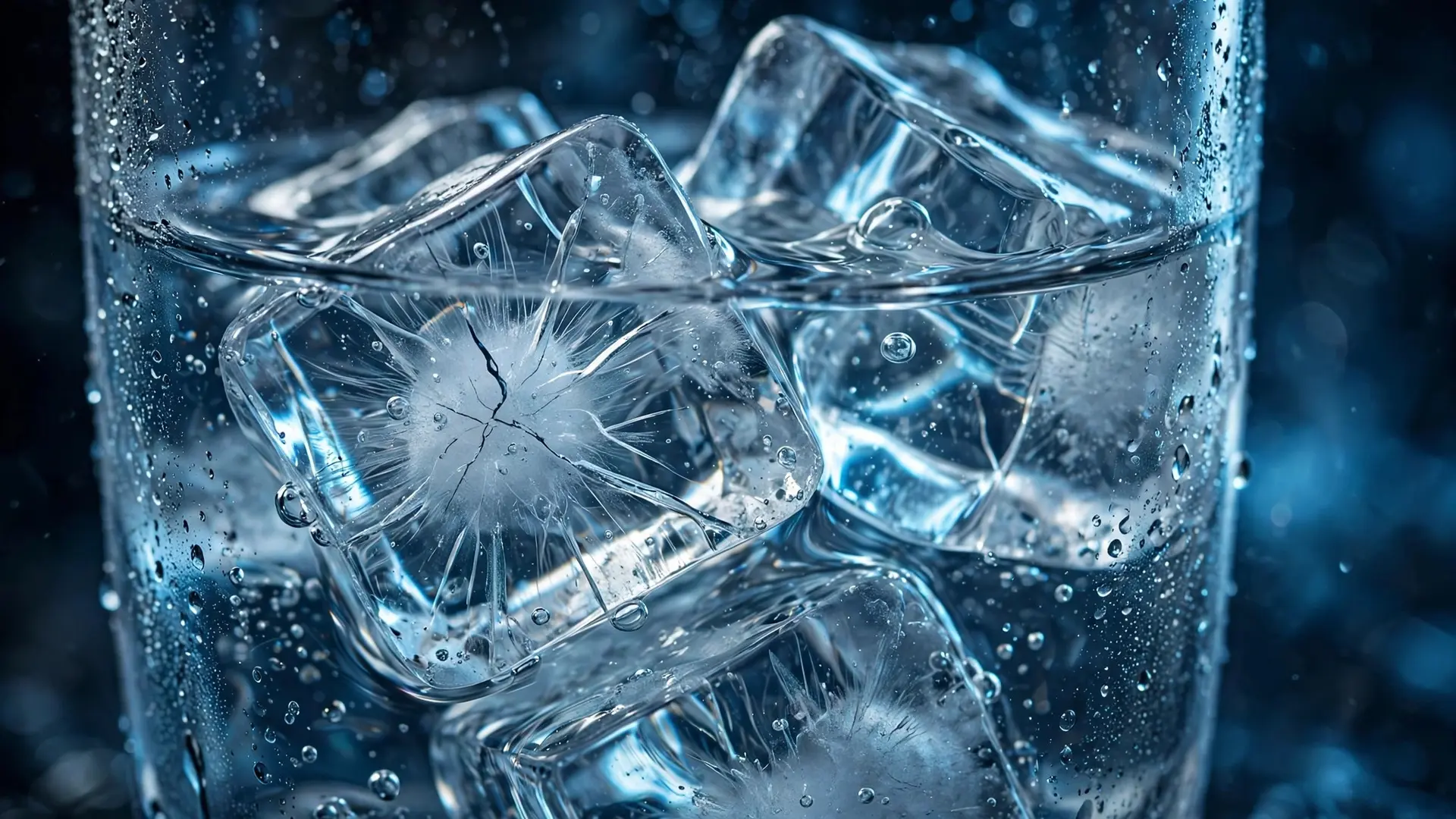
- Ice at 0°C has a density of about 0.917 g/cm³ versus 1.000 g/cm³ for liquid water, so roughly 9% of a floating ice cube rides above the surface.
- Freezing locks water molecules into an open hexagonal lattice held by hydrogen bonds, forcing them farther apart than they sit in liquid water.
- Liquid water reaches its maximum density at about 4°C; cool it further and organized hydrogen bonds make it expand instead of contract.
- Because ice forms on top, frozen lakes insulate the water beneath at around 4°C, letting aquatic life survive the winter.
- Ice is nearly unique among natural solids in floating on its own liquid — the exception that helps make water-based life possible.
Ice floats because it is less dense than the very liquid it formed from — about 9% of a floating ice cube rises above the surface, with the rest hanging below. Almost every other substance in nature does the opposite: it packs tighter, grows denser, and sinks as it freezes. Water breaks the rule, and the reason comes down to the geometry of a single molecule. A water molecule is a tiny bent V: one oxygen atom carrying a slight negative charge, two hydrogen atoms carrying a slight positive one. That lopsided charge makes water molecules "sticky." The positive hydrogen side of one molecule tugs at the negative oxygen side of another, forming a connection chemists call a hydrogen bond. These bonds are constantly forming and snapping in liquid water, and they are the reason ice behaves like nothing else.
What Makes Ice Different From Almost Every Other Solid?
Most liquids shrink as they cool. Their molecules slow down, jostle less, and settle closer together, so the solid that forms is compact and dense — which is why a solid chunk of most metals sinks in its own melt. Water follows this pattern only part of the way down the thermometer. Cool liquid water from room temperature and it contracts, getting steadily denser, until it reaches about 4°C. Then something strange happens: it stops contracting and begins to expand. By the time it reaches 0°C and freezes, the solid takes up roughly 9% more space than the liquid it came from. That 9% is the entire story of floating. Density is just mass divided by volume, so when the same molecules occupy more volume, their density falls. At 0°C, liquid water has a density of approximately 1.000 grams per cubic centimeter, while ice comes in at about 0.917. An object floats whenever it is less dense than the fluid around it, and ice wins that comparison against water — barely, but decisively.
How Do Hydrogen Bonds Force Water Apart?
The expansion is not random; it is architectural. In liquid water, molecules slide past one another in a crowded, disordered crowd. But as the temperature approaches freezing, the hydrogen bonds between molecules grow stable enough to organize the crowd into a fixed pattern. Each water molecule locks to four neighbors in a precise tetrahedral arrangement, and the whole crystal settles into an open hexagonal lattice — the same six-sided symmetry that gives snowflakes their identical signature. That lattice is full of empty space. The molecules are held at set distances by their bonds, unable to squeeze into the gaps the way a disordered liquid can. Same molecules, same mass, larger volume — and therefore lower density. It is a rare case where order makes things fluffier instead of more compact, and water owes it entirely to the odd bond angle of its molecule, which resists packing neatly. The floating itself follows the oldest rule of buoyancy: an object rises when the fluid it displaces weighs more than it does. A kilogram of ice displaces roughly 1.09 kilograms' worth of water's volume, so the water's upward push wins, lifting the ice until only the lighter-than-water surplus peeks above the surface. That is why icebergs hide nine-tenths of their bulk underwater — and why a glass of iced water never spills as the cubes melt, since the displaced water equals exactly the mass that melted.
Why Does Water's Density Peak at 4°C?
The 4°C density maximum is one of water's subtlest tricks, and it drives everything that happens in a freezing lake. Cool a lake through autumn and the surface water grows denser and sinks, churning the lake as it goes. But once the whole lake reaches about 4°C, the behavior flips: further cooling makes surface water less dense, so it stops sinking and stays on top.
That thin, cold top layer is the only part that can reach 0°C and freeze. The ice then forms a cap — and that cap is an insulator. Because ice floats, it blankets the surface instead of piling up on the bottom, trapping the deeper water at a life-friendly 4°C all winter long. Fish, plants, and microbes wait out the cold beneath a roof of ice that exists only because ice refused to sink.
What Would Earth Look Like If Ice Sank?
The counterfactual shows how much depends on this quirk. If ice were denser than water, lakes would freeze from the bottom up. Each winter's ice would sink to the floor and stay there, since sunlight and air could never reach it to melt it. Season after season, ice would accumulate until lakes froze solid — and the aquatic ecosystems in them would not survive. Rivers, ponds, and shallow seas would become seasonally sterile, and the base of many food webs would collapse. The consequences reach the planetary scale. Sea ice covers millions of square kilometers of polar ocean, and because it floats, it forms a bright, reflective lid that bounces solar energy back into space — one of Earth's most important cooling mechanisms. If that ice sank, the dark ocean would absorb far more heat, and the planet's climate would be a different, harsher regime. Even the tides that stir those oceans would be moving water with no floating lid to regulate the exchange of heat between sea and sky. Curiously, the same freezing expansion that saves lakes also cracks them in another way: pipes burst in winter, rocks split along their seams, and engineers must account for water's odd behavior in every cold-climate design. The expansion on freezing is a force — roughly strong enough to shatter stone given enough cycles. Ice floats because water's molecules refuse to pack. That refusal is written into the hydrogen bond — a sticky, bent connection between molecules that, at the moment of freezing, chooses open hexagonal order over dense crowding. The result is a solid lighter than its liquid, a frozen lid on every northern lake, and one of the quiet architectural decisions of nature that made water the stage for life. Next time a cube bobs in your glass, you are watching the exception that keeps the oceans blue and the lakes alive.
Frequently asked questions
How much of an iceberg is above water?
Only about 9% to 10%. Ice has a density of roughly 0.917 g/cm³ compared to 1.000 g/cm³ for liquid water, so most of its mass stays submerged.
Why doesn't water contract when it freezes like most substances?
As water freezes, hydrogen bonds lock molecules into a rigid, open hexagonal lattice full of empty space. That structure takes up more volume than the molecules occupied as a liquid, so the solid ends up less dense.
Is ice the only solid that floats in its own liquid?
It is not the only one, but it is a rare exception. A handful of other substances — including silicon, gallium, and bismuth — also expand on freezing, though none has water's planetary importance.