Why Are Traffic Lights Red, Yellow, and Green?
Traffic lights inherited their colors from 19th-century railroads — where the original 'go' light was white, and it caused enough trouble to be abolished.
Key takeaways
- Railroads used the colors first: white meant go, green meant caution, and red meant stop — roads inherited the scheme.
- White was dropped as 'go' because town lights made white lanterns hard to see, and a fallen colored lens could reveal a deadly false white.
- London's first road signal, built by railway engineer J.P. Knight in December 1868, exploded on January 2, 1869, injuring its operator.
- The first electric signal went up in Cleveland in 1914 with only red and green; Detroit policeman William Potts added the yellow 'caution' light in 1920.
- The federal government standardized the red-yellow-green scheme nationwide in 1935; engineers now debate adding a blue phase for self-driving cars.
The colors weren't chosen for drivers at all — they were inherited from trains. In the 1800s, railroads signaled their engineers with colored lanterns: stop, caution, go. The road simply borrowed the scheme, scars and all. And the reason there is no white traffic light today — even though white was the railroads' original "go" — is that it kept nearly getting people killed.
What did the colors mean on the railroad?
The railway palette started out differently from the one you know. As the Bullock Texas State History Museum explains, early railroad lanterns used white to mean it was safe to proceed, green to signal caution, and red for stop or danger. It was a sensible system on paper. In practice, it had a fatal flaw. The trouble was how the lights were built: plain white bulbs shining through colored glass lenses. If a lens cracked or fell out of its socket, the naked white bulb underneath blazed through — and a signal meant to show red suddenly displayed white, which every engineer read as "go." According to one well-traveled account, stars could even be mistaken for the white lights on dark nights. There are documented collisions blamed on exactly this failure. There was a second, quieter problem: as towns and cities filled up with white light from streetlamps and windows, a white railroad lantern simply became hard to see against the glow. So the railroads rewrote the code. Green was promoted to mean "proceed," and a new color — yellow, sometimes orange — was introduced for caution. Red, the danger color with the longest wavelength in visible light, kept its job: it can be seen from farther away than any other color, which is exactly what you want from a stop signal. Why red for danger in the first place? Partly convention, partly physics. Red has long been the human shorthand for peril, and its long wavelength means it scatters less in fog and dust — the same reason sunsets glow red, and part of the same light physics that paints rainbows across the sky. That combination made it the natural choice for the one signal nobody could afford to miss.
Why did London build a traffic light before cars existed?
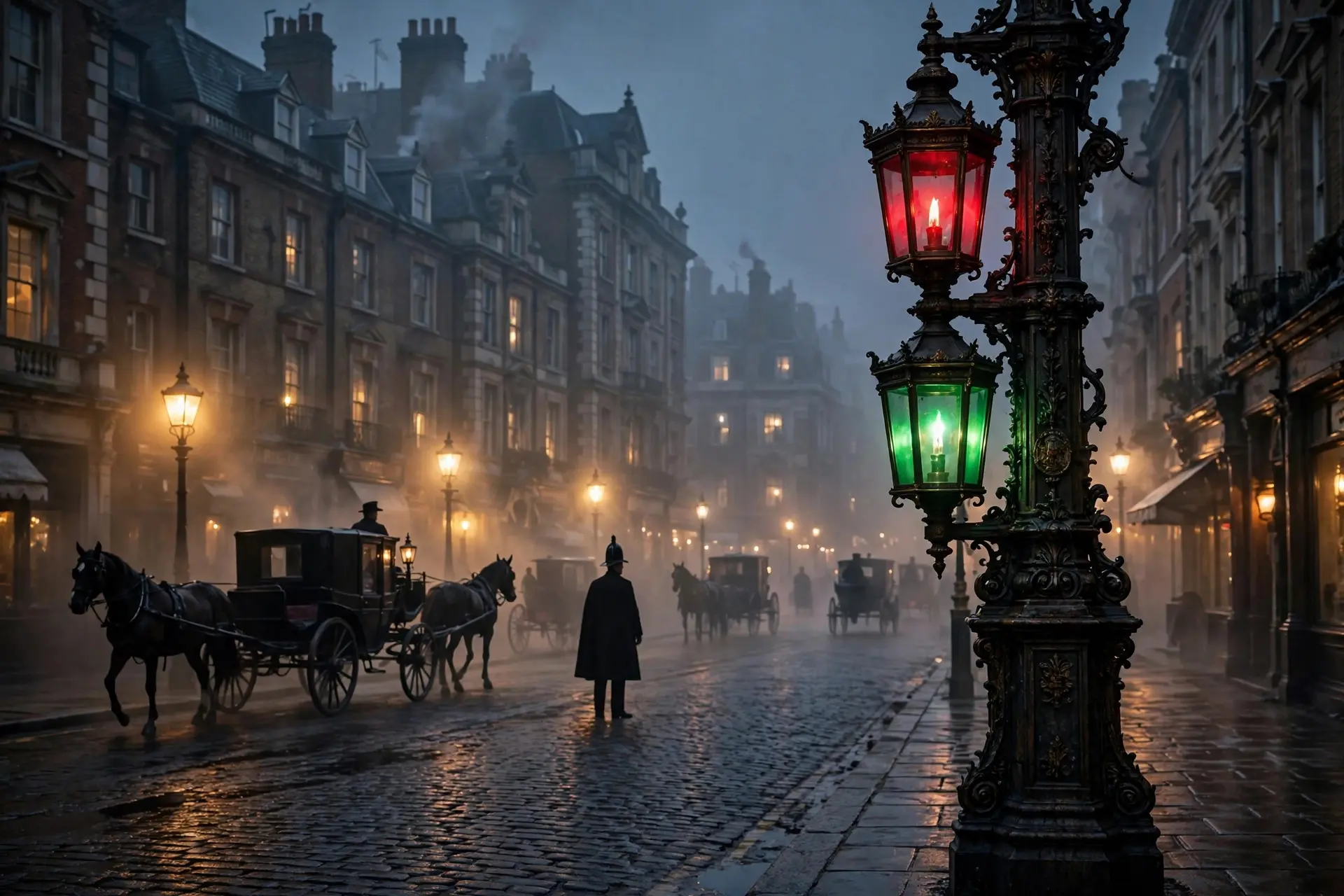
Because the traffic was made of horses. By the 1860s, the streets around Westminster Bridge in London were choked with horse-drawn carriages, and pedestrians — including members of Parliament hurrying to vote — had to thread through the chaos on Bridge Street. The railway manager John Peake Knight, a Nottingham railway engineer, proposed a solution borrowed from his own industry: a tall signal post with semaphore arms that a police constable would raise and lower, with red and green gas lamps for use after dark. In December 1868 the device went up outside the Houses of Parliament, built by the railway signal engineers Saxby & Farmer. It stood about 22 feet high. By day, the constable worked the arms — horizontal meant stop, lowered to an angle meant proceed with caution. By night he turned a gas lantern with a lever at the pillar's base so the right color faced traffic: red for stop, green for caution. It lasted less than a month. On 2 January 1869, leaking gas exploded, injuring the policeman operating the signal, and the contraption was taken down. London wouldn't see traffic lights again for more than half a century. The idea, though, had been planted — and it crossed the Atlantic.
How did America get the electric version?
The second act opened in the American West. In 1912, Lester Wire, a policeman in Salt Lake City, designed the first electric traffic light — a red-and-green device. On 5 August 1914, the American Traffic Signal Company installed it at the corner of East 105th Street and Euclid Avenue in Cleveland, Ohio, based on a design by James Hoge that tapped into the streetcar power lines. It had only two colors. To warn drivers that a change was coming, officers simply blew a whistle. The years that followed were a Cambrian explosion of signal designs. In 1917, Salt Lake City linked six intersections to a single manual switch — the first interconnected system. In 1920, Los Angeles mounted Acme signals on Broadway that paired "Stop" and "Go" semaphore arms with small red and green lights and bells that rang just before the flags flipped. And Paris had tried its own contraption back in 1912: a revolving metal box on a tower with "Stop" painted in red and "Go" in white.
Where did the yellow light come from?
From a Detroit policeman who thought two colors weren't enough. In 1920, William Potts — Superintendent of Signals for the Detroit Police Department — built the first four-way, three-color traffic light, adding an amber light to warn drivers that red was on its way. The following year he installed automatic four-way, three-color signals in fifteen towers across Detroit, making it the first city to run the full red-yellow-green system. Others kept tinkering. In 1923, the inventor Garrett Morgan patented an electric signal with a distinctive warning position; General Electric bought the rights for $40,000. In 1928, Charles Adler Jr. built a signal in Baltimore that changed when drivers honked their horns into a microphone on the pole, and a year later he added the first pedestrian push button. By 1935 the experimentation ended at the federal level: the government's manual on uniform traffic control devices mandated the red-yellow-green scheme nationwide, locking in the colors every American driver learns as a teenager. Even standardization couldn't stop local rebellions. In Syracuse, New York, in the 1920s, residents of the heavily Irish Tipperary Hill neighborhood kept smashing a new traffic light because it placed British red above Irish green. The city eventually relented and hung the light upside down — green on top — and it remains flipped to this day.
Why has the system barely changed since?
Because it works, and because every change has to be learned by millions of drivers at once. The upgrades since 1935 have been about brains, not colors: pressure plates in the 1950s let signals detect waiting cars, computers took over timing in the 1960s, and countdown timers for pedestrians arrived in the 1990s. But the next color may already be coming. As connected and self-driving vehicles learn to talk to intersections, traffic researchers have proposed adding a blue phase — a signal telling human drivers to simply follow the vehicle ahead while the automated system choreographs the flow. The intelligence to run such signals is the same edge computing already being woven into smart cities. If blue happens, it will be the first new traffic-light color in a century — and like the original three, it will arrive to solve a problem the old colors can't. So the next time you're sitting at a red light, remember: you're obeying a railway lantern. The colors were picked for steam locomotives, debugged by explosions and falling lenses, and standardized by a government manual — a 19th-century solution still directing 21st-century traffic, because nobody has found a better language for telling strangers when to stop. It belongs to that curious family of conventions nobody voted for but everybody follows, like the 10:10 frozen on every watch advertisement.
Frequently asked questions
Why is red the 'stop' color?
Red was the railroads' danger signal long before cars existed, and it has a physical edge: it has the longest wavelength of visible light, so it cuts through fog and haze and stays visible from the greatest distance.
Why isn't there a white traffic light?
There used to be one — on railways, white meant go. But white lanterns became hard to pick out among town lights, and if a colored lens fell off a signal, the bare white bulb underneath could flash a false 'go.' Railroads replaced it with green.
When were traffic lights invented?
The first road signal was installed outside London's Houses of Parliament in December 1868, but it was gas-lit and exploded within weeks. The first electric one appeared in Cleveland, Ohio, in August 1914.
Who invented the yellow light?
Detroit police officer William Potts, who in 1920 built the first four-way, three-color signal and added an amber light to warn drivers that red was coming.