How Did Petra's Builders Bring Water to the Desert?
Nabataean builders gave Petra water in a near-rainless desert with dams, rock-cut channels, clay pipes, and hundreds of cisterns — here's how it worked.
Key takeaways
- Petra's Nabataean builders fed 20,000 to 30,000 people in a basin receiving less than six inches of rain a year.
- A two-sided water system in the Siq carried spring water on clay pipes while flash-flood barriers kept the gorge safe.
- Hundreds of plaster-lined, roofed cisterns banked winter rain, with settling basins keeping sediment out of the supply.
- The core waterworks were Nabataean, built in the last decades of the 1st century BC — before Rome took over.
Petra's Nabataean builders solved a problem that should have made their city impossible: they sustained a capital of 20,000 to 30,000 people in a sandstone basin that receives less than six inches of rain a year. They did it with a complete water system — dams that tamed flash floods, channels and clay pipes that carried spring water for miles, and hundreds of rock-cut cisterns that banked winter rain for the dry summer. The real achievement was not any single invention but the way capture, storage, delivery, and flood defense were designed as one connected machine.
Two Problems, One System
Petra faced two opposite water crises at once. On most days of the year there was far too little water to support a city; but when winter storms arrived, the wadis could deliver far too much, all at once. A single narrow gorge, the Siq, funnels runoff straight toward the city center, so a storm over the hills could send a wall of water through the main entrance and destroy everything the Nabataeans had carved. The Nabataean answer was to treat collection, transport, storage, and flood diversion as different jobs done by different structures working together. Dams and catchment walls intercepted storm runoff before it could tear through the city. Channels cut into rock moved spring water across the landscape. Ceramic pipes delivered it to buildings and homes. And underground cisterns stored the surplus of the wet months so the city could drink through the dry ones. Archaeologist Craig Harvey of Western University, who has worked on Nabataean sites for over a decade, describes them as masters of hydraulic engineering — builders of dams, catchment systems, underground cisterns, and aqueducts, designed to collect as much winter rain as possible and lose as little as possible to evaporation in summer.
From the Spring to the City
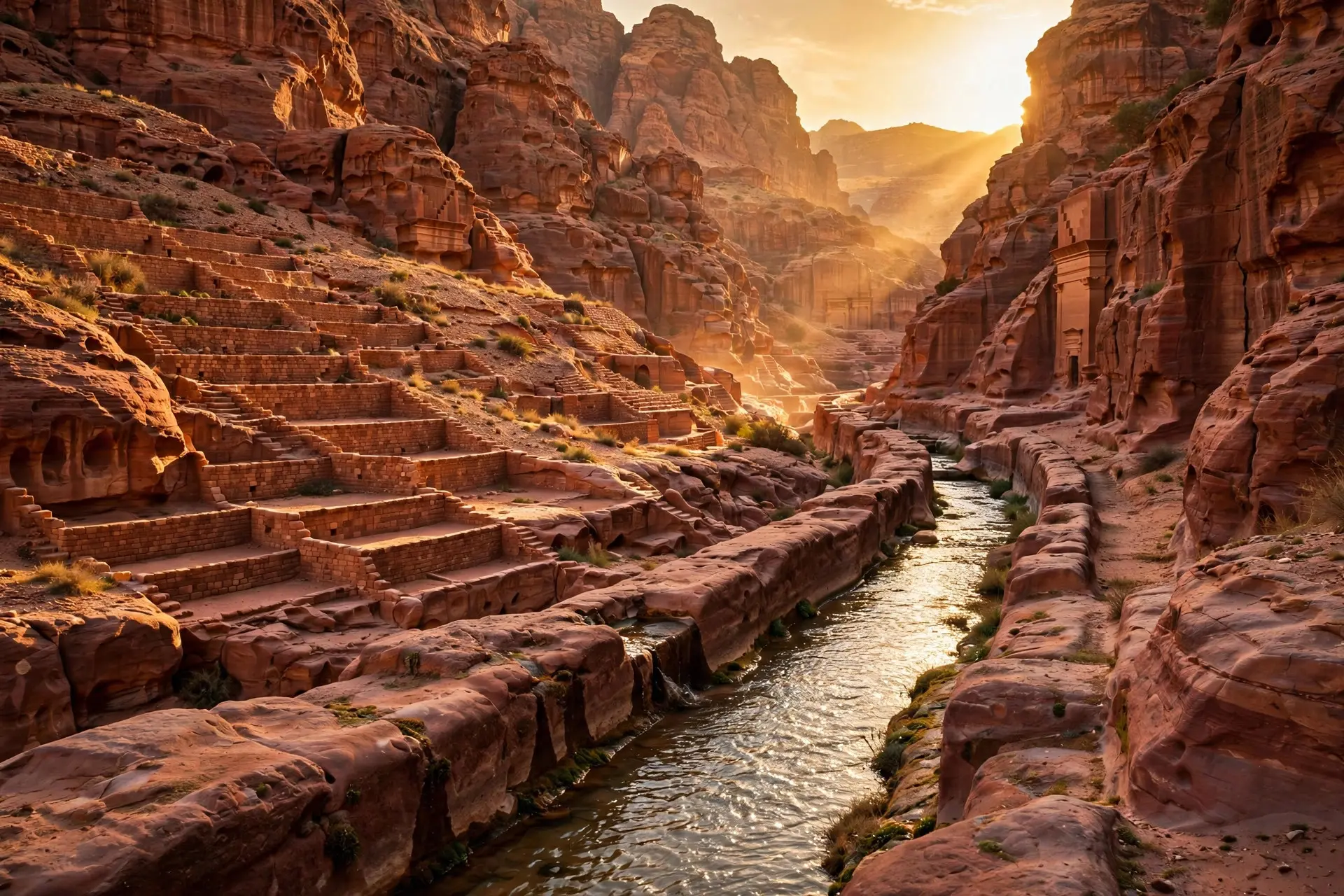
The most visible part of the system runs through the Siq itself. Along both walls of the 1.2-kilometre gorge you can still see the remains of conduits that once carried water into the city — built in the final decades of the first century BC, at the same time as the Siq's flash-flood defenses and its paved road. The two sides did different jobs.
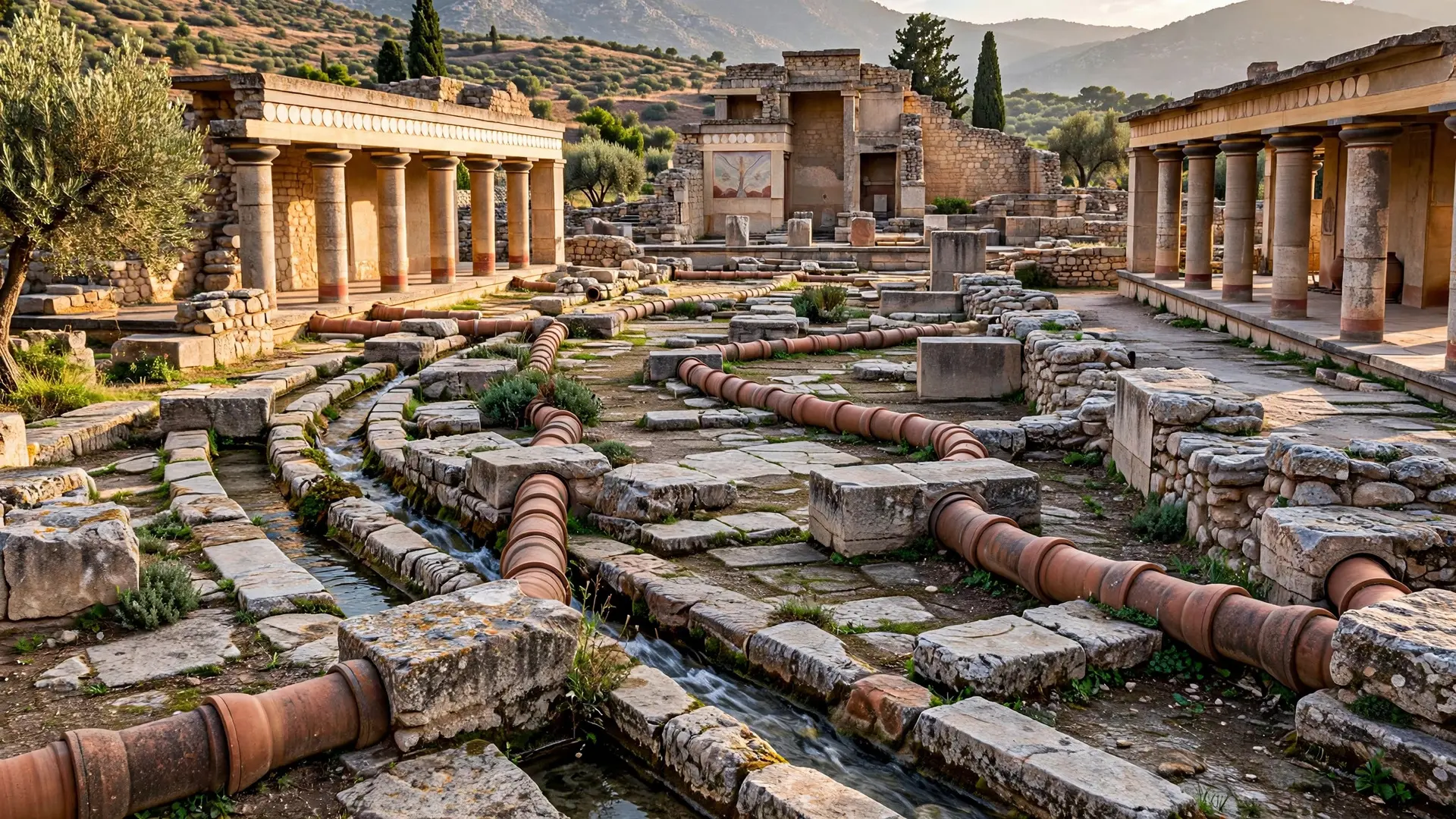
On the northern side ran a pipeline of earthenware clay tubes, carrying drinking water from the Ain Musa — the Moses spring — at the edge of today's Wadi Musa all the way to the ancient city. On the southern side, a channel cut into the rock face carried another stream, covered with stone slabs to keep it clean. At intervals along the way, settling tanks calmed the flow and let lime and silt fall out of the water before it continued. From at least four wells along the route, travelers could drink directly. Covered channels like these also delivered water from the springs straight into Petra's city center. The pipe technology was more sophisticated than it sounds. The Petra Museum dates the arrival of long terracotta pipes to the 1st century BC and notes their practical advantages: sealed pipes lose less water to evaporation, stay cleaner than open channels, and distribute water more efficiently. Their joints were sealed with hydraulic lime mortar, and engineering studies of the network have found that the pipe layouts were arranged to hold a steady flow — the designers understood pressure and gradient well enough to keep the lines neither bursting nor running dry. Similar gravity-fed systems carried Rome's own drinking water across the empire, and the Nabataeans were solving the same physics with the same seriousness. South of Petra, at the settlement of Hawara — modern Humayma — Canadian archaeologists documented a system still working today. Catchment walls directed rainwater runoff into large roofed cisterns that held it through the dry season; the roofs cut evaporation, and settling basins trapped sediment before the water entered storage. A 26.5-kilometre spring-fed aqueduct also fed the settlement, and much of this ancient system remains in use.
Banking Rain in the Rock
Springs could not carry the whole city, so the Nabataeans also harvested the rain itself. Hundreds of cisterns were cut directly into Petra's rock to capture rainfall and hold it through the dry months. Deep and plaster-lined to keep water from seeping away, they were roofed or covered where possible so the desert sun could not steal what the winter had delivered. On the hillsides around the city, terraces absorbed runoff, slowing floods while feeding small plots of agriculture. Engineer Charles Ortloff's 2005 study of the network in the Cambridge Archaeological Journal interpreted it as a deliberately coordinated design: settling basins removed suspended particles, reservoirs balanced storage against continuous supply, and the pipe arrangements kept flows stable. Water management was not improvised, it was planned — the speed of the water, the sediment it carried, and the reliability of its delivery were all controlled. And the Nabataeans were not shy about their success. The system worked so well that they built open-air pools and monumental fountains in the middle of a desert city — conspicuous displays of wealth and power that told every visitor: we have water to spare. Their mastery of stone without mortar is the famous half of the Nabataean story; this quiet plumbing is the half that actually kept people alive.
The Misconception: Rome Gets the Credit
It is tempting to assume the Romans built all this. Rome annexed the Nabataean kingdom in 106 CE under Trajan, folded it into the province of Arabia Petraea, and Petra kept flourishing under Roman rule for another century. But the core waterworks predate the annexation: the Siq's conduits, dams, and flood defenses were laid down in the last decades of the 1st century BC, by Nabataean hands, roughly a hundred years before Rome took over. Time eventually broke the system. A severe earthquake in 363 CE devastated Petra, destroying much of the infrastructure in the Siq — and the telltale detail is that afterward, only the water channel was repaired. Even in a damaged city, water came first. Petra faded gradually as trade routes shifted and earthquakes struck, but its engineering did not die with it: efforts are now underway to revitalize Nabataean water-management systems around Petra for flood control and agriculture, because the principles still work. The Nabataeans built their city to store the sky. Every winter, they banked the rain in stone; every summer, they withdrew it. Two thousand years later, in a world getting hotter and drier, that is starting to look less like archaeology and more like a lesson.
Frequently asked questions
Where did Petra's water come from?
From two places: springs in the surrounding highlands, including the Ain Musa (Moses spring) near Wadi Musa, and the rain itself. Spring water traveled to the city through rock-cut channels and clay-pipe pipelines, while dams, catchments, and hundreds of cisterns captured and stored winter rainfall for the dry months.
Did the Romans build Petra's water system?
No — the core system was Nabataean. The conduits, dams, and flood defenses in the Siq were built in the final decades of the first century BC, roughly a century before Rome annexed the Nabataean kingdom in 106 CE. Roman-era additions came later, but the engineering was already there.
Does any of Petra's water system still work?
Yes, at least outside the city itself. At Hawara, the Nabataean-era settlement of Humayma south of Petra, much of the ancient water supply system — roofed cisterns, settling basins, and a 26.5-kilometre spring-fed aqueduct — is still in use today, and efforts are underway to revitalize old systems around Petra.
Sources
- Expert Insights: Ancient techniques may help mitigate effects of Prairie drought, Western University
- Water supply channels and pipes in the Siq, Petra, Art Destination Jordan (universes.art)
- Petra: How the Nabataeans Built a Desert City, Presda
- Petra: The Rose City, Ancient Origins
- Petra & the Nabataean Civilization, Jordan Private Tours
- The Nabataeans: How the Masters of the Desert Built the Rose-Red City of Petra, The Archaeologist