How Penicillin Works, and Why Bacteria Fight Back
Penicillin kills bacteria by jamming the enzymes that build their walls. Why it spares human cells, how resistance spread and why most allergy labels are wrong.
Key takeaways
- Penicillin's beta-lactam ring disables the penicillin-binding proteins that cross-link a bacterium's peptidoglycan wall, so growing cells build weak walls that give way.
- Human cells have no cell wall, so the drug has nothing comparable to attack in the body, and it only affects bacteria that are actively growing.
- Penicillin G is broken down by stomach acid and must be injected, while acid-resistant penicillin V is taken by mouth; both remain first-line treatments for strep throat.
- Bacteria resist with beta-lactamase enzymes that destroy the drug or, like MRSA, with an extra penicillin-binding protein encoded by the mecA gene.
- About 10% of US patients report a penicillin allergy, but the CDC says fewer than 1% of people actually have the allergy, and testing can remove most labels safely.
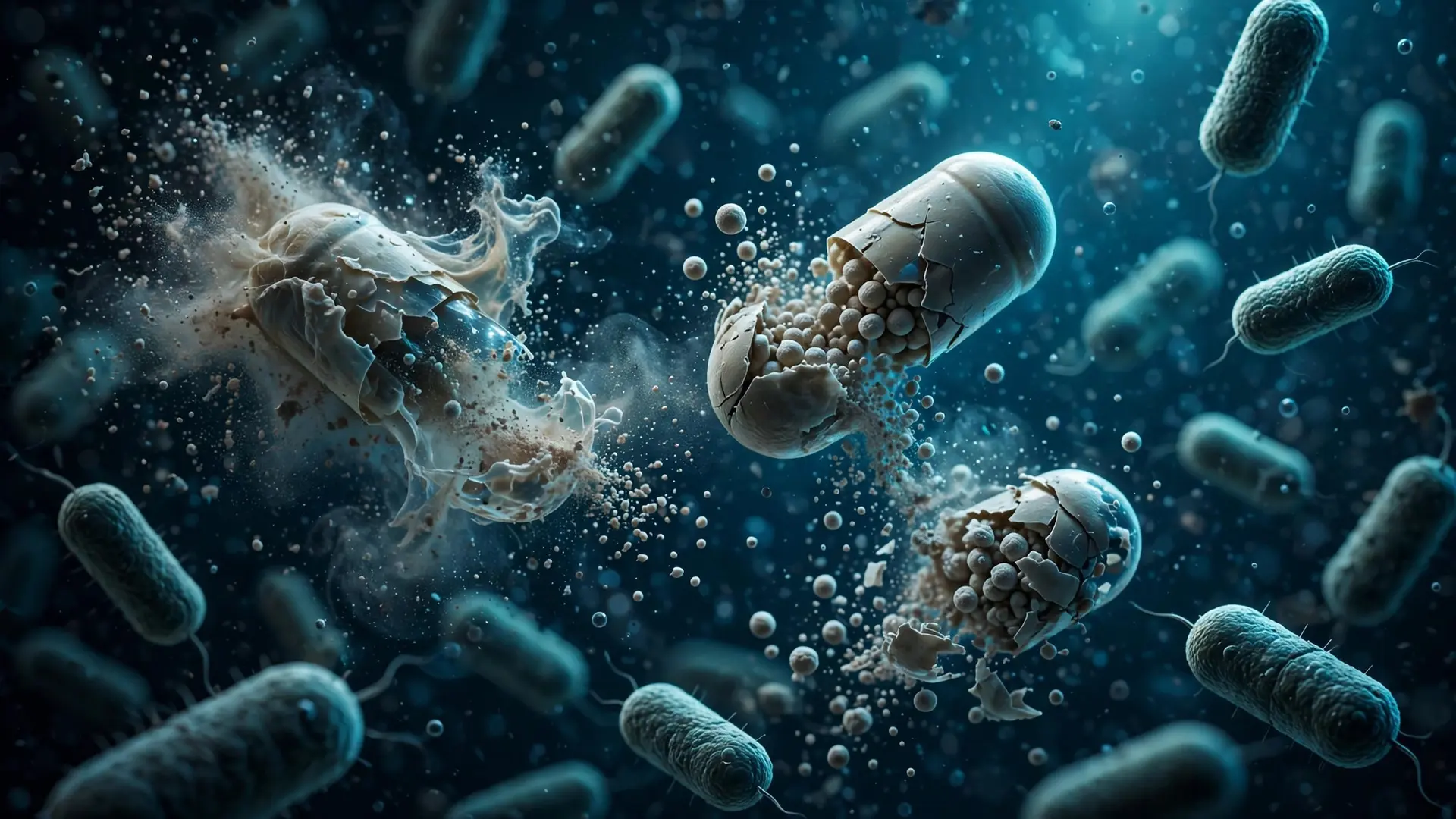
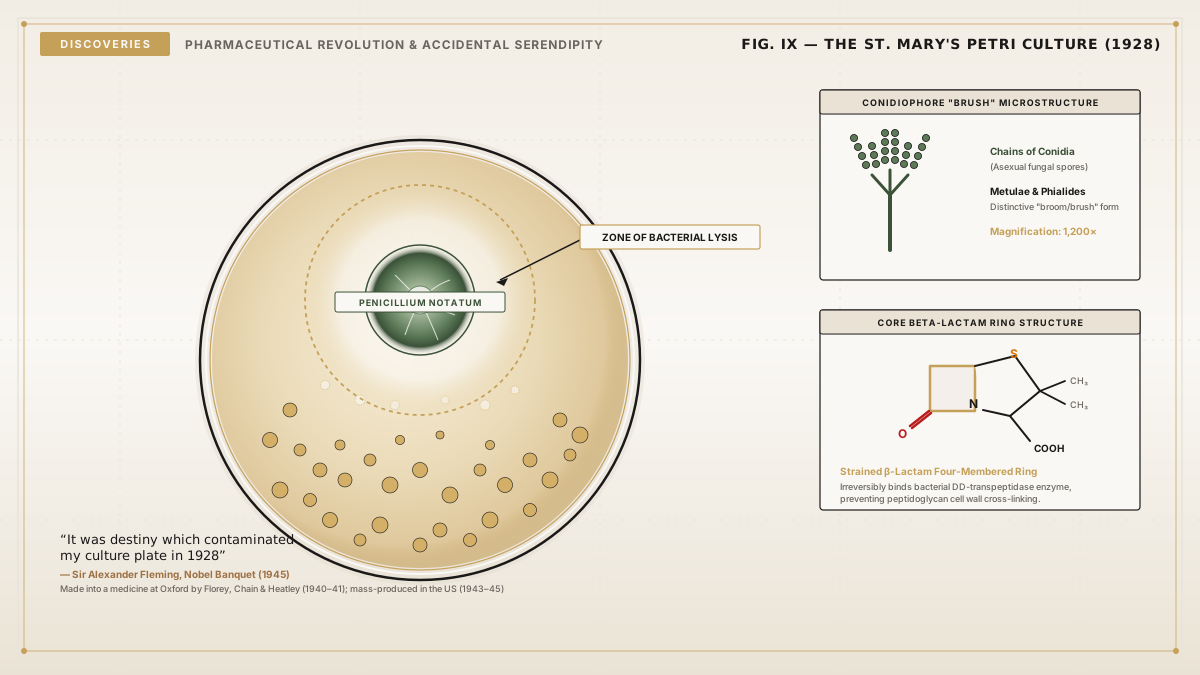
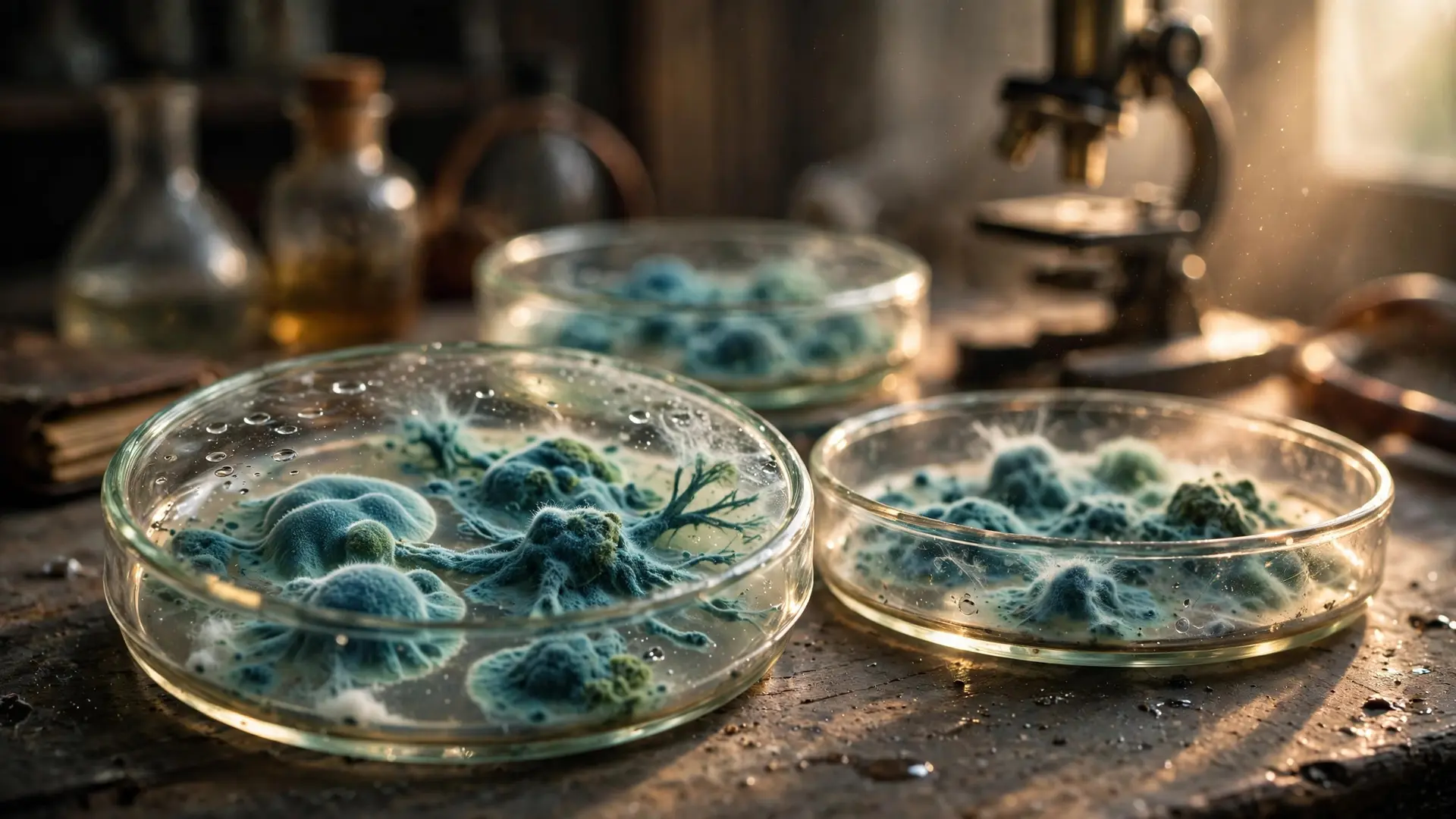
Penicillin kills bacteria by wrecking the wall that holds them together. Its molecule carries a small, strained ring of four atoms, the beta-lactam ring, which jams the enzymes bacteria use to cross-link their cell walls, so a growing cell lays down a wall full of weak points until it gives way. Human cells have no such wall, which is why the drug can be deadly to bacteria and largely harmless to the patient taking it. The discovery story, from Alexander Fleming's contaminated culture plate in 1928 to the Oxford team that turned his mold extract into a medicine, is told in our history of penicillin's accidental spore. The drug arrived a few generations after germ theory had pinned infectious disease on microbes. This article is about the drug itself: what it does inside an infection, why it works brilliantly against some bacteria and barely touches others, and why so many people who think they are allergic to it are not.
How does penicillin break a bacterium's wall?
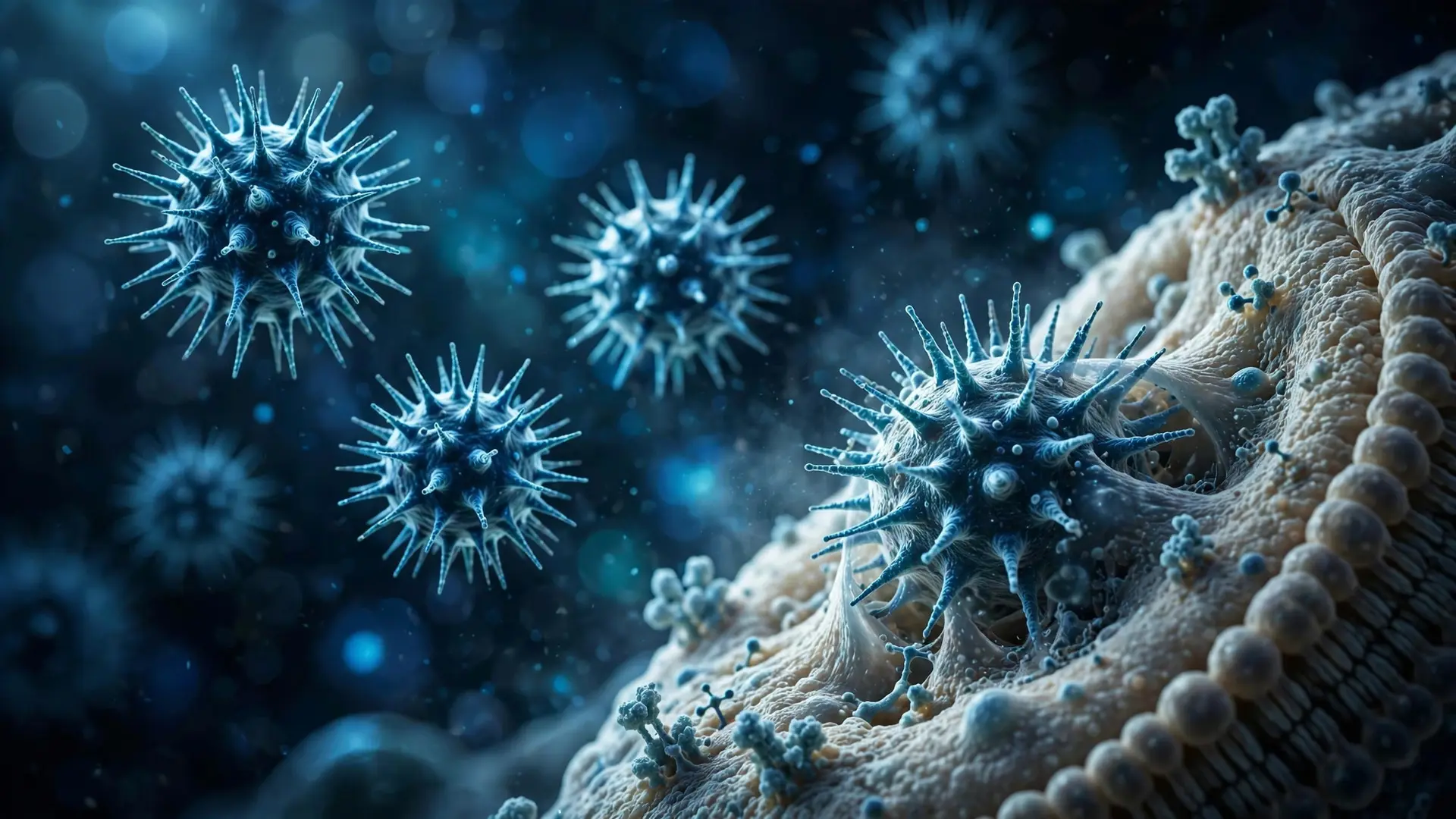
Most bacteria live under pressure. Their insides are crowded with dissolved material that draws water in, and the only thing stopping them from swelling until they burst is the cell wall, a mesh made of peptidoglycan. Long sugar chains run through it, and short peptide bridges tie neighboring chains together, the way rungs stiffen a ladder. That final tying step, the cross-linking, is carried out by enzymes called transpeptidases, members of a family known as penicillin-binding proteins. The beta-lactam ring is shaped like the end of the peptide those enzymes normally grab. An enzyme latches on to penicillin instead, the strained ring springs open, and the drug ends up bonded to the enzyme's active site, leaving it permanently disabled. A bacterium that keeps growing keeps adding wall material that never gets properly stitched together. Penicillins also stir up the cell's own wall-dismantling enzymes, and the weakened wall eventually fails. Two consequences follow. Penicillin only works on bacteria that are actively multiplying and building new wall, so it does little to cells that are not growing. And because human cells lack a cell wall altogether, the body offers nothing equivalent for the drug to hit. The exact architecture behind all this was worked out by Dorothy Crowfoot Hodgkin, who used X-ray crystallography to solve the structure of penicillin in the mid-1940s.
Why does it work on some bacteria but not others?
Bacteria come in two broad builds, named after how they react to the Gram stain used in microbiology labs. Gram-positive species, such as streptococci, wear a thick, exposed peptidoglycan wall, which makes an easy target. Gram-negative species, such as E. coli and Klebsiella, keep a thin wall behind an extra outer membrane, and many of them are naturally resistant to beta-lactam drugs. That is why the original penicillin G counts as a narrow-spectrum antibiotic that acts mainly on Gram-positive bacteria. Some of its oldest targets remain firmly within range. The US Centers for Disease Control and Prevention (CDC) says no sample of group A strep, the bacterium behind strep throat, taken from a patient has ever been found to resist penicillin, and penicillin or amoxicillin remains the treatment of choice. Syphilis is another long-standing target: the CDC's recommended treatment for adults with primary or secondary syphilis is a single injection of benzathine penicillin G, and pregnant patients who are allergic to penicillin are desensitized so they can still receive it. Chemists widened the net by altering 6-aminopenicillanic acid, the core structure that all penicillins share. That produced semisynthetic broad-spectrum versions such as ampicillin and amoxicillin, which also reach some Gram-negative rods and are used, for example, against urinary tract infections.
What is the difference between penicillin G and penicillin V?
Only two of the naturally occurring penicillins are still used in clinics. Penicillin G, also called benzylpenicillin, fares badly in stomach acid, which destroys much of a swallowed dose, so it is given by injection instead. Penicillin V, or phenoxymethylpenicillin, stands up to stomach acid better and is taken by mouth. For strep throat, the CDC lists both among the first-line options: a 10-day course of oral penicillin V, or a single intramuscular injection of benzathine penicillin G.
How did bacteria learn to fight back?
The most common defense is an enzyme. Beta-lactamases, also called penicillinases, cut open the beta-lactam ring, leaving a molecule that can no longer disable its target. Staphylococcus became notorious for this trick, and drug makers answered with penicillinase-resistant penicillins such as methicillin, oxacillin and cloxacillin.
Staphylococcus adapted again. Methicillin-resistant Staphylococcus aureus, or MRSA, appeared in the early 1960s, soon after doctors began using methicillin. Instead of shielding itself, it changed the target. MRSA acquired a gene called mecA from a distantly related species, and that gene makes an extra penicillin-binding protein that keeps the wall-building going even with the drug present. Methicillin itself has since been retired. MRSA has not: the CDC estimates that in 2017 it caused some 323,700 infections among hospitalized patients and 10,600 deaths in the United States. Medicine has a countermove of its own. Pairing a penicillin with a beta-lactamase inhibitor, such as clavulanic acid, dramatically improves its performance against bacteria that make the enzyme.
Are you really allergic to penicillin?
Probably not. According to the CDC, about 10% of US patients say they have reacted badly to a penicillin-family drug, yet fewer than 1% of people actually have the allergy. The American Academy of Allergy, Asthma & Immunology puts it more bluntly: more than 90% of people carrying the label may not be allergic at all. Many reported reactions were never the classic IgE-mediated allergy in the first place, and even genuine allergy tends to fade. The CDC estimates that roughly 80% of people with a true, IgE-mediated penicillin allergy are no longer allergic after 10 years. The label is not harmless. Patients flagged as allergic tend to be given broader-spectrum alternatives, which the CDC links to higher healthcare costs, a greater risk of antibiotic resistance and less effective treatment. Checking is usually straightforward with an allergist. A skin test uses a penicillin derivative alongside penicillin G itself; if it is negative, it is normally followed by a supervised dose of amoxicillin by mouth, and the two steps together rule out IgE-mediated allergy with close to 100% reliability. Some low-risk patients can skip the skin test and go straight to the supervised dose. People who have had severe reactions such as Stevens-Johnson syndrome are not candidates and should keep avoiding the drug. Penicillin has been in medical use for more than 80 years, and its central trick has not changed: a small, strained ring that bacteria mistake for part of their own building kit. What has changed is the opposition. Defenseless microbes such as group A strep keep it on the front line, the ones that learned to cut the ring or swap the target keep chemists busy, and the most common obstacle to using it may now be an allergy note in a medical record that was never true.
Frequently asked questions
How does penicillin kill bacteria?
It disables the penicillin-binding proteins that cross-link the peptidoglycan in bacterial cell walls. Growing bacteria end up with weakened walls that give way, while human cells, which have no walls, are unaffected.
Why is penicillin G injected while penicillin V is taken by mouth?
Penicillin G is unstable in acid, so much of a swallowed dose would be destroyed in the stomach. Penicillin V resists stomach acid better, so it works as an oral drug.
Is a penicillin allergy permanent?
Often not. The CDC says roughly 80% of people with an IgE-mediated penicillin allergy lose their sensitivity within 10 years, and fewer than 1% of the population is truly allergic even though about 10% of US patients report it.
What is MRSA?
Methicillin-resistant Staphylococcus aureus, first isolated in the early 1960s. It carries the mecA gene, which makes an extra penicillin-binding protein that keeps building the cell wall when penicillin-type drugs are present.
Sources
- Penicillin Allergy Fact Sheet, Centers for Disease Control and Prevention
- Penicillin, StatPearls
- Clinical Guidance for Group A Streptococcal Pharyngitis, Centers for Disease Control and Prevention
- Syphilis - STI Treatment Guidelines, Centers for Disease Control and Prevention
- CDC's 2019 Antibiotic Resistance Threats Report: Methicillin-resistant Staphylococcus aureus (S. aureus) (MRSA), Centers for Disease Control and Prevention
- The Nobel Prize in Chemistry 1964 - Perspectives: Enhancing X-ray vision, Nobel Prize