What Is the Most Remote Island in the Pacific Ocean?
Pitcairn Island sits 2,170 km from Tahiti, has 35 residents and no airport. What makes it the most remote inhabited island in the Pacific Ocean?
Key takeaways
- Pitcairn Island lies 2,170 km (1,350 miles) southeast of Tahiti, and its nearest inhabited neighbor is a roughly 32-hour sail away.
- Only 35 people lived on Pitcairn in 2023, all in the single settlement of Adamstown.
- The island has no airport, and its only supply ship carries at most 12 passengers on 26 voyages a year from Mangareva.
- Pitcairn sits at the center of an 842,000 sq km marine reserve, one of the largest fully protected ocean areas on Earth.
- Its people descend from nine HMS Bounty mutineers and 18 Polynesians who settled the island in 1790.
Pitcairn Island is the most remote inhabited island in the Pacific Ocean. Its nearest inhabited neighbor, Mangareva, is a roughly 32-hour sail away, there is no airport, and only 35 people lived there in 2023, all in one small settlement above Bounty Bay.
- Pitcairn lies 2,170 km (1,350 miles) southeast of Tahiti, in the south-central Pacific Ocean. Britannica
- Only 35 people lived on Pitcairn in 2023, all in Adamstown, the island's single settlement. United Nations
- The island has no airport, and its only supply ship, the MV Silver Supporter, carries at most 12 fare-paying passengers. Far and Away Adventures
- The ship makes 26 trips a year to Mangareva, in the Gambier Islands of French Polynesia, and 4 trips a year to New Zealand. United Nations
- Pitcairn sits at the center of a marine protected area of 842,000 sq km (325,000 sq miles), the world's third-largest fully protected contiguous marine reserve. United Nations
How remote is Pitcairn, exactly?
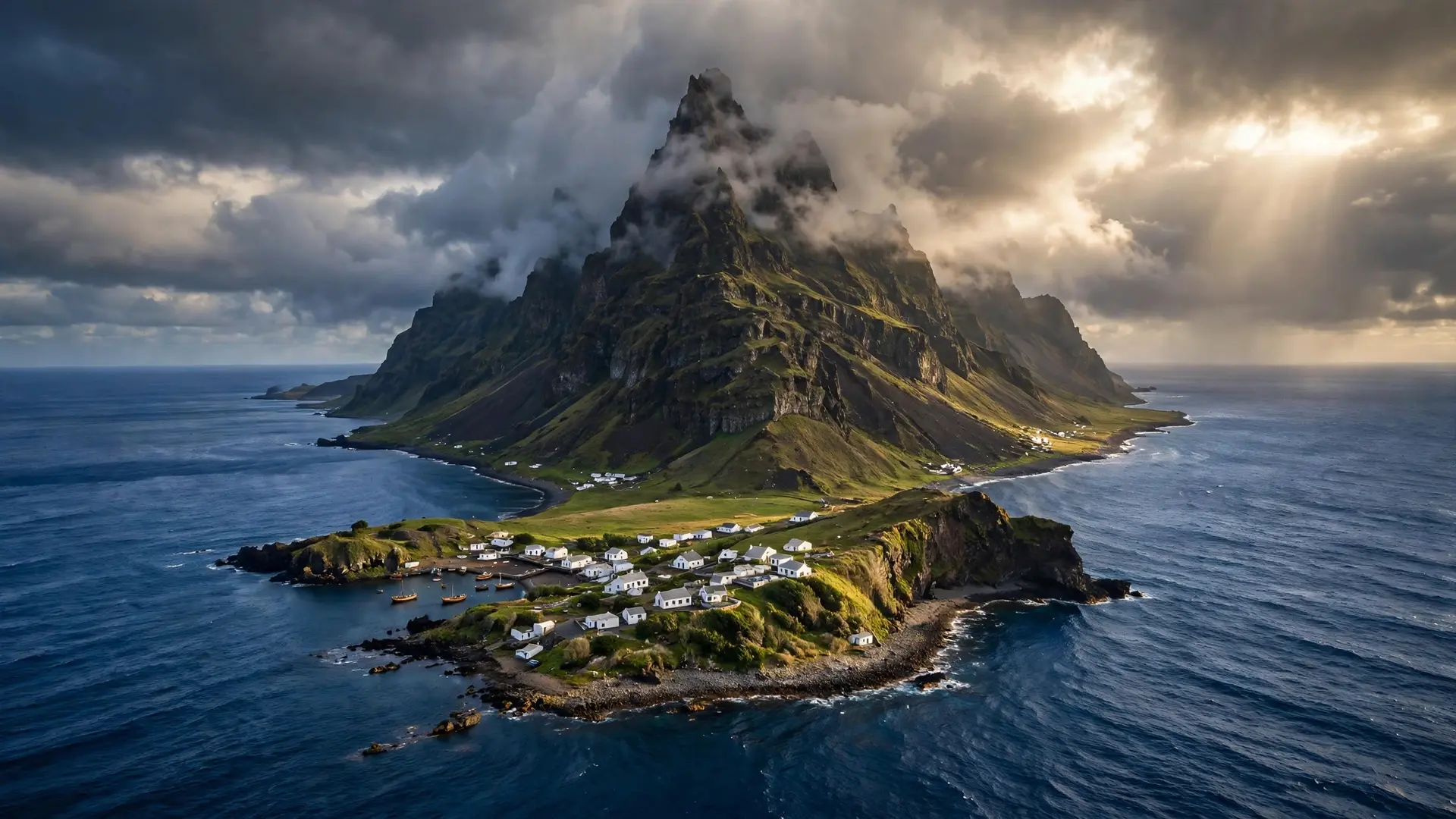
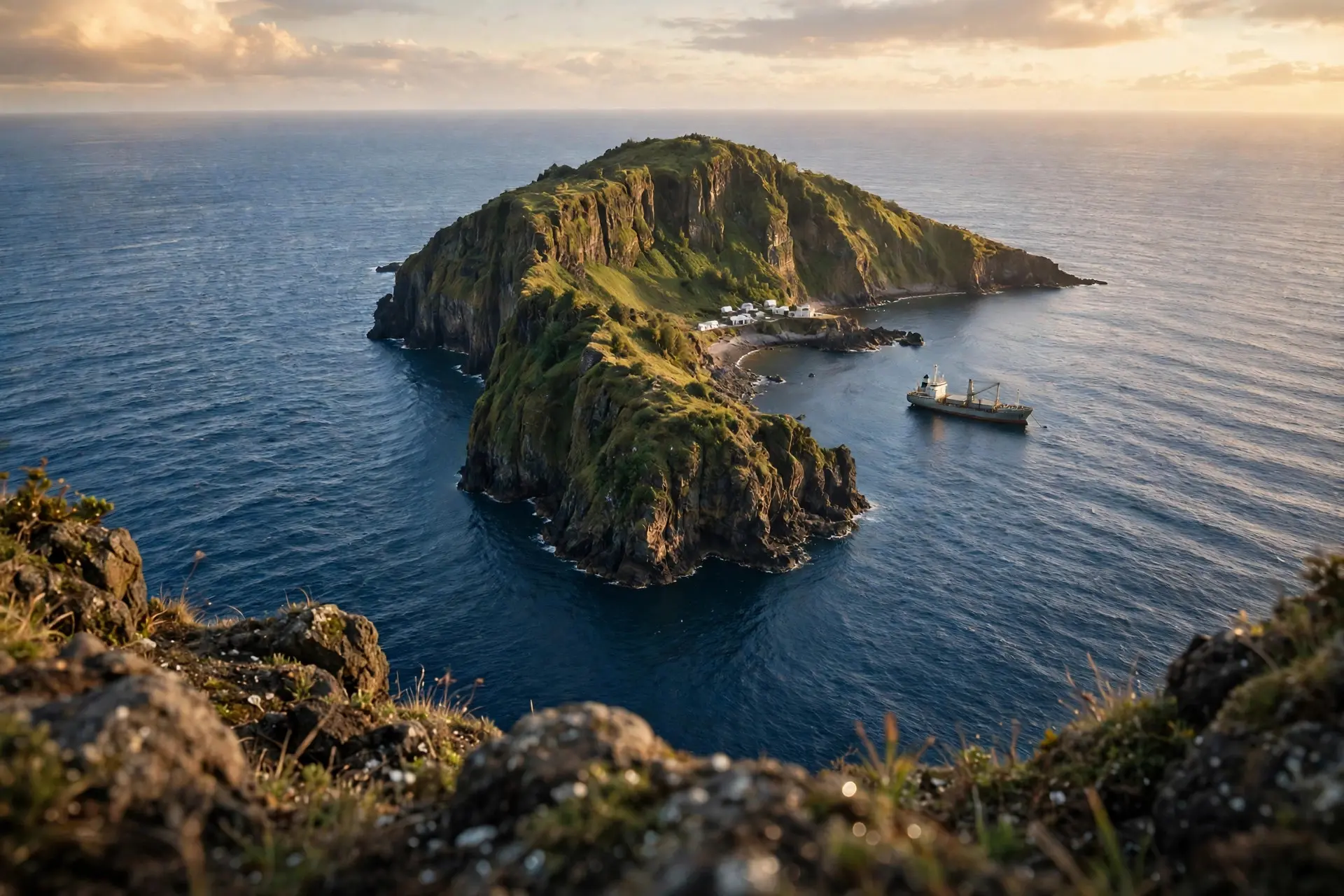
Remoteness is not one number, so it helps to measure it three ways: distance, journey time, and daily contact with the outside world. By all three, Pitcairn is in a class of its own among inhabited Pacific islands. On distance, Pitcairn sits about 2,170 km (1,350 miles) southeast of Tahiti, roughly midway between New Zealand and the continent of South America, at 25 degrees south and 130 degrees west. The island group has four islands: Pitcairn, Henderson, Ducie and Oeno. Only Pitcairn is inhabited. Pitcairn Island itself covers just 4.35 sq km (1.68 sq miles), a rugged volcanic half-crater rising about 340 m (1,100 ft) above steep coastal cliffs. Henderson, the largest island in the group, is uninhabited and has been a UNESCO World Heritage site since 1988. On journey time, the numbers are starker. There is no airport and no runway, so the sea is the only way in. The crossing from Mangareva, the nearest inhabited island, takes roughly 32 hours aboard the MV Silver Supporter, the government-chartered supply ship. The published schedule shows the pattern clearly: the ship leaves Mangareva on a Tuesday and arrives at Pitcairn on a Thursday. A medical emergency means a sea evacuation to Mangareva first, then a flight on to Tahiti or New Zealand. Visitors book one of just 12 passenger berths, and the ship's schedule allows stays of about four days or around eleven days.
On daily contact, Pitcairn is a British Overseas Territory administered from New Zealand: the governor is the British high commissioner in New Zealand, and the deputy governor is based in Auckland. The island has a private satellite Wi-Fi system, a general practitioner and a nurse, and a solar farm built in September 2024 that cut diesel generator use by 85 percent. It has no banks. Its school has closed because there are no children left to teach; the last two students now attend secondary school in New Zealand. Remoteness takes more than one shape: a desert like the Sahara can feel just as cut off, but Pitcairn's isolation is measured in sea miles and sailing days.
How did the Bounty mutineers end up there?
Pitcairn's story starts with a sighting, not a settlement. In 1767 the British ship HMS Swallow found the island, and its captain, Philip Carteret, named it for the sailor who first saw it, midshipman Robert Pitcairn. The island was uninhabited, and it stayed that way for 23 years. Then came the mutiny. In 1789, on a voyage from Tahiti to the West Indies carrying breadfruit saplings, the crew of HMS Bounty, led by first mate Fletcher Christian, mutinied and set Captain William Bligh and loyal sailors adrift. The mutineers and their Tahitian companions eventually reached uninhabited Pitcairn in January 1790, went ashore, and burned the ship so they could not be found. Nine mutineers and 18 Polynesians, 12 women and six men, formed the founding community. Most of today's islanders trace their ancestry back to those settlers. The community survived in obscurity until American whalers discovered it in 1808. Ships began calling with books and supplies, and the population grew until the island's limited land became a concern. In 1856, because of overpopulation, some islanders were removed to Norfolk Island, east of Australia, and the mutineers' descendants remain divided between the two places to this day. The island's official languages are English and Pitkern, a mixture of Tahitian and 18th-century English.
What is life like on the island today?
Life on Pitcairn runs on a scale that is hard to picture from a city. Adamstown, the only settlement, sits on the north coast above Bounty Bay. The main road and one side road in Adamstown are paved; much of the rest of the road network is not, and quad bikes are the main mode of transport. Most people hold several jobs, from running the general store to crewing the longboats that ferry people and cargo ashore from the supply ship. Money comes from a small set of sources: tourism, the sale of stamps and coins, handicrafts, honey, and the sale of internet domain names ending in .pn. Two islanders started growing coffee, with their first commercial harvest completed in 2025. The territory's budget for 2025/26 is 5.45 million pounds, and shipping takes about 69 percent of it. Pitcairn has needed development assistance for 90 to 95 percent of its budget requirements since 2004. The harder problem is people. The population peaked at more than 230 in the 1930s and has fallen steadily through emigration, mostly to New Zealand. According to the World Health Organization, about 80 percent of Pitcairn's residents will be over 65 years old within five years. The Island Council has made attracting new residents its top strategic goal, and in February 2025 it reviewed its immigration and settlement policy.
The island has still found ways to make its isolation count. Its marine reserve protects humpback whales and green turtles, and a marine science base has operated there since 2023. On March 18, 2019, the whole island group was designated an International Dark Sky Sanctuary, one of only 15 in the world at the time, and the first British Overseas Territory to hold the status. A small museum in Adamstown holds stone tools made by Polynesians before the mutineers arrived, plus cannonballs, an anchor and a swivel gun from HMS Bounty.
What do most people get wrong about Pitcairn?
The first mistake is to measure remoteness with a ruler alone. On pure distance, Easter Island would win: it sits 1,900 km (1,200 miles) east of Pitcairn and 3,540 km (2,200 miles) west of Chile, and its population was 7,750 in 2017. Pitcairn takes the title because of access. Easter Island is a town of thousands; Pitcairn is 35 people with no runway, one supply ship, and a two-day sail to the nearest inhabited island. Zoom out to the whole planet and the remoteness title belongs to Tristan da Cunha in the Atlantic, which is why this question is about the Pacific. The second mistake is to assume the island is empty or abandoned. It is small, but it is governed: a constitution came into effect in March 2010, an elected Island Council manages internal affairs, and a mayor was elected on November 5, 2025. The school closed for lack of pupils, not for lack of a community. The third mistake is to picture a tropical hideaway with no rules. Pitcairn is a British Overseas Territory with courts, a police officer seconded from New Zealand, and a budget that depends on British aid. Its people speak Pitkern at home and English in official life, and they celebrate Bounty Day every January 23. Isolation has not made Pitcairn lawless; it has made it careful, because a community of 35 cannot afford to lose anyone.
| Year | What happened |
|---|---|
| 1767 | HMS Swallow sights the island; Captain Carteret names it for midshipman Robert Pitcairn |
| 1790 | Nine Bounty mutineers and 18 Polynesians settle; they burn the Bounty |
| 1808 | American whalers rediscover the community |
| 1856 | Some islanders move to Norfolk Island; descendants remain split between the two |
| 2010 | A new constitution comes into effect |
| 2016 | A marine protected area is created around the islands |
| 2019 | The island group becomes an International Dark Sky Sanctuary |
| Pitcairn's answer to the question is not a single distance but a whole way of life: a two-day sail from the nearest neighbor, a ship that carries 12 passengers, and a community of 35 people who have kept a settlement alive on a speck of volcanic rock for more than 230 years. The Diomede Islands show how a border can put two islands a day apart; Pitcairn shows what happens when the gap is measured in ocean instead. | |
| How we made this article: FactSpire researched and drafted it with AI assistance and checked every fact against the sources listed above. |
Frequently asked questions
How far is Pitcairn Island from anywhere?
Pitcairn sits about 2,170 km (1,350 miles) southeast of Tahiti. The closest inhabited island is Mangareva in French Polynesia, and reaching it takes a roughly 32-hour voyage on the supply ship. Pitcairn has no airport, so the sea is the only way in or out, and its governor is based in New Zealand.
How do you get to Pitcairn Island?
Fly to Tahiti, then take the weekly Air Tahiti flight to Mangareva, and board the MV Silver Supporter for the roughly 32-hour crossing. The ship carries at most 12 fare-paying passengers and makes 26 trips a year to Mangareva. Visitors usually stay about four days or around eleven days, depending on the sailing schedule.
How many people live on Pitcairn Island?
Only 35 people lived on Pitcairn in 2023, all in Adamstown, the island's single settlement. The population peaked at more than 230 in the 1930s and has fallen steadily since, mostly through emigration to New Zealand. The island's government is now trying to attract new residents.
Why is Pitcairn Island famous?
Pitcairn is famous as the refuge of the HMS Bounty mutineers, who settled there in 1790 with their Tahitian companions and burned their ship. Their descendants still form the island's community today. The island is also known for its huge marine reserve and its exceptionally dark night skies.
Sources
- Pitcairn, United Nations
- Pitcairn Island, Britannica
- International Dark Sky Sanctuary, Pitcairn Islands Tourism
- Shipping Schedule, Pitcairn Islands Tourism
- Pitcairn Island Travel, Far and Away Adventures