Inside a Data Center: The Physical Internet
The internet is not a cloud — it is warehouses of servers devouring power. Step inside a data center and see the power, cooling, and fiber behind each click.
Key takeaways
- A hyperscale data center houses 5,000 or more servers and can consume electricity on the scale of a small city — some draw gigawatts.
- Cooling is the second-largest energy cost after computing itself, typically consuming 30–40% of a facility's total power.
- If the grid fails, battery banks carry the servers instantly until diesel generators spool up, targeting 99.999% uptime.
- Google reported a fleet-wide average PUE of 1.10, while the industry average sits at 1.56 — a wide gap in efficiency.
- Spine-leaf networks make every server the same number of network hops from every other, guaranteeing predictable latency at scale.
The cloud is not in the sky. It is in windowless buildings the size of stadiums, humming in anonymous industrial parks, guarded like bank vaults — because in a sense they are. Press "play" on a video and you send a request to one of these fortresses, where tens of thousands of servers wake up, find your file among millions, and fling it back across undersea fiber cables in milliseconds. Let us walk inside and see what the internet actually looks like when you stand next to it.
What happens the moment you tap an app?
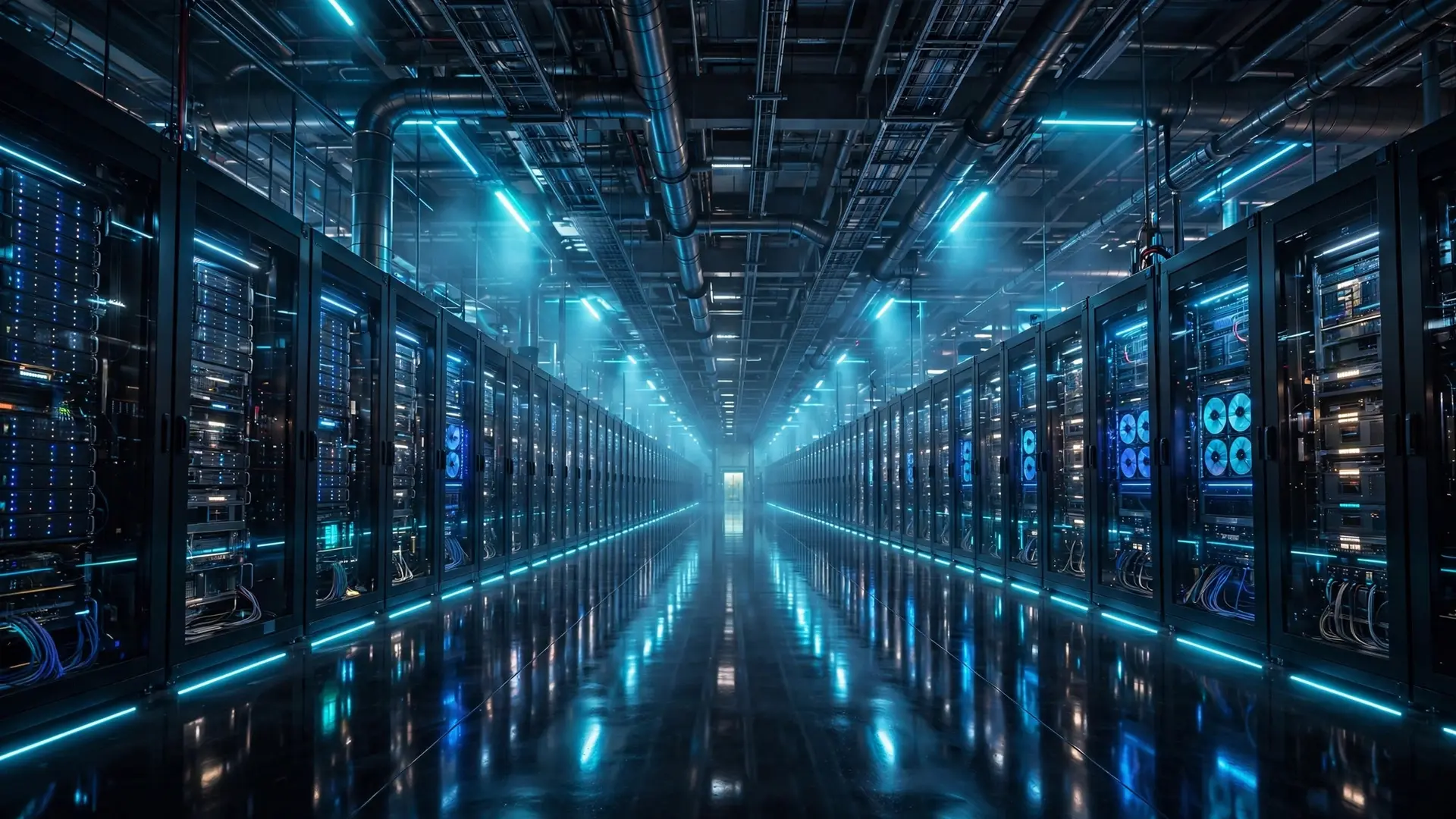
It starts in the Meet-Me Room, a modest chamber where fiber optic cables from multiple internet providers physically enter the building. This is the data center's front door: the cables carrying every request and every answer, deliberately redundant, arriving through separate trenches so a single careless backhoe cannot sever the building from the world. Your request travels from there into the data hall — a cathedral of computing. Row after row of black cabinets, each one packed with servers blinking and roaring, fans spinning at full cry. A hyperscale facility typically occupies at least 10,000 square feet and houses 5,000 or more servers, with some campuses scaling to hundreds of thousands. Your video frame was encoded, stored, and duplicated across machines like these; your bank balance is a row in a database here; your email's journey passed through racks much like these. The building exists to do one thing: turn electricity into computation, billions of times per second, without ever pausing.
Where does all that power actually go?
Almost entirely into heat. A server converts nearly every watt it draws into thermal energy, which is why a data center is, at its core, a problem of organized thermodynamics. Cooling is the second-largest energy consumer in the facility after the IT equipment itself — typically 30 to 40 percent of total facility energy, and the Congressional Research Service puts it at 38 to 40 percent.
So how do you cool a building full of furnaces? The workhorse is the chilled-water loop: cold air blasted between the racks through contained aisles, hot exhaust captured and carried by water to cooling towers outside, where evaporation dumps the heat into the atmosphere. In cooler climates, operators cheat with free cooling — simply bringing in outside air instead of running compressors, as Google does in Oregon and Microsoft in Wyoming. And the newest, densest workloads have outgrown air entirely: AI GPU racks can draw 30 to 60 kilowatts per rack, 10 to 20 times a standard rack, and for those, chilled water runs directly to the chips through cold plates, or whole servers are submerged in non-conductive fluid. Liquid cooling at scale has been measured to cut facility power by about 18 percent versus pure air cooling. The industry's report card is PUE — Power Usage Effectiveness, total facility power divided by IT power, where 1.0 is theoretically perfect. The Uptime Institute's 2024 survey found the industry average at 1.56, meaning more than half the power is overhead, and that number has been stuck for five consecutive years. The leaders run far ahead: Google reported a trailing twelve-month average PUE of 1.10 across its global fleet, so only about 10 percent of its power never touches a server. The gap between the average building and the best one is where the industry's next decade of engineering lives.
How do fifty thousand servers talk without gridlock?
A data center is also a network, and at hyperscale the network is the product. When you search, stream, or ask an AI a question, your request ricochets between dozens or hundreds of servers — a search touches index shards, an AI response synchronizes thousands of GPUs mid-thought. This east-west traffic, server to server, is enormous. Older networks were trees, and trees have trunks that clog. Hyperscale buildings instead use a spine-leaf topology: every "leaf" switch (plugged directly into the servers) connects to every "spine" switch. The result is a non-blocking fabric where any server is always exactly the same number of hops from any other, giving predictable, ultra-low latency for distributed computation. AI training campuses now run 400 and 800 gigabit fabrics within their halls, and even microsecond-level delays between GPUs waste training time — so the network is engineered like a Swiss railway timetable, except packets instead of trains, and everything measured in microseconds.
What keeps it all running when the grid fails?
Data centers promise 99.999% uptime — about five minutes of downtime per year — so the power story has layers. Grid electricity enters the building and passes through switchgear, transformers, and power distribution units before it reaches a single server, each stage conditioned and redundant. Then come the two backup acts. Act one: the UPS — uninterruptible power supply — rooms full of battery banks (older lead-acid, increasingly lithium-ion) that take over instantly when the grid drops, with not a millisecond of interruption. They only hold for a few minutes, but minutes are all they need. Act two: an army of diesel or natural-gas generators outside the building that spool up automatically and carry the entire load for as long as fuel lasts. All of it is watched from a network operations center where engineers monitor power, temperature, network traffic, and alarms around the clock. Nothing about a data center is left to chance; the building is a machine for turning risk into boredom.
What is the internet's hidden water bill?
Here is the uncomfortable chapter. Many data centers cool themselves with evaporative cooling towers — essentially giant kettles that boil water into the sky to dump heat. A medium-sized facility can consume millions of gallons of water a year; the largest hyperscale sites can approach 5 million gallons a day, comparable to a town of 10,000 to 50,000 people. Roughly two-thirds of data centers built since 2022 have landed in water-stressed regions, according to a Bloomberg analysis — the industry keeps putting its thirstiest buildings where water is scarcest. And the bill runs deeper than the cooling towers. Meta reported about 786 million gallons of direct water use at its data centers in 2024 — but the water embedded in the electricity it purchased was about 24 times that figure, because thermal power plants drink rivers to make steam. When operators proudly report zero on-site water use, some of that water was simply consumed upstream, at the power plant. The newest designs answer with closed-loop liquid cooling and dry coolers that barely sip water, but the fundamental bargain remains: compute anything at scale and you are moving water somewhere, whether you see it or not. Next time you tap an icon, picture it: the fiber at the door, the blinking canyon of racks, the rivers of cold air, the batteries waiting in the dark, the cooling towers exhaling into the night. The internet feels weightless because all its weight has been concentrated somewhere — in a humming building full of heat, water, and electricity, engineered so obsessively that you never have to think about it. Until now.
Frequently asked questions
How much power does a data center actually use?
A hyperscale facility can consume tens of megawatts to gigawatts of electricity. Google's global data centers run at a PUE of 1.10, meaning only about 10% of their power goes to overhead like cooling and distribution.
Why do data centers need so much cooling?
Nearly all the electricity a server consumes becomes heat. Cooling typically accounts for 30–40% of total facility energy, using chilled water systems, outside-air free cooling, and increasingly direct liquid cooling for AI hardware.
What happens if a data center loses power?
Uninterruptible power supplies — rooms of batteries — take over instantly, bridging the seconds until massive diesel generators start up. The design target is 99.999% uptime, or about five minutes of downtime per year.
Do data centers really use as much water as towns?
Large evaporative-cooled sites can consume millions of gallons a day, and roughly two-thirds of data centers built since 2022 sit in water-stressed regions. Meta reported about 786 million gallons of direct water use at its data centers in 2024.