How Fiber Optic Internet Carries the Web
Light pulses racing through hair-thin glass carry nearly everything you do online. Here is how fiber optics turn light into the internet, and cross the oceans.

Key takeaways
- Fiber internet works by converting electrical signals into pulses of laser light guided through hair-thin glass strands.
- Total internal reflection keeps the light trapped in the fiber's core as it bounces over vast distances.
- Corning's 1970 low-loss fiber, at 17 dB per kilometer, made long-distance optical communication practical.
- More than 95 percent of intercontinental internet traffic travels through submarine fiber-optic cables.
Fiber optic internet carries the web as pulses of laser light racing through strands of glass thinner than a human hair. Your computer's electrical signals are converted into flashes of light, guided across continents by bouncing them inside a glass core — and converted back into data when they arrive. The entire global internet is, at bottom, a choreography of light.
How does light become the internet?
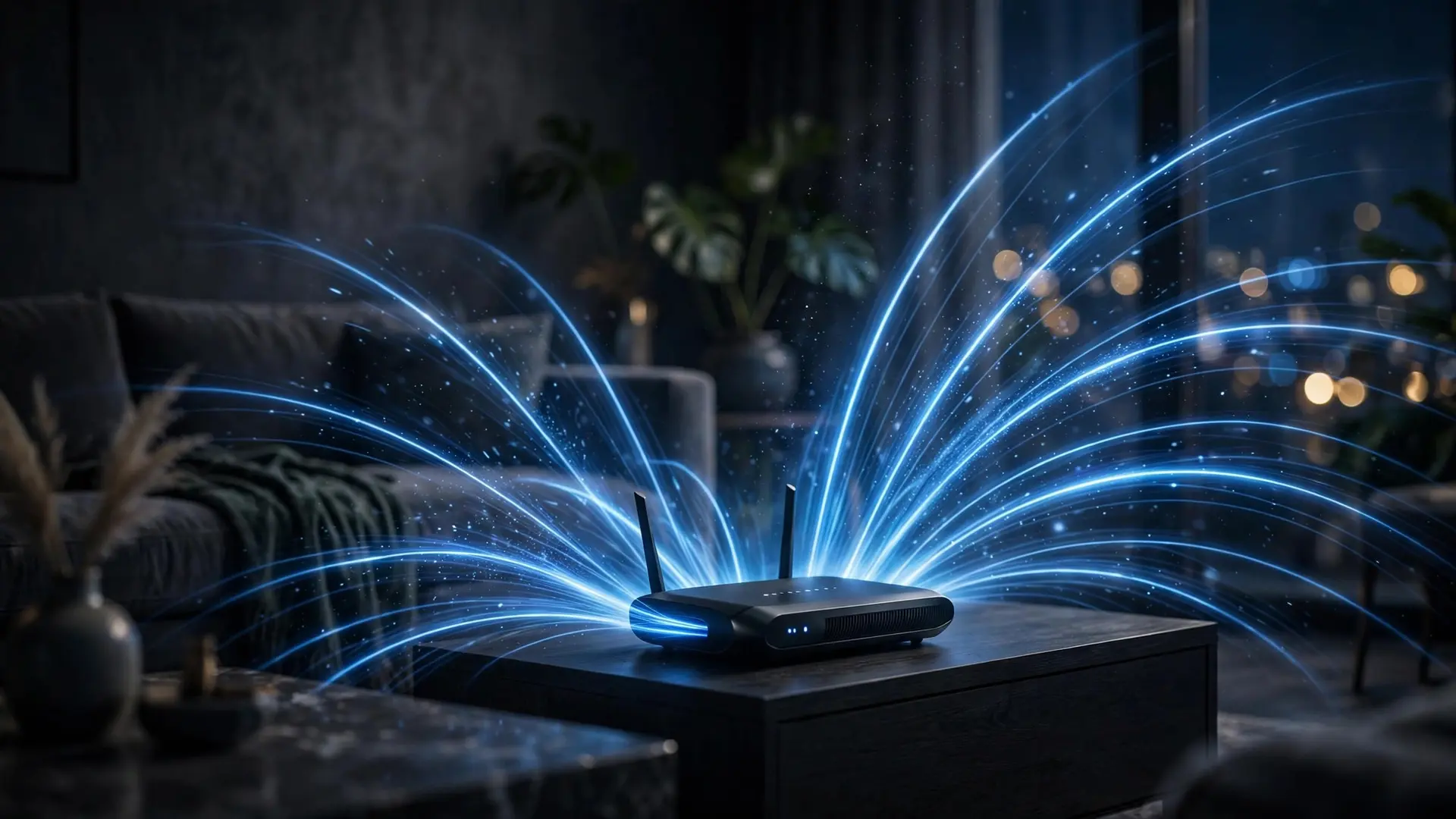
The trick rests on a property of glass called total internal reflection. An optical fiber has two layers: a hair-thin inner core and an outer cladding made from a different glass composition. The core has a higher refractive index than the cladding — meaning light travels more slowly through it — so any light ray entering at a shallow angle reflects off the core-cladding boundary instead of escaping. The pulse zigzags down the fiber, trapped by physics, for kilometers at a time. In practice the journey starts when a laser turns your data into photons, the elementary particles of light, fired down the core in rapid succession. The glass itself is a triumph of purity: fiber cores are made from exceptionally clean silica, sometimes with added germania, because any impurity absorbs or scatters the light, weakening the signal in a process engineers call attenuation. By driving attenuation down, engineers made it possible for a pulse to survive a transatlantic crossing. What finally reaches your home is usually the last leg — the fiber line to your building hands off to the wireless signal your Wi-Fi router broadcasts, which is why even "wireless" internet is wired almost all the way.
Who turned glass into a telephone wire?
Guiding light through transparent material began as a parlor trick. In 1854, the Irish physicist John Tyndall demonstrated that light could follow a stream of water pouring from a tank — the water bent, and the light bent with it. Glass fibers existed by the 1920s but were useless for communication: early fibers lost more than 1,000 decibels per kilometer, so light died within meters.
The theoretical breakthrough came in 1966, when Charles K. Kao and George Hockham published a landmark paper arguing that purified silica glass could carry telephone signals — provided losses could be pushed below about 20 decibels per kilometer. That calculation set the target for a worldwide race in glassmaking. Kao's vision later earned him the nickname "Father of Fiber Optics" and a share of the 2009 Nobel Prize in Physics. The practical breakthrough arrived in 1970 at Corning Glass Works, where researchers Robert Maurer, Donald Keck, and Peter Schultz produced the first low-loss optical fiber, measuring about 17 decibels per kilometer. It was an astonishing leap, and progress only accelerated: by 1979, losses had fallen to roughly 0.2 decibels per kilometer at infrared wavelengths near 1550 nanometers — the sweet spot where glass is most transparent. The laser, invented in 1960 and made compact and durable in semiconductor form by the 1970s, supplied the coherent light source the system needed. Within a decade, light had become a serious rival to copper.
How did fiber cross the oceans?
The technology proved itself on the seabed. On December 14, 1988, the first fiber-optic cable to cross an ocean entered service: TAT-8, the Transatlantic Telephone cable number eight, stretching about 5,846 kilometers from New Jersey to the European coast, with branches to the United Kingdom and France. Built by a consortium led by AT&T, British Telecom, and France Telecom, it carried three pairs of optical fibers with an initial capacity of around 280 megabits per second — enough for roughly 40,000 simultaneous phone calls, nearly double the copper coaxial cable it replaced.
TAT-8 filled up far faster than anyone predicted and was retired in 2002, but it established the template every later cable followed: glass fibers, optoelectronic repeaters, and digital transmission. The network that grew from it is staggering. Around 570 submarine cable systems are now in operation, with roughly 1.5 million kilometers of fiber lying on the ocean floor — and they carry more than 95 percent of all intercontinental telecommunications traffic. Satellites still matter, but fiber moves far more data, far more cheaply. Modern cables push past 20 terabits per second using wavelength-division multiplexing, which sends many colors of light down the same fiber simultaneously. The undersea cables that form the internet's physical backbone are the reason a video call to another continent feels effortless. Nearly all of the data moving around the planet at any given second is traveling across the bottom of an ocean somewhere.
Why is data still not instant if it travels at light speed?
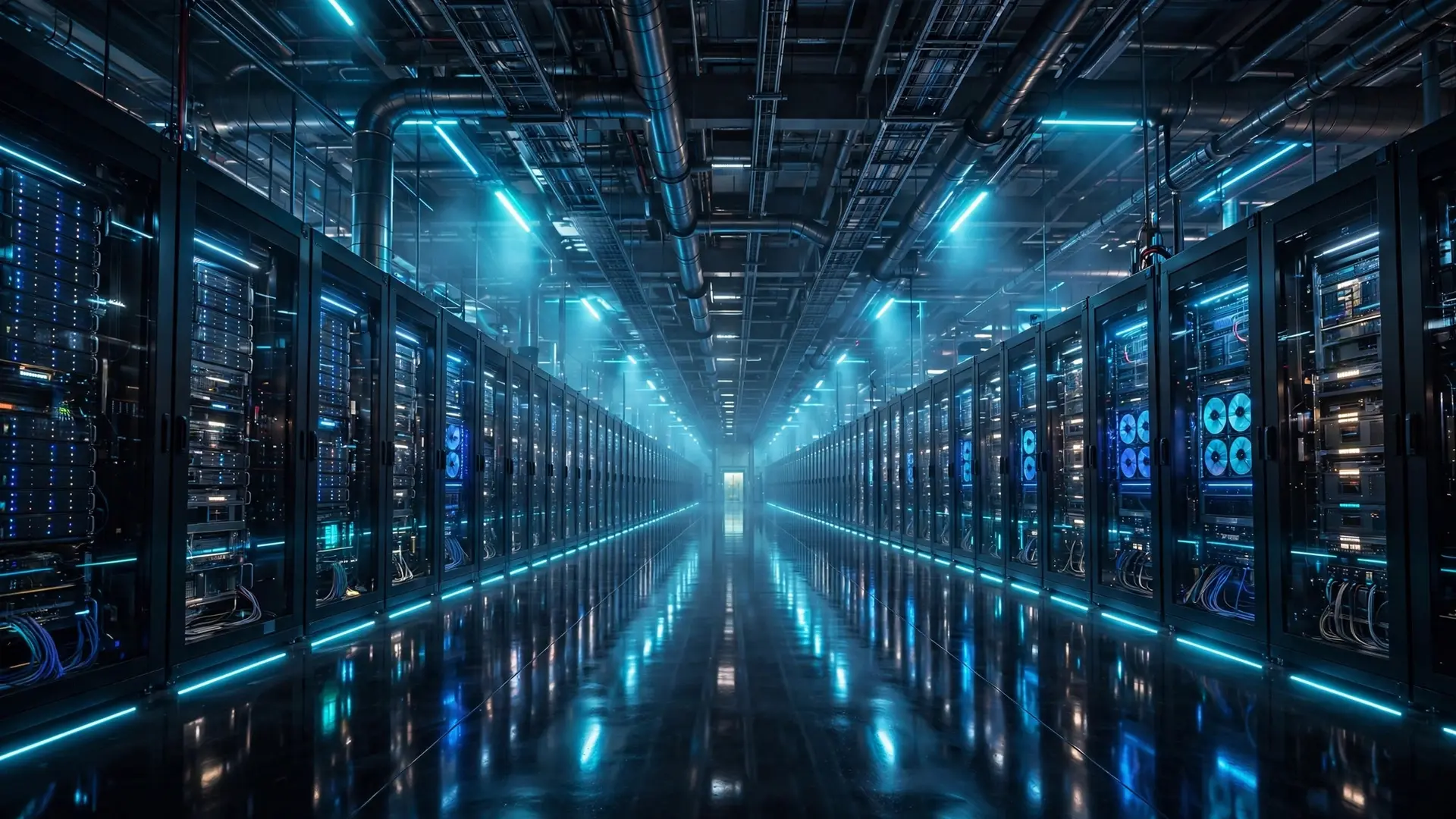
Here is the catch: light in glass is slower than light in a vacuum. Glass's refractive index of about 1.47 means pulses travel at roughly 200,000 kilometers per second instead of 300,000 — still blistering, but the difference shows up as latency. Network engineers use a rough rule of thumb: about one millisecond of delay for every 100 kilometers of fiber, one way. A round trip across the Atlantic adds tens of milliseconds before a single router or server is involved. Distance also degrades the signal. Even the purest glass absorbs a little light, so long routes need repeaters — stations that detect, amplify, and regenerate the pulse before sending it onward. Under the ocean, repeaters sit inside the cable itself, powered by electrical current running through its casing. And dispersion — the spreading of a pulse as its different frequency components travel at slightly different speeds — must be managed or the pulses blur together into noise. Fiber is a triumph, not magic: every design choice is a negotiated truce with physics. There is one more layer most people never see. The cables landing at coastal stations feed terrestrial fiber networks, which feed the data centers where the internet actually lives. Your request may bounce through several such facilities before the answer starts its journey back. The cloud is not in the sky; it is a building full of machines, connected by glass.
What should you remember the next time you go online?
The internet feels weightless, but it is one of the heaviest things humans have built: millions of tons of glass, steel, and plastic wrapped around a planet. The next time a page loads in a blink, picture the path — a laser flashing your request into a thread of glass, bouncing it across an ocean floor, amplified and regenerated a hundred times, then surfacing in a data center on another continent. It is the fastest postal system ever devised, and it runs on light.
Frequently asked questions
How fast does light travel through fiber optic cable?
About 200,000 kilometers per second — roughly two-thirds the speed of light in a vacuum. Glass slows light down, which is why engineers often count on about one millisecond of latency per 100 kilometers of fiber.
Is fiber optic internet faster than copper cable?
Fiber carries far more data over far longer distances than copper. Light pulses suffer less loss and interference than electrical signals, and a single fiber pair can carry tens of terabits per second using multiple wavelengths of light.
Why does the ocean floor have internet cables?
Submarine fiber-optic cables carry more than 95 percent of intercontinental traffic because they move vastly more data, more cheaply and reliably, than satellites can. About 1.5 million kilometers of fiber now rest on the seabed.