How Solar Panels Turn Sunlight Into Electricity
Sunlight knocks electrons loose inside silicon, and an electric field herds them into a current. The solar panel is the story of taming that trick.
Key takeaways
- The photovoltaic effect — light knocking electrons loose in a material — was first observed by 19-year-old Edmond Becquerel in 1839.
- A solar cell is a silicon p-n junction: photons free electrons, and a built-in electric field sweeps them into a one-way current.
- The first practical silicon solar cell came from Bell Labs in 1954 at about 6% efficiency; modern cells reach 15-20%, and lab tandems exceed 34%.
- Panels produce direct current, so an inverter must convert it to alternating current before it can power a home or feed the grid.
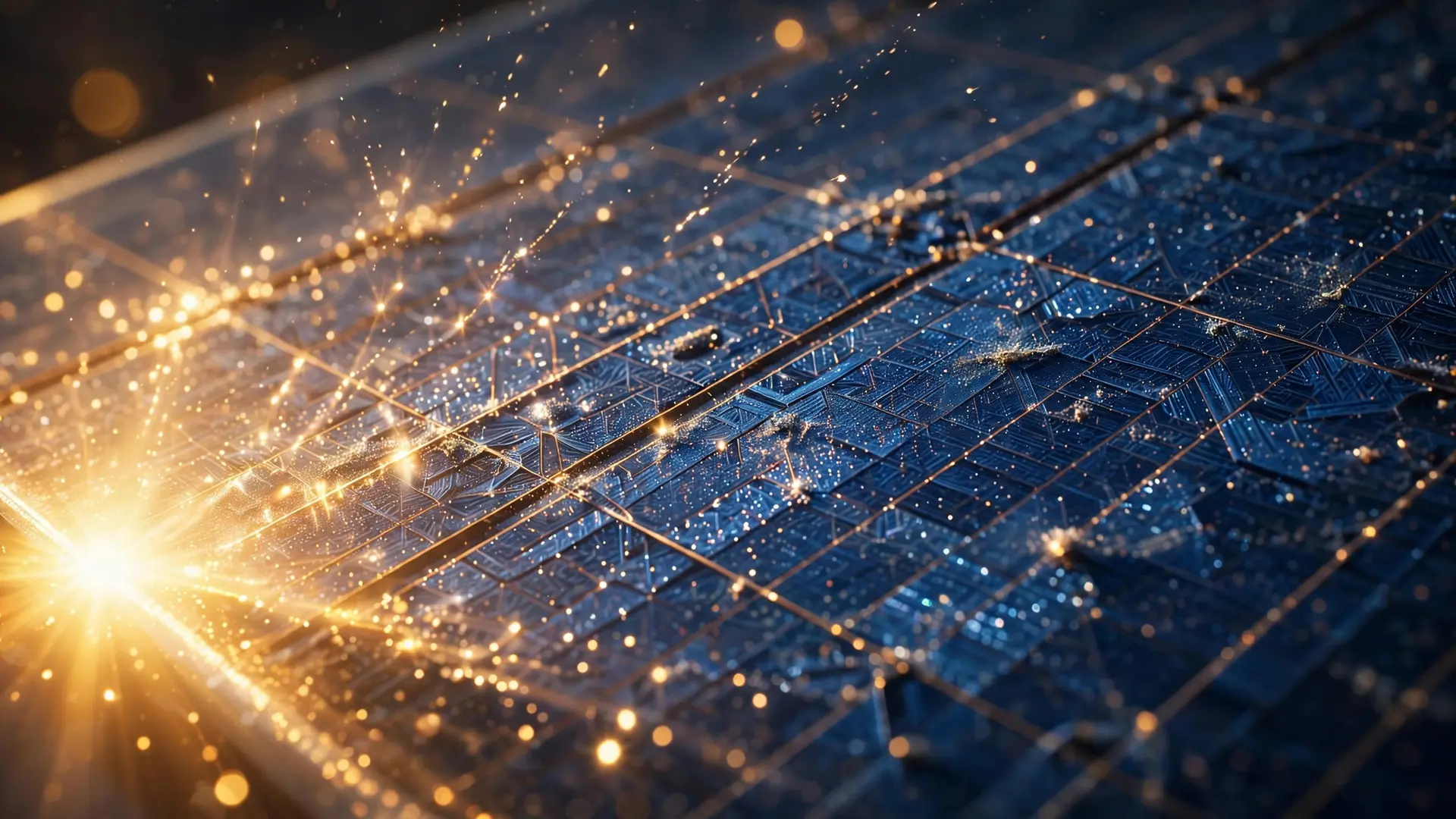
Sunlight falls on a dark blue panel, and electricity flows out of a wire. There are no moving parts, no heat engine, no noise — just light in, power out. The trick is called the photovoltaic effect, and here is the strange part: scientists discovered it in 1839 but could not build a genuinely useful solar cell until 1954. The 115-year gap between those two dates is the real story of the solar panel — the difference between noticing a phenomenon and taming it.
What happens inside a solar cell when sunlight hits it?
It starts with a photon, a packet of light energy, striking the silicon that makes up the cell. Silicon is a semiconductor, and its electrons sit in orderly atomic bonds — until a photon with enough energy arrives and knocks one loose. The freed electron leaves behind a vacancy called a hole, which behaves like a positive charge. This is the photovoltaic effect, first observed in 1839 by French physicist Edmond Becquerel, who was just 19 years old when he noticed that light shining on an electrode in a chemical solution produced a weak electric charge. Becquerel's discovery was a laboratory curiosity with minuscule efficiency, and it stayed one for decades. In 1873, English engineer Willoughby Smith found that selenium's electrical resistance changed with light; in 1876, William Grylls Adams and Richard Evans Day showed selenium could generate electricity directly from light with no heat or moving parts. In 1883, New York inventor Charles Fritts built the first working solar cell — selenium coated with a whisper-thin layer of gold — and it converted a mere 1 to 2 percent of incoming sunlight into electricity. The effect was real, but the materials were not up to the job.
Why doesn't the freed electricity just wander off?
Knocking electrons loose is only half the problem. Freed electrons and holes naturally drift back together and recombine, which produces nothing useful. A solar cell needs a traffic system — a built-in one-way street — and that comes from the p-n junction.
Here is how it works. Pure silicon is deliberately contaminated, a process called doping. One layer is doped with phosphorus, which has extra electrons to spare (the n-type layer, for negative). The adjacent layer is doped with boron, which is electron-hungry and full of holes (the p-type layer, for positive). Where the two layers meet, electrons spill from the n-side to the p-side until an internal electric field builds up that stops further flow. That field is the genius of the cell: whenever sunlight frees an electron-hole pair near the junction, the field grabs them and sweeps them in opposite directions — electrons one way, holes the other — before they can recombine. Wire up both sides and you get a steady flow of electrons: direct current, straight from sunlight. This architecture only became possible once scientists could grow ultra-pure single-crystal silicon — a technique pioneered by Polish scientist Jan Czochralski in 1918 — and it explains why the solar cell had to wait for the semiconductor age. Albert Einstein's 1905 paper explaining the underlying photoelectric physics (which earned him the 1921 Nobel Prize) gave the theory; the silicon industry gave the material.
Why did it take 115 years to make a working cell?
Because pure silicon was the missing ingredient all along. The breakthrough finally came in 1954 at Bell Telephone Laboratories, where Daryl Chapin, Calvin Fuller, and Gerald Pearson built the first practical silicon solar cell, converting about 6 percent of sunlight into electricity — triple what Fritts had managed, and the first efficiency worth engineering around. The timing was perfect: the space program needed a way to power satellites, and solar cells were light, silent, and had no moving parts to break. In 1958, the Vanguard 1 satellite carried the first solar-powered payload into orbit, and photovoltaics had their first real job. Interest in solar surged again during the 1970s oil crisis, when energy independence became a national priority, then faded with federal funding cuts in the 1980s — but research never stopped. Each decade shaved costs and added efficiency points, turning a satellite power supply into the cheapest source of new electricity in much of the world.
How efficient can a solar panel really get?
There is a hard ceiling. Not every photon can be used: photons with too little energy pass straight through the silicon, and photons with too much waste their excess as heat. This band-gap limitation caps a single-junction silicon cell at roughly 29 percent in theory; the panels on rooftops today typically deliver 15 to 20 percent in practice. Heat is the enemy too — panels actually perform worse on scorching days, since rising temperature saps voltage. Engineers are now beating the limit by stacking materials. By layering perovskite — a cheap, tunable crystal — on top of silicon, tandem cells catch a wider slice of the solar spectrum. LONGi Solar has had a crystalline silicon–perovskite tandem cell certified at 34.85 percent efficiency by NREL, the U.S. national lab — a figure that would have sounded like fantasy in the Fritts era. The industry is also shifting cell designs from older PERC architecture to N-type TOPCon and heterojunction cells that lose fewer electrons to recombination. A panel's power rarely stays as direct current, either — which is where storage comes in. Homes pair panels with lithium-ion batteries to bank daytime electricity for the night, and satellites have relied on the same sunlight-to-power trick since the first solar-powered spacecraft.
So where does the panel's power actually go?
A solar cell produces direct current at low voltage, but homes and grids run on alternating current — so the panel's output first passes through an inverter that flips DC into AC. From there, the electricity either powers the building directly, charges a battery, or flows back into the grid. Modern systems add maximum power point trackers, small circuits that constantly adjust the electrical load so the panel always operates at its most productive voltage as sunlight conditions change. A panel's story, then, is really two inventions fused together: Becquerel's 1839 observation that light can move charge, and the 1954 realization that a slab of doped silicon could turn that observation into a machine. For over a century, the photovoltaic effect was a parlor trick of physics — a faint current in a beaker. Today, that same trick, refined through purer silicon and smarter junctions, powers satellites, homes, and entire grids. The sunlight did not change. We just finally learned how to catch it.
Frequently asked questions
Do solar panels work on cloudy days?
Yes, but at reduced output — they respond to light, not heat. Diffuse daylight still frees electrons, so a panel typically produces 10 to 25 percent of its rated power under heavy cloud.
Who invented the solar panel?
Edmond Becquerel discovered the photovoltaic effect in 1839, Charles Fritts built the first working cell in 1883, and Daryl Chapin, Calvin Fuller, and Gerald Pearson created the first practical silicon cell at Bell Labs in 1954.
Why are most solar panels blue?
The blue comes from an anti-reflective coating on the silicon that helps trap more light. Raw silicon is gray; the coating that maximizes absorption gives cells their familiar deep-blue sheen.