How Do Smartwatches Measure Your Heart Rate?
Your smartwatch flashes green light into your wrist hundreds of times per second and counts pulses in the reflection. Brilliant at rest, fragile in the cold.
Key takeaways
- Smartwatches use photoplethysmography: green LEDs shine into the wrist, and photodiodes read the reflected light hundreds of times per second.
- Each heartbeat pushes more blood into the wrist, changing the reflection; the watch counts those changes per minute.
- Apple's sensor covers 30–210 bpm and auto-boosts LED brightness and sampling when the signal is weak.
- Tattoos, cold skin, and fast arm movements can all defeat the sensor — and wrist accuracy degrades as exercise intensity rises.
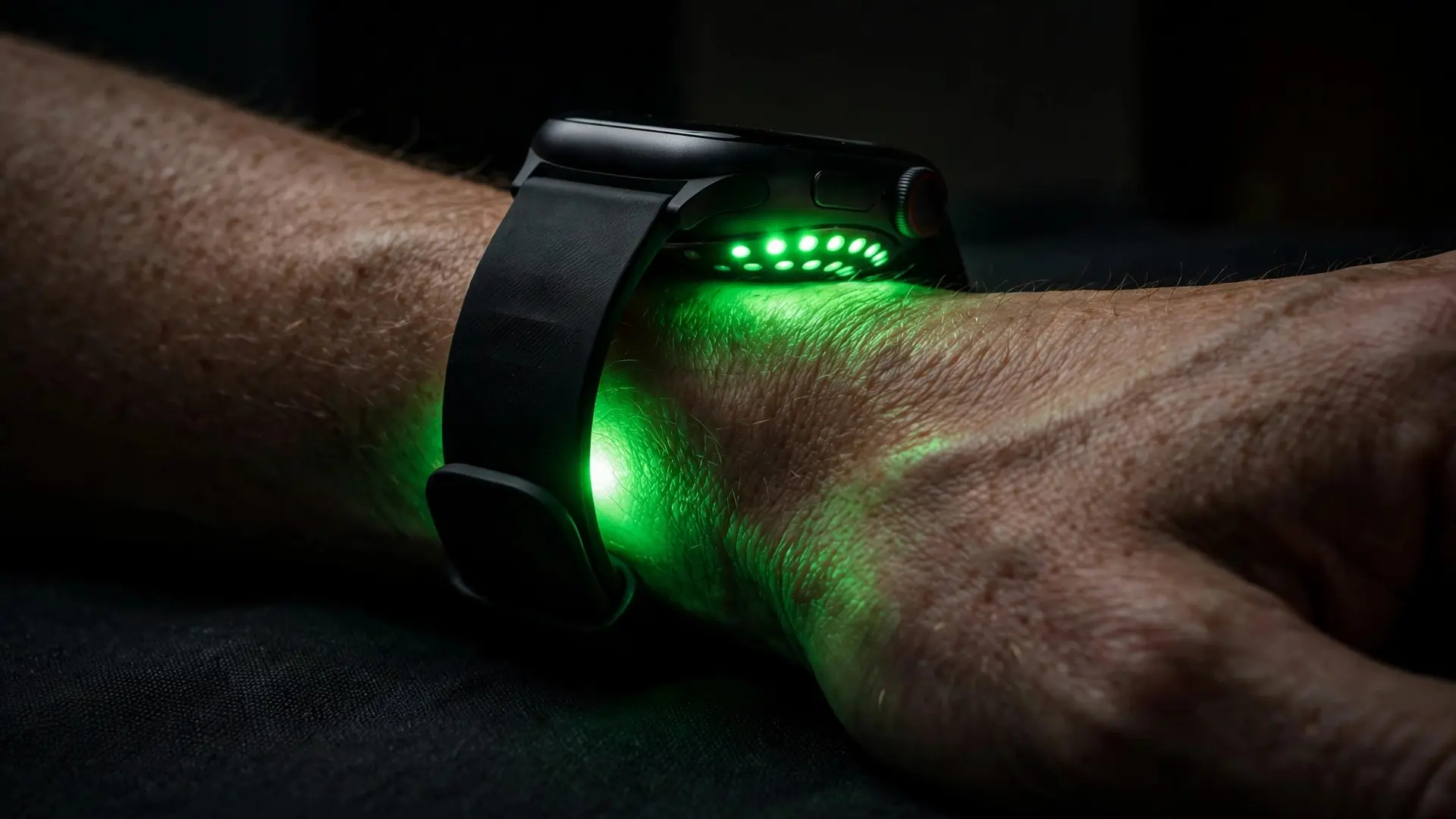
Your smartwatch never touches your pulse. It touches your wrist, flashes green light into it hundreds of times per second, and reads what bounces back. Each heartbeat pushes a little more blood into the wrist; blood absorbs green light; the reflection changes; the watch counts the changes per minute. That is the whole trick — and it works beautifully, until it doesn't. The technique is called photoplethysmography, PPG for short. Follow one heartbeat of light and you will understand both why the sensor is so good and why it is so fragile.
How does the green light trick work?
On the back of the watch, green LEDs shine into the skin while photodiodes measure the light that reflects back. Blood is red because it reflects red light and absorbs green light — Apple's own explanation for the color choice — and that makes green the most sensitive wavelength for detecting changes in blood volume. The LEDs flash hundreds of times per second, far faster than any heartbeat, so each pulse is sampled many times. Apple's sensor is rated for 30 to 210 beats per minute — the lower bound covers resting and sleeping hearts, the upper bound near-maximum exertion. Outside that window, the watch reports nothing rather than guessing, which is exactly the right behavior for a sensor that is not a medical device. When the signal is weak it automatically boosts LED brightness and sampling rate — the watch tries harder before it gives up. LED color also varies by model and situation: newer watches use infrared rather than green for background sampling during sleep, while green stays on continuously during the day. Fitbit calls its PPG implementation "PurePulse" and is blunt about its limits: "This product is not a medical device, and is not intended to diagnose, treat, cure, or prevent any disease." Its accuracy, Fitbit says, "is not intended to match medical devices." That honesty matters, because the failures are interesting.
What breaks the reading?
Start with tattoos. Apple confirms that "permanent or temporary changes to your skin, such as some tattoos, can also impact heart rate sensor performance. The ink, pattern, and saturation of some tattoos can block light from the sensor" — and recommends a Bluetooth chest strap for tattooed wrists. If the light can't reach the blood, there is no signal to read. Then the cold. Apple notes that "if you're exercising in the cold, for example, the skin perfusion in your wrist may be too low for the heart rate sensor to get a reading." Constricted blood vessels mean less blood volume change per beat, and the reflection changes shrink below what the sensor can track. Winter runners learn this fast: the same watch that reads perfectly in July goes silent in January. Then motion. A 2025 study of the Fitbit Charge 4 put numbers on the chaos: for sports with sharp, random arm movements — badminton and soccer — the sensor's bias reached −16.5 beats per minute, with mean error rates around 16 to 17 percent. Running, by contrast, was highly accurate, with an error of just 0.1 bpm and a mean error rate of 1.2 percent. The difference is the pattern of movement: the arm's motion sloshes the sensor's readings, and rhythmic motion like running is easy to filter out, while chaotic motion is not. Skin tone is the subtlest question. The evidence is mixed: a systematic review of 10 studies with 469 participants found 4 showing reduced accuracy in darker skin, 4 showing no effect, and 2 mixed — "preliminary evidence is inconclusive." A newer study using colorimeter-measured pigmentation found that pigmentation did not meaningfully raise per-reading error for Apple or Garmin watches, but that missing or outlier data was disproportionately from dark-skinned participants — a data-quality problem rather than a per-reading bias.
The results also depend on the brand. A narrative review in Cureus found device-dependent bias: one major brand showed differences under 5 beats per minute across skin tones, while others underestimated resting heart rate by 10 to 15 bpm in darker-skinned users — and by more than 20 percent during vigorous activity. The sensor is the same physics everywhere; the algorithms and hardware around it are not. The honest summary is that the science is still catching up.
How accurate is a wrist sensor, really?
The benchmark study is from the Cleveland Clinic in 2017, published in JAMA Cardiology: 50 adults, wrist wearables against the EKG gold standard, tested at rest and through increasing exercise intensity. The Apple Watch was about 90 percent accurate; chest straps were about 99 percent. And every wrist device degraded as exercise intensity rose — the harder the body worked, the worse the wrist did, across every brand tested. Apple's own caveat is worth quoting: even under ideal conditions, the watch "may not be able to get a reliable heart rate reading every time for everybody." For some users, some combinations of factors make readings impossible. Note that the optical sensor is not the only heart sensor in a modern watch. The Apple Watch Series 4 and later, and the Ultra, also carry electrodes in the Digital Crown and back crystal: a finger on the crown completes a circuit that measures the heart's electrical impulses directly — the ECG app — "with higher fidelity" than the optical sensor. Light counts the pulse; electricity reads the beat. One is a census, the other is a conversation. The green glow on your wrist is a small marvel of applied physics — a pulse oximeter's cousin, miniaturized and worn all day, feeding sleep and activity tracking with every beat. Hospitals measure the same signal with a finger clip and a wire; your watch does it with reflected light and patience, hundreds of times a second, all day, asking nothing of you. It is not a medical device. But for counting the quiet drumbeat of a resting heart, few tricks in consumer electronics are as elegant.
Frequently asked questions
How does a smartwatch measure heart rate?
With photoplethysmography (PPG). Green LEDs flash into the wrist hundreds of times per second; photodiodes detect the reflected light. Each heartbeat pushes more blood into the wrist, changing how much light reflects back, and the watch counts those changes per minute.
Why does the sensor glow green?
Blood is red because it reflects red light and absorbs green light — Apple's own explanation. Green light is the most sensitive to changes in blood volume, so it gives the cleanest pulse signal.
Why does my watch fail to read my heart rate during exercise?
Motion artifacts. A 2025 study found wrist sensors worst for sports with sharp, random arm movements (badminton, soccer — errors around 16 bpm) but excellent for running (error 0.1 bpm). Tattoos and cold skin can also break the reading.
Are smartwatch heart rate readings accurate?
Roughly — at rest. A 2017 Cleveland Clinic study against EKG found the Apple Watch about 90% accurate and chest straps about 99%, with all wrist devices degrading as exercise intensity rose. Fitbit states outright that its devices are not medical devices.