How Did the Romans Lift 100-Ton Stones With Cranes?
How did the Romans lift 100-ton stones? Treadwheel cranes and compound pulleys let small crews raise tons; capstan towers and ramps handled the true monsters.
Key takeaways
- A four-man Roman crane crew could lift 3,000 kg; fitting a treadwheel doubled that to 6,000 kg with half the crew.
- Vitruvius described the machines in De architectura: the trispastos, the pentaspastos and the many-pulleyed polyspaston.
- Trajan's Column's 53.3-ton capital rose 34 meters on a capstan tower; Baalbek's 100-ton cornice blocks went up 19 meters.
- The 455-ton Lateran obelisk was raised in 357 CE with derricks, rope webs and thousands of men; no crane could do it.
The Romans lifted heavy stones by trading distance for force. Treadwheel cranes with compound pulleys let a four-man crew raise 3,000 kg; fitting a treadwheel doubled that to 6,000 kg. For the heaviest loads, they built timber lifting towers worked by capstans, and for true monsters like the 455-ton Lateran obelisk they used ramps and thousands of workers.
Key facts
- Book 10 of Vitruvius's De architectura, written in the 1st century BCE, catalogues the lifting machines: the three-pulley trispastos, the pentaspastos, and the many-pulleyed polyspaston. (Lexundria)
- Modern reconstructions estimate a four-man crew at the winch could lift 3,000 kg (6,600 lbs); replacing the winch with a treadwheel doubled the load to 6,000 kg (13,200 lbs) with half the crew. (Gruas y Aparejos)
- A marble relief from the tomb of the Haterii, a family of builders buried along Rome's Via Labicana in the early 2nd century CE, shows a treadwheel crane worked by men inside the wheel. (Vatican Museums)
- Trajan's Column, dedicated in 113 CE, stacks 20 Carrara marble drums of 32 tons apiece; its capital, weighing 53.3 tons (48 tonnes), was raised 34 meters (112 feet) by a special lifting tower. (Linda Hall Library, Gruas y Aparejos)
- At Baalbek's Temple of Jupiter, architrave blocks of up to 60 tons were set 19 meters (62 feet) up, and one corner cornice block topped 100 tons (110 short tons). (Gruas y Aparejos)
- The Lateran obelisk, 455 tons (413 tonnes) and about 107 feet (33 meters) tall, was erected at Rome's Circus Maximus in 357 CE under Constantius II, with thousands of men turning capstan wheels, as described by Ammianus Marcellinus. (Encyclopaedia Romana, University of Chicago)
What did a Roman crane look like?
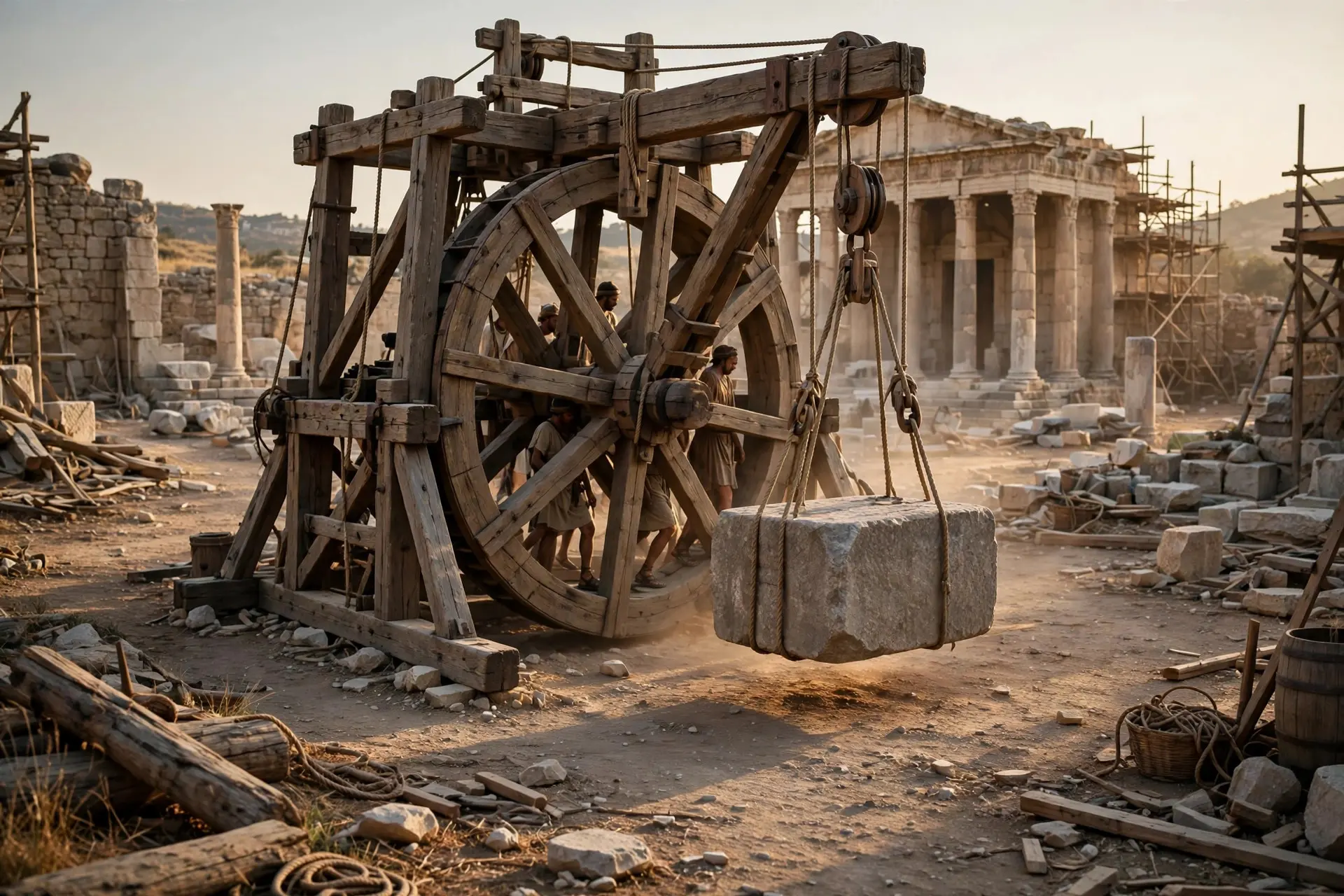
Vitruvius describes the standard machine plainly. Three timbers, sized to the load, were pinned together at the top and splayed wide at the feet, then steadied with guy ropes staked into the ground. A pulley block hung from the head; a second block traveled with the load. The rope threaded through both blocks, and its loose end wound onto an axle turned by levers. Iron shears gripped the stone itself, their teeth set into holes cut for the purpose. For heavier loads the recipe scaled up: more pulleys, stouter timbers, longer levers. The named grades ran from the trispastos (three pulleys) through the pentaspastos to the polyspaston, the many-pulleyed heavy lifter. For the heaviest work of all, Vitruvius prescribed a great drum-wheel, the tympanum, fixed on the axle and driven by a capstan — or better, built large enough for men to walk inside it, their body weight turning at a far greater radius than the axle. The worker never lifted the stone in one heroic pull. He kept walking, and the machine converted distance into torque.
How much weight could Roman cranes actually lift?
The workhorse polyspaston, worked by four men at a winch, managed about 3,000 kg (6,600 lbs). Fitting a treadwheel in place of the winch doubled the capacity to 6,000 kg (13,200 lbs) with only half the crew, because the wheel's large diameter gave each step far more turning effect on the axle. That handled everyday building blocks with ease, and two surviving stone reliefs of treadwheel cranes, including the detailed Haterii tomb carving, show the machines as ordinary site equipment. Beyond about six tons, the crane gave way to the lifting tower: four masts arranged in a rectangle with the load rising through the middle, worked by capstans, human and animal powered, set on the ground around it. That is how the 53.3-ton capital of Trajan's Column climbed 34 meters (112 feet), and how Baalbek's 60-ton architraves, and one cornice block over 100 tons, rose 19 meters (62 feet).
How did workers attach a rope to a smooth stone?
A crane is useless without a grip, and the grip was its own engineering. The Romans cut lewis holes, dovetailed recesses, into the top of each block and dropped in iron lewis devices that jammed tighter as the load pulled. Slings, iron clamps and lifting tongs served other shapes. At Baalbek, architrave blocks of 55 to 60 tons carry eight lewis holes each, which works out to about 7.5 tons of load per iron. The holes had to be cut with care: a badly placed recess could split the stone's edge under load, and the gear had to stay secure until the block rested, then come free without damaging the finished work. Attachment was engineering, not rigging, and the marks it left still show on ancient blocks today.
What happened when the stone was too heavy for any crane?
The Lateran obelisk is the answer. Quarried at Karnak around 1400 BCE, it reached Rome in 357 CE, when Constantius II had it erected on the central barrier of the Circus Maximus. Ammianus Marcellinus, a contemporary historian, described the raising: a grove of tall timber derricks, a web of heavy ropes "hiding the sky with their excessive numbers," and the 455-ton shaft gradually drawn upright through the air while many thousand men turned wheels "resembling millstones." No crane did that. Ramps, scaffolds, rope webs and massed muscle did. The Romans shipped at least a dozen obelisks to Rome under the emperors, and the full story of how Egypt's obelisks were raised shows the same pattern: when the load outgrew the machine, the engineers changed the method rather than the machine.
What do people get wrong about Roman lifting?
First, the brute-force myth. The image of endless slaves straining at ropes misses the point of the machines: pulleys, treadwheels and capstans multiplied force so that routine lifts needed crews as small as two to four men. Second, the treadwheel was no medieval invention. The Haterii tomb relief, carved around 100 to 120 CE, shows a treadwheel crane at work, some thirteen centuries before the harbor cranes of the Middle Ages. Third, the scale myth. Rome's documented crane-era lifts top out near the 100-ton cornice blocks of Baalbek, and even those needed special towers. The far larger trilithon blocks at Baalbek, sometimes cited around 800 tons, belong to an earlier Herodian-era podium and are not evidence of Roman cranes at work.
| Lift | Weight | Height | Method |
|---|---|---|---|
| Trispastos, one man at the winch | 150 kg (330 lbs) | Course level | 3 pulleys |
| Polyspaston, four men at the winch | 3,000 kg (6,600 lbs) | Course level | Compound pulleys |
| Polyspaston with treadwheel | 6,000 kg (13,200 lbs) | Course level | Treadwheel and pulleys |
| Trajan's Column capital, 113 CE | 53.3 tons (48 tonnes) | 34 m (112 ft) | Lifting tower and capstans |
| Baalbek cornice block | Over 100 tons (110 short tons) | 19 m (62 ft) | Lifting tower and winches |
| Lateran obelisk, 357 CE | 455 tons (413 tonnes) | 107 ft (33 m) | Derricks, ropes, thousands of men |
| Roman heavy lifts, from routine to extreme, after modern reconstructions. | |||
| The Romans rarely lifted 100-ton stones with a crane, because they rarely needed to. Their system scaled: pulleys and treadwheels for everyday blocks, capstan towers for temple architraves, ramps and thousands of workers for the true monsters. The same culture that moved water uphill through its aqueducts and spanned valleys with works like the Pont du Gard treated lifting as a system too. The machine fit the load, not the other way around. | |||
| How we made this article: FactSpire researched and drafted it with AI assistance and checked every fact against the sources listed above. |
Frequently asked questions
Did the Romans invent the crane?
No. They adopted the Greek crane and developed it into a construction system, with the treadwheel, or magna rota, as their signature hoist. Vitruvius devoted the tenth book of De architectura to the machines, and reliefs show them at work on Roman building sites.
What is a lewis iron?
A wedge-shaped iron device dropped into a dovetailed hole cut in the top of a stone block; it grips tighter as the load pulls. Baalbek's 55 to 60 ton architrave blocks carry eight lewis holes each, about 7.5 tons of load per iron.
How was the Lateran obelisk raised in 357 CE?
With tall timber derricks, a web of heavy ropes and thousands of men turning capstan wheels, according to the contemporary historian Ammianus Marcellinus. Constantius II had the 455-ton shaft erected on the spina of the Circus Maximus in Rome.
Could a Roman crane lift 100 tons?
Not a standard treadwheel crane, which topped out around 6 tons. The 100-ton class needed special lifting towers with multiple capstans worked by large crews, and anything heavier, like the Lateran obelisk, required ramps and massed labor instead.
Sources
- Vitruvius, On Architecture 10.2, Lexundria
- Roman Cranes Turned Footsteps into Lifting Power, The Lost Eagles
- Five Pulleys Made One Roman Crane Stronger, The Lost Eagles
- Mausoleum of the Haterii, Vatican Museums
- Trajan and Apollodorus of Damascus, Linda Hall Library
- Trajan and the Circus, Encyclopaedia Romana, University of Chicago
- Ancient Cranes - Who invented the Crane? Medieval vs Roman, Gruas y Aparejos
- Obelisk, Encyclopaedia Britannica