How Do E-Ink Displays Work Without Any Power?
An e-ink screen spends power only to change the image - never to show it. Charged pigment microcapsules hold the picture in place, like ink on paper.
Key takeaways
- E-ink displays hold millions of microcapsules filled with oppositely charged black and white pigment particles.
- An electric field pulls the right pigment to the surface; once parked, the image needs zero continuous power — this is bistability.
- E-readers run for weeks between charges because the screen spends power only on page turns, never on display.
- The technology is electrophoretic ink, born at MIT's Media Lab in the mid-1990s and popularized by the 2007 Kindle.
The screen on your phone is a glutton: it burns power every second it shows anything. The screen on an e-reader is the opposite — a display that spends power only to change the image, never to show it. Once a page is drawn, the display could be unplugged and the page would stay. That is not a metaphor. It is physics, and it is called bistability. Everything about e-ink — the weeks-long battery, the sunlight readability, the sluggish page turns, the ghosting — falls out of one fact: the image is real physical pigment, parked in place.
What is inside an e-ink display?
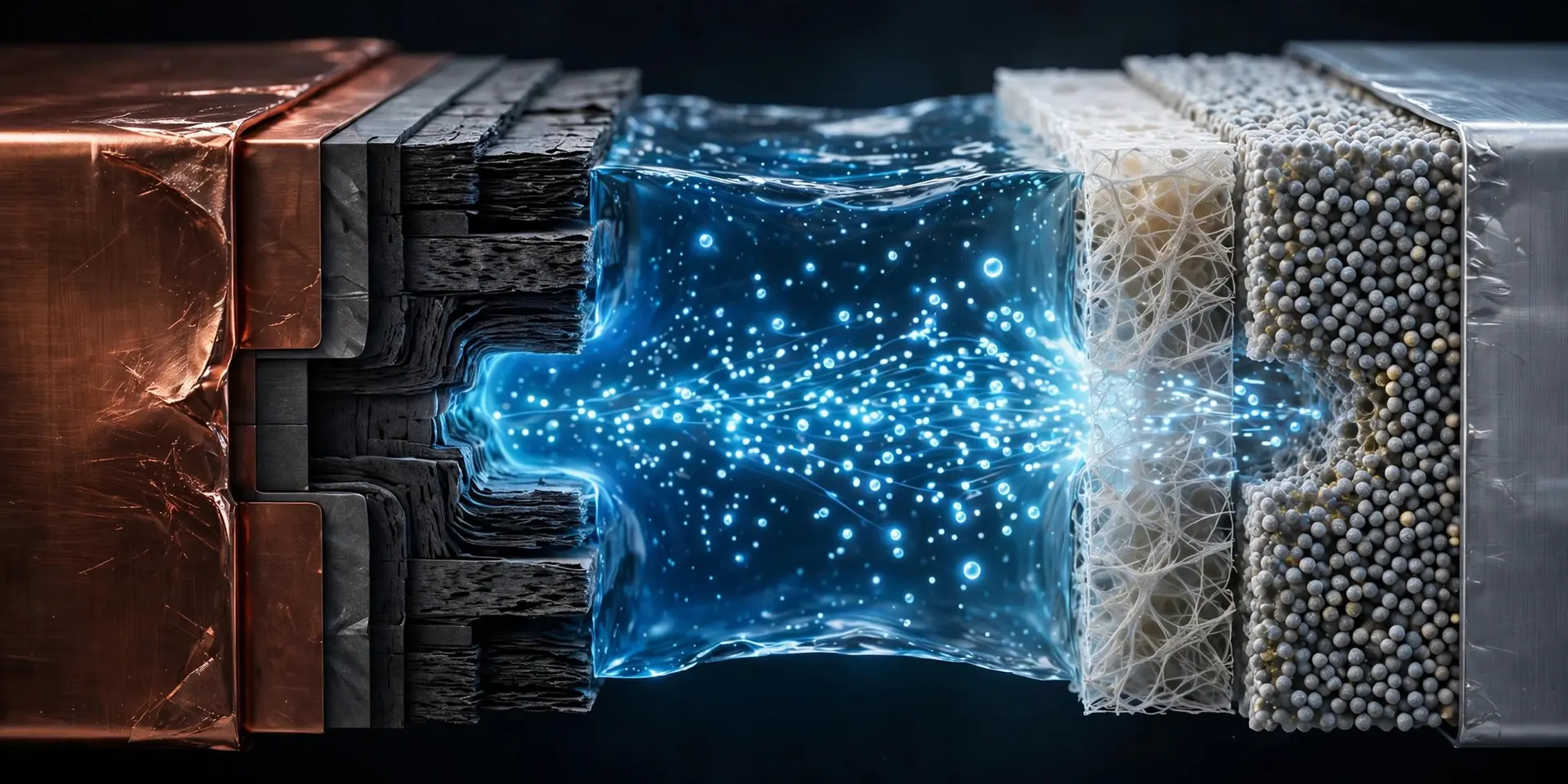
Under the surface of an e-reader sit millions of microcapsules, each about 100 microns across — roughly a human hair's diameter. Every capsule is filled with clear fluid and two kinds of pigment particles, each under a micron wide, coated in silicon dioxide with added polymers so they hold their charge and don't clump: positive white particles made of titanium dioxide, and negative black particles. Beneath the capsules lies an electrode layer. Apply a voltage one way and the white particles are pulled to the viewing surface — that pixel turns white. Reverse the polarity and the black particles rise instead. The migration of charged particles through a fluid under an electric field is called electrophoresis, which is the technology's proper name; "E Ink" is the company that commercialized it. Sub-addressing the pixels — controlling how many capsules in each pixel show white versus black — produces grayscale, up to 16 shades on the E Ink Pearl spec. Newer Pearl panels can complete updates in 50 to 250 milliseconds depending on the mode: still glacial next to an LCD, but fast enough that reading never feels broken.
Why does the image need no power to stay?
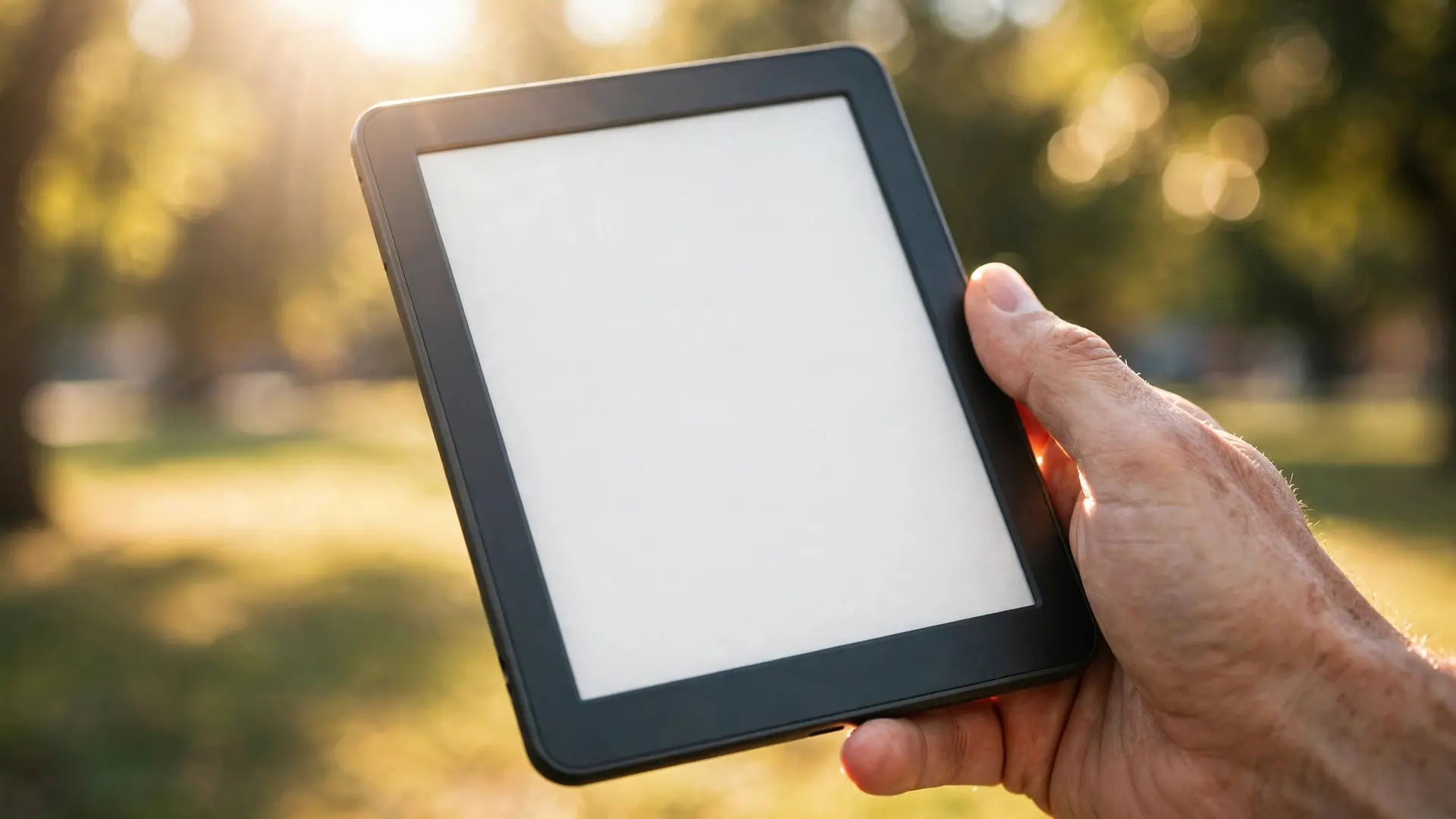
Bistability: once the pigment is parked, it stays parked. No continuous current holds it there. The display spends electricity only in the brief moment of a page change, moving particles to their new positions. Between turns, the e-reader's screen costs nothing — a book left open on a table for a month would show the same page when you picked it up, battery or no battery. The rest of the power budget follows the same logic. The screen is reflective, not emissive: it bounces ambient light off the pigment, exactly like ink on paper. There is no backlight to feed — e-readers use a front light, a row of LEDs shining across the screen, for reading in the dark. No backlight plus a zero-maintenance image is why e-readers routinely run for weeks on a single charge — one university source cites weeks from a four-hour charge — while a phone dies in a day. And the brightness bonus is free: because the screen reflects its surroundings, the brighter the ambient light — including direct sunlight — the easier it is to read. A phone screen fights the sun; an e-ink screen uses it. That is also why e-ink feels different to read: there is no flicker, no backlight glare, no glass shine fighting the room — just pigment and ambient light, like paper. One caution, straight from the research: claims that e-ink is medically better for the eyes or reduces eye strain remain untested. The USC Illumin engineering journal explicitly warns against presenting eye-comfort advantages as established science. The reading experience feels paper-like, and many readers prefer it — but "feels" is not a clinical trial.
Why are page turns slow, and what is ghosting?
Refresh is slow for a physical reason: particles must actually migrate through fluid, which takes time. Modern panels can complete a full update in about 120 milliseconds; older panels took around 200 milliseconds per response with page turns near a second. That is glacial next to an LCD — and it is why e-ink will never play video well. The screen's talents are reading, signage, and patience: exactly the jobs where nothing needs to move fast.
The black "flash" you see on some page turns is a full refresh: the display cycles every particle to wipe away ghosting — the faint residue of the previous image left by particles that didn't quite reach their new positions. E Ink's Regal voltage waveforms claim the full refresh is needed as little as once every 100 pages, but the underlying trade-off is permanent: physical pigment is slow to move and occasionally lazy about it. Color e-ink carries the same trade-offs. Triton (November 2010) laid a color filter over the standard display and produced dim, washed-out colors. Spectra went three-pigment — black, white, and red or yellow — in a Microcup structure, good enough for electronic shelf labels. ACeP (2016) put four pigments — cyan, magenta, yellow, and white — in every pixel with no filter, rendering eight primary colors. All of them stay reflective and low-power, and none of them matches OLED or LCD brightness, saturation, or speed.
Who invented e-ink?
The technology was born at MIT's Media Lab in the mid-1990s from Joseph Jacobson's vision of a changeable book, built by his students Barrett Comiskey and JD Albert. The inventors launched E Ink in 1997 — MIT's own account dates it to that year — with patents filed in 1996 and 1997, and the core concept was published as a 1998 paper in the journal Nature. Amazon's original Kindle in 2007 made e-ink mainstream; some 3.6 million e-readers sold in 2009 alone, according to Gartner. The founding team behind the 1997 company included Jacobson, Albert, Comiskey, Russ Wilcox, and Jerome Rubin — a mix of MIT researchers and business builders betting that the world wanted a better book. Nearly two decades later, the screen in the newest e-reader still works on the same electrophoretic principle — pigment, parked, needing nothing until you turn the page. Compared with the touchscreens that respond to your fingers, e-ink is the display technology that does the least work possible, and that laziness is the whole product.
Frequently asked questions
How does an e-ink display work?
Each pixel sits over microcapsules (about 100 microns wide) containing charged black and white pigment particles in clear fluid. An electrode layer applies voltage: one polarity pulls white particles to the viewing surface, the reversed polarity pulls black up. Particle migration under an electric field is called electrophoresis.
Why do e-readers last weeks on one charge?
The display is bistable: once the pigment is parked, the image persists with no continuous power, and the reflective screen has no backlight. Power is spent only to change the image — at page turns — never to keep showing it.
Can you read an e-ink screen in sunlight?
Yes — better than indoors. The screen is reflective, bouncing ambient light off the pigment like ink on paper, so the brighter the surroundings, including direct sunlight, the easier it is to read. E-readers use a front light for reading in the dark.
Does e-ink come in color?
Yes, though with trade-offs. Triton (2010) used a color-filter overlay with washed-out results; Spectra put three pigments in each pixel for shelf labels; ACeP (2016) puts four pigments — cyan, magenta, yellow, white — in every pixel with no filter, rendering eight primary colors. All stay dimmer than LCD or OLED.