How Bats See in Total Darkness With Sound
Bats hunt in pitch darkness by shouting in ultrasound and reading echoes. Meet Doppler-shift compensation, the acoustic fovea, and nature's living sonar.
Key takeaways
- Echolocating bats emit ultrasonic calls and build a picture of the world from the returning echoes, hunting insects in total darkness.
- The word 'echolocation' was coined by zoologist Donald Griffin in 1944, after he and Robert Galambos demonstrated bat sonar around 1940.
- Horseshoe bats lower their call frequency in flight so Doppler-shifted echoes land precisely in the acoustic fovea, a super-sensitive hearing band reserved for prey.
- A 2026 study showed greater horseshoe bats actively separate prey echoes from masking background echoes into different frequency ranges.
- Fluttering insect wings stamp rhythmic modulations onto echoes, letting some bats detect prey hidden against cluttered backgrounds.
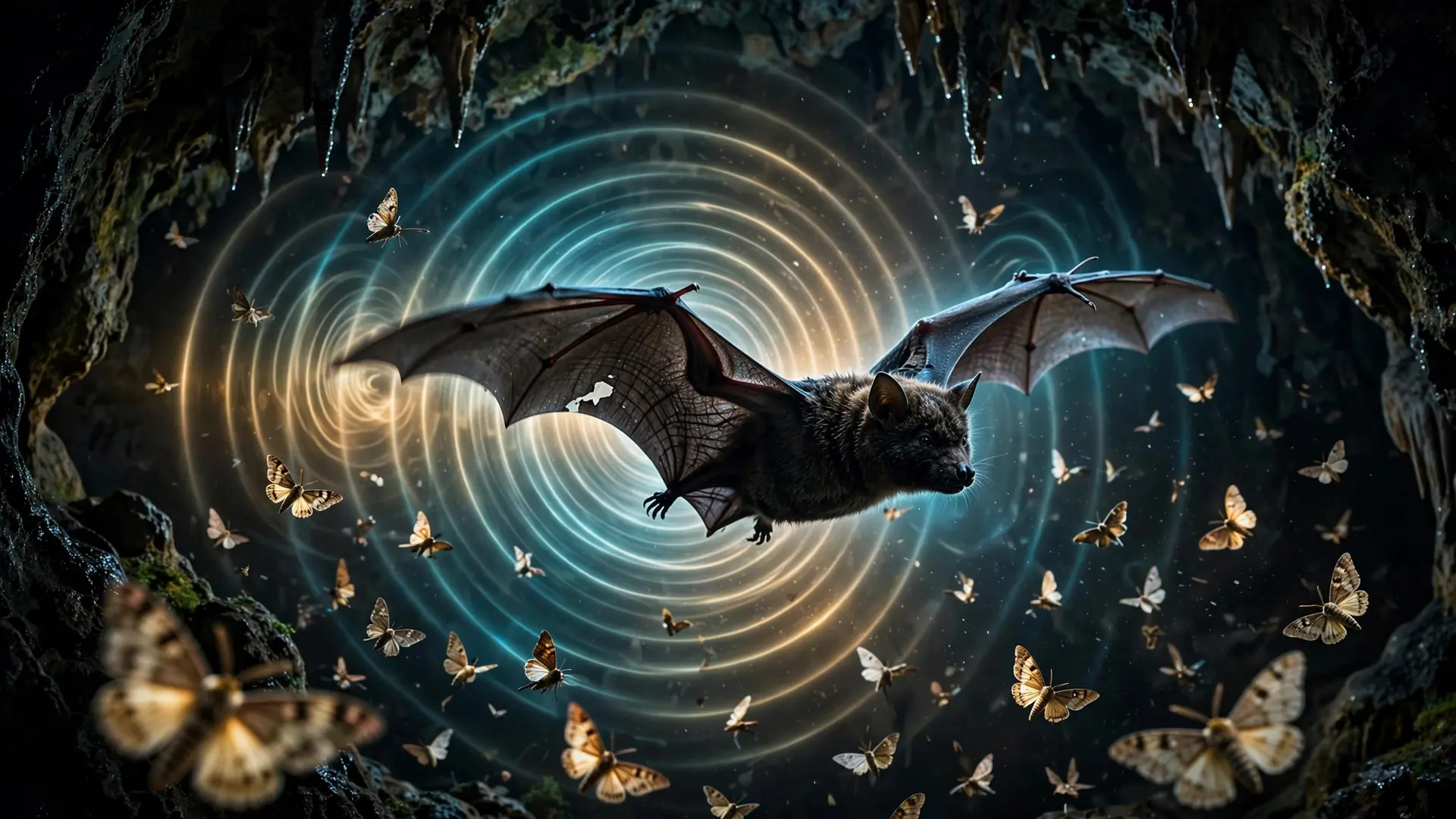
A bat can chase a mosquito through a pitch-black cave, thread its way between stalactites, and land upside down on a crack in the ceiling — all without seeing a thing. It does this by shouting into the dark and reading what shouts back. Echolocation is nature's sonar, and in some bat species it is so sophisticated that it solves a signal-processing problem engineers are still working to match.
How does shouting in the dark actually work?
The principle is the same one sailors use with depth sounders and navies use with sonar: send out a pulse, listen for the echo, and measure how long it took to return. Sound travels at a predictable speed, so the delay of an echo reveals the distance to the object that reflected it. A bat sweeping a dark room gets a continuous stream of echoes from walls, stalactites, and flying insects — and its brain assembles them into a picture of the world, updated many times per second. The pulses themselves are ultrasonic: frequencies well above the roughly 20 kHz limit of human hearing. When Donald Griffin made the first recordings of bat calls in the 1940s, using a microphone sensitive to ultrasound, he found that a little brown bat's calls swept downward from about 80 kHz to about 40 kHz in just a few milliseconds — a miniature frequency sweep not unlike the chirp of a radar. It is an extreme sense, operating at the outer edge of what any animal ear can do, in the same league as the mantis shrimp's astonishing color vision. Because sound rather than light builds this picture, it works where eyes are useless. Caves, hollow trees, the inside of a barn on a moonless night — a bat's sonar does not need a single photon. The result is a genuinely different mode of perception: where we would see shapes and colors, the bat hears distances, textures, and motion.
Why are there two kinds of bat calls?
Not all bat shouts are the same. Most echolocating bats use frequency-modulated calls, or FM: short, broadband sweeps that slide from high to low frequency. A broadband sweep is brilliant at measuring distance, because the wide spread of frequencies gives the bat's brain a precise timestamp for the returning echo — the same trick that pulse-compression radar uses.
But a minority of bats, including horseshoe bats and hipposiderids, use a very different tool: long, constant-frequency calls, or CF, often bookended by brief FM sweeps. A constant tone is a poor ruler but an excellent speedometer. Any movement between the bat and its target shifts the echo's pitch through the Doppler effect, and a pure tone makes those tiny shifts easy to measure. This makes CF calls ideal for detecting motion — specifically, the fluttering of insect wings. That flutter is the prize. When a moth's wings beat, they stamp rhythmic modulations of amplitude and frequency onto the returning echo, like a shimmer riding on the tone. Bat researchers call these "glints," and they carry remarkable detail: wing-beat rate, wing size and structure, even hints of the insect's identity. A bat listening for glints is not just finding its prey — it is reading its wings.
How do horseshoe bats outsmart the Doppler effect?
There is a catch, and the horseshoe bat's solution to it is the most elegant piece of signal processing in the animal kingdom. Doppler shift is indiscriminate: when the bat flies forward, every echo from everything ahead of it shifts upward in frequency — trees, bushes, the ground, and the moth, all at once. The bat needs the moth's echo and wants to ignore the rest. Horseshoe bats dedicate a special piece of hardware to this problem. They possess an acoustic fovea: a narrow frequency band in their auditory system where the representation of sound is enormously expanded, like the fovea of our own eyes devoting extra resolution to the center of vision. The fovea is tuned to a precise reference frequency and is exquisitely sensitive to the rhythmic modulations of fluttering prey. The problem is that Doppler shift keeps pushing echoes out of it as the bat's flight speed changes. So the bat re-tunes its voice. As it flies faster, it lowers the frequency of its calls by exactly the amount the Doppler shift will add back, keeping the returning echoes locked inside the acoustic fovea. Measured with a tiny microphone mounted on the bat's head, the echo frequency stays nearly constant through the approach — the bat's brain always hears its prey in exactly the right channel. And there is a newer twist. In 2026, an international team — Annette Denzinger and Hans-Ulrich Schnitzler of the University of Tübingen, Yossi Yovel of Tel Aviv University, and Laura Stidsholt of Aarhus University — tracked greater horseshoe bats hunting in the wild in Bulgaria, riding along with miniature GPS and microphone tags. Published in the Proceedings of the National Academy of Sciences, the study found the bats go one step further: they lower their emission frequency so that background echoes from vegetation stay just below the acoustic fovea while prey echoes land inside it. In other words, they actively sort the world into two frequency bands — clutter in one, prey in the other — in real time, mid-flight. The horseshoe-shaped nose that gives these bats their name acts as a focusing horn for the beam, aiming the whole system like a searchlight made of sound.
Who figured out that bats were using sonar?
The discovery took nearly two centuries, which says something about how invisible the phenomenon is to human senses. In 1793, the Italian naturalist Lazzaro Spallanzani captured bats from a cathedral belfry, removed their eyes, and released them — and found they could still fly and feed normally. Some sense other than vision was guiding them. In 1798, the Swiss naturalist Louis Jurine repeated the experiments and concluded the sense was hearing. But nobody could explain how hearing alone could replace vision in the dark. The missing piece was that the sounds were ultrasonic — literally inaudible to the experimenters. In 1920, the English physiologist Hamilton Hartridge correctly proposed that bats were using frequencies above human hearing, but he had no way to prove it. Proof came around 1940, when Donald Griffin and Robert Galambos at Harvard recorded bat calls with an ultrasonic microphone and showed that bats emit sounds and navigate by their echoes. Griffin coined the word "echolocation" in 1944 — the same year radar technology was maturing in wartime laboratories, and the parallel was not lost on anyone. Griffin's discovery inaugurated one of the richest research programs in animal behavior. From a few milliseconds of recorded squeak, scientists have built up a picture of neural circuits that compute distance to the microsecond, and of bioluminescent signaling research that, alongside echolocation, shows just how many ways evolution has invented to perceive the dark.
Why does bat sonar matter beyond the cave?
Echolocation has already fed back into human engineering. Sonar technologies are routinely refined with observations from echolocating species, and the horseshoe bat's real-time Doppler compensation and clutter sorting are exactly the problems that radar and medical ultrasound engineers wrestle with. A bat weighing a few grams outperforms room-sized equipment at picking a fluttering target out of a noisy forest. There is also a conservation angle. Bat populations are endangered in many places, and understanding how they hunt — where they forage, how their sonar interacts with clutter — gives clues about how to protect them. A creature that perceives the world entirely through sound needs its acoustic environment intact as much as a whale or a songbird does. The deepest lesson, though, is about perception itself. We tend to assume the world is what our senses report. A bat's world is built from echoes — distance, speed, texture, and wingbeat encoded in sound, rendered into something as navigable as a landscape. Darkness, for a bat, is not the absence of information. It is just a different channel.
Frequently asked questions
Can bats see?
Most bats can see reasonably well; echolocation supplements vision rather than replacing it. In total darkness, though, sound takes over completely and guides flight and hunting on its own.
What frequencies do bats use for echolocation?
Ultrasonic frequencies above the range of human hearing. Donald Griffin's first recordings captured downward sweeps from about 80 to 40 kHz in little brown bats and about 50 to 25 kHz in big brown bats.
What is the acoustic fovea?
A narrow, super-sensitive frequency band in the hearing of horseshoe bats. They re-tune their calls during flight so prey echoes always land inside it, while distracting background echoes are kept out.
How did scientists discover echolocation?
In the 1790s, Lazzaro Spallanzani showed blinded bats could still fly and hunt, proving they used another sense. It took until 1940 for Donald Griffin and Robert Galambos to demonstrate that the sense was hearing ultrasound.