The Higgs Boson: What CERN Found in 2012 and Why It Matters
In 2012 CERN announced a new particle of about 125 GeV: the Higgs boson. What the Higgs field is, how it gives matter mass, and what's still unknown.
Key takeaways
- On July 4, 2012, the ATLAS and CMS experiments at CERN announced a new particle with a mass around 125 GeV — the Higgs boson.
- The boson is a ripple in the Higgs field, an invisible background that fills the universe and gives elementary particles their mass.
- The mechanism was proposed in 1964 by Brout and Englert, by Higgs independently, and refined by Guralnik, Hagen, and Kibble.
- Englert and Higgs won the 2013 Nobel Prize in Physics; the prize citation credited confirmation by ATLAS and CMS at the Large Hadron Collider.
- The field switched on about a trillionth of a second after the Big Bang; before that, all particles were massless and moved at light speed.
On July 4, 2012, in a packed seminar room at CERN in Geneva, the spokespeople of two enormous experiments — ATLAS and CMS — took the stage one after another and showed the same thing: a bump in their data at a mass of about 125 GeV that was far too large to be a fluke. A new particle had been found. It was the Higgs boson — the last missing piece of the Standard Model of particle physics, predicted nearly fifty years earlier. CERN's Director-General, Rolf Heuer, closed the session with four words: "I think we have it." So what is it, and why did it take half a century to find?
What is the Higgs field — and what does it actually do?
Start with a puzzle. The theory of the fundamental forces demanded that elementary particles be massless — yet in the real world, electrons, quarks, and the carriers of the weak force clearly have mass. A massless electron would fly at light speed and never settle into an atom; there would be no chemistry, no planets, no people. The answer physicists proposed is an invisible background that fills all of space: the Higgs field. Every particle moves through it all the time. Particles that interact strongly with the field are slowed, in a sense — they resist changes in their motion, which is what inertial mass is. The stronger the interaction, the heavier the particle. The electron interacts only weakly, so it is light. The top quark couples powerfully, so it is heavy. The photon does not interact with the field at all, so it stays massless and moves at light speed. This is worth stating carefully, because it is the most common mix-up: the field is what gives mass. The boson is not. The Higgs boson is a ripple in that field — a place where enough energy is packed in to make a disturbance briefly visible as a particle. You cannot see the field directly, but you can bang on it hard enough to hear it ring. That is what the Large Hadron Collider did. And the field has been there nearly forever: according to CERN's timeline, particles began interacting with it about a trillionth of a second after the Big Bang. Before that, everything was massless and raced along at light speed.
Why did physicists believe in it decades before seeing it?
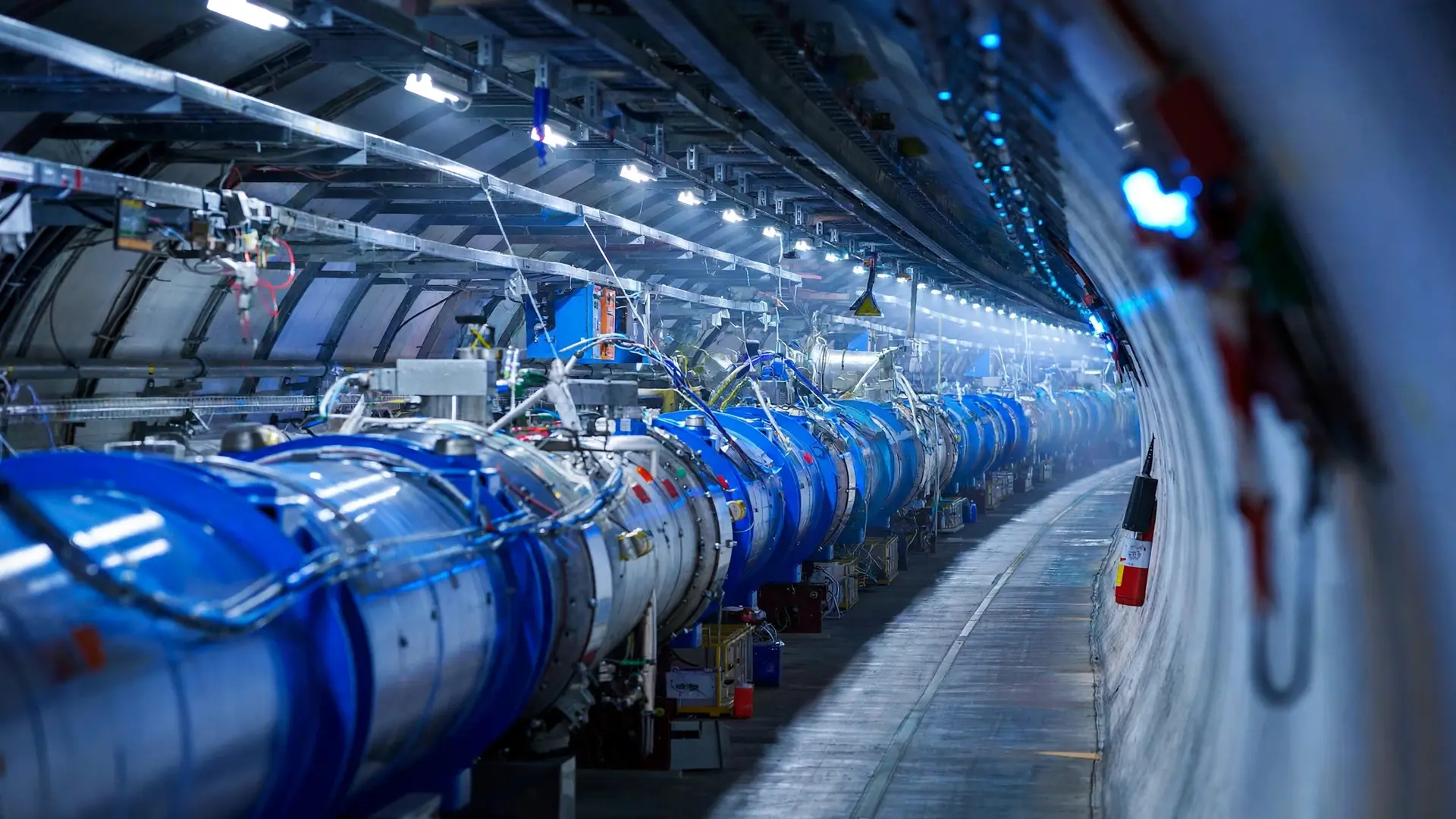
In 1964, several theorists independently found a way to let particles have mass without breaking the mathematical structure of the theory of the weak force — the force at work in radioactive decay and in the reactions that make the Sun shine. Robert Brout and François Englert in Brussels published the idea first; Peter Higgs at the University of Edinburgh published it independently weeks later; a third group — Gerald Guralnik, Carl Hagen, and Tom Kibble — added their own contribution. Physicists now call it the Brout-Englert-Higgs mechanism. The idea made two testable predictions. First, the carriers of the weak force — the W and Z bosons — should be heavy. They were discovered at CERN in 1983, with masses as the theory implied. Second, the field itself should materialize as a new particle: the Higgs boson. But nobody knew its mass. Theorists could only say it had to be lighter than about 1 TeV — beyond any accelerator then conceivable. So began a thirty-year hunt. CERN's LEP collider, running through the 1990s, ruled out anything below 114 GeV. Fermilab's Tevatron in Illinois narrowed the range further before shutting down in 2011. CERN gambled on the Large Hadron Collider, built in the same tunnel as LEP, designed to smash protons together at unprecedented energies and luminosity. Its detectors — ATLAS and CMS, built by thousands of physicists — would watch billions of collisions for the rarest decays of a particle nobody had ever seen.
How do you find something that vanishes in an instant?
The Higgs boson does not hang around for a portrait. It decays almost immediately into other particles, so ATLAS and CMS never saw it directly — they saw its fingerprints: pairs of photons, pairs of W or Z bosons, tau particles, bottom quarks. The strategy was to measure everything, everywhere, and look for a small excess of events at some particular mass that neither background nor error could explain. By the end of 2011, both teams were seeing the same thing: a modest excess, around three sigma, clustered near 125 GeV, driven by the two-photon and four-lepton channels. In particle physics, three sigma is evidence; five sigma — less than a one-in-a-million chance that a background fluctuation produced the signal — is a discovery. When the LHC's collision energy was raised in 2012, the dataset doubled, and the bump at 125 GeV kept growing in both experiments, each reaching about five sigma. Rumors flew around CERN in the days before the joint seminar on July 4; the room was so crowded that only those who had queued overnight got seats. The celebrations were unscripted. ATLAS handed out champagne and T-shirts printed with the famous mass plots — later discovered to contain a typo, which only made them collectors' items. The two papers were published in Physics Letters B a few weeks later. A year later, the 2013 Nobel Prize in Physics went to François Englert and Peter Higgs "for the theoretical discovery of a mechanism that contributes to our understanding of the origin of mass of subatomic particles" — confirmed, the citation added, by ATLAS and CMS at CERN's Large Hadron Collider. Brout had died in 2011; Nobel Prizes are not given posthumously.
What have we learned since — and what is still missing?
Finding the boson was the beginning of a measurement program, not the end. At first the teams cautiously called it a "Higgs-like boson"; only after its properties checked out did they dare call it the Higgs boson. The mass turned out to be a lucky one — about 125 GeV, roughly 130 times the proton's mass — at which the largest number of decay modes are possible, giving physicists many independent ways to study it. Its measured properties have all matched the Standard Model's predictions: zero spin, no electric charge, no interaction with the strong force. One of the neatest results: when physicists plot how strongly different particles interact with the Higgs field against their masses, they get a clean line — the heavier the particle, the stronger the coupling. It is exactly what the 1964 theory predicted, and it is arguably the most convincing portrait of the mechanism at work. And yet the theory leaves enormous questions untouched. The Higgs mechanism explains why elementary particles have mass, but it does not explain dark matter, the matter-antimatter imbalance of the universe, or why the particles have the particular masses they do. Physicists are still hunting for deviations — decays the Standard Model forbids, invisible decay products that might betray new particles. So far, the Higgs boson has refused to misbehave.
A useful way to picture it
The most famous explanation was invented in 1993 by physicist David Miller, who won a challenge to describe the Higgs mechanism in plain language. Imagine the Higgs field as a roomful of party guests, evenly spread and chatting. An unknown person can cross the room almost undisturbed. But a celebrity walking in gets mobbed — a knot of guests clusters around, slowing every step, making each change of direction an effort. That knot of people is the particle's mass. The boson, in this picture, is like a rumor sweeping through the crowd — a cluster that forms and dissolves as it travels. It is made of the same crowd, but it is not the crowd's job; the field was giving mass to particles long before any boson was ever produced. Physicists caution that every analogy leaks if you push it too far, but this one captures the essentials: the field is the background, mass is resistance to motion, and the boson is the field's brief, visible shiver. Physicists had chased that shiver for nearly half a century — a hunt that began with the first map of the atom's structure and ran through the physics of the universe's earliest light. What they found in July 2012 is the reason anything has weight at all.
Frequently asked questions
What exactly is the Higgs boson?
It is a ripple — an excitation — in the Higgs field, the invisible background that fills all of space. Finding it in 2012 confirmed the field itself exists.
How does the Higgs field give particles mass?
Particles moving through the field interact with it, and the interaction resists changes in their motion — what physicists call inertial mass. The stronger a particle interacts with the field, the heavier it is.
Why is the Higgs boson so hard to find?
It is extremely rare and vanishes almost instantly, so experiments had to sift through mountains of collision data. ATLAS and CMS needed signals at five sigma — less than one-in-a-million odds of being a fluke — before claiming discovery.
Is the Higgs boson related to dark matter?
Not directly. It explains the masses of known elementary particles in the Standard Model. Dark matter is a separate unsolved puzzle — and the search for [invisible mass in the universe](/articles/dark-matter-invisible-universe) is one reason physicists keep probing the Higgs for any surprise it might be hiding.