Cosmic Microwave Background: Echo of the Big Bang
In 1964 two Bell Labs astronomers chased a hiss they could not remove. It was the oldest light in the universe, released when the cosmos was 380,000 years old.
Key takeaways
- The cosmic microwave background is light set free when the universe was about 380,000 years old and had cooled enough to become transparent. It now measures about 2.725 K.
- Arno Penzias and Robert Wilson found it by accident at Bell Labs in 1964-65 as a stubborn 3.5 K excess hiss in a horn antenna, and shared half of the 1978 Nobel Prize in Physics.
- Princeton's Robert Dicke and Jim Peebles had predicted the glow and were preparing to look for it; Ralph Alpher and Robert Herman had estimated about 5 K back in 1948.
- NASA's COBE showed the radiation has an almost perfect blackbody spectrum and found ripples of about one part in 100,000, earning John Mather and George Smoot the 2006 Nobel Prize.
- Planck's 2013 results found that dark energy makes up 68.3% of the universe, dark matter 26.8% and ordinary matter only 4.9%, and put its age at about 13.8 billion years.
The cosmic microwave background is the oldest light in the universe: a faint, almost perfectly even glow of microwaves that reaches Earth from every direction. It was set free when the universe was about 380,000 years old and had cooled enough to turn transparent, and the expansion of space has been stretching it ever since, down to a chill 2.725 degrees above absolute zero. Nobody found it on purpose. Two radio astronomers at Bell Labs stumbled on it in 1964 while trying to get rid of it. Their problem was noise. Every radio receiver hisses a little, and careful astronomers account for each fraction of a degree of that hiss before they trust a measurement. Arno Penzias and Robert Wilson had an unusually quiet instrument and a stubborn surplus they could not explain.
What did Penzias and Wilson actually hear?
The instrument was a horn-shaped antenna on Crawford Hill in Holmdel, New Jersey, with a 20-foot (6-meter) opening. Bell Labs had built it in 1959 for Echo, an early satellite communications project, and once newer satellites made Echo obsolete the horn was free for science. Penzias and Wilson used it in 1964 and 1965 to study radio emission from the Milky Way, at a wavelength of about 7 centimeters. Even when pointed at empty sky, the antenna ran about 3.5 kelvin hotter than every known source could account for. The excess was the same in all directions, carried no polarization and showed no seasonal change between July 1964 and April 1965. The pair aimed the horn at New York City to test for urban interference, considered military transmissions and ruled out the galaxy itself. Then there were the pigeons. A pair had moved into the horn and coated its insides with what Penzias called "white dielectric material." The birds were removed, came back, and were finally shot, a decision Penzias later admitted he was not happy about. The horn was scrubbed clean. The hiss barely changed.
How did a Princeton prediction explain the noise?
Penzias mentioned the puzzle to a fellow radio astronomer, Bernard Burke, who had heard about work by Jim Peebles, a young theorist at Princeton. Peebles had calculated that a hot, dense early universe should have left space filled with radiation that might still be detectable. His senior colleague Robert Dicke was getting ready to search for it.
When Penzias phoned, Dicke reportedly put down the receiver and told his team, "Well boys, we've been scooped." The two groups published side by side in the Astrophysical Journal in 1965. Penzias and Wilson's paper was a dry report of excess antenna temperature at 4,080 megahertz; a companion letter from Dicke, Peebles, Peter Roll and David Wilkinson offered the explanation that the excess was relic radiation from the Big Bang. Even that was a rediscovery. In 1948, Ralph Alpher and Robert Herman, working on George Gamow's hot Big Bang model, had estimated that the leftover radiation should now sit at about 5 kelvin. Most experts assumed such a faint glow could never be picked out from other sources, and the idea lay largely forgotten for 17 years. The 1978 Nobel Prize in Physics gave half of its award to Penzias and Wilson "for their discovery of cosmic microwave background radiation," with the other half going to Pyotr Kapitsa for low-temperature physics. Peebles had to wait until 2019, when he received half of that year's physics prize for theoretical discoveries in physical cosmology.
What exactly is this radiation?
For its first few hundred thousand years, the universe was a hot plasma of bare atomic nuclei and electrons. Light could not travel far through it, because free electrons kept knocking photons in new directions, so the whole cosmos glowed like the inside of a fog bank. Some 380,000 years in, the plasma had cooled to around 3,000 K, cool enough for electrons to settle onto protons and form neutral hydrogen. With the free electrons gone, light could fly straight. The universe became transparent. The cosmic microwave background is that released light. It does not come from one spot, because the clearing happened everywhere at once: whichever way a telescope looks, it sees glow from regions that let their light go at that moment. Over 13.8 billion years, the expansion of space has stretched those waves from visible and infrared light into microwaves, and the temperature they correspond to has fallen from about 3,000 K to 2.725 K.
NASA's Cosmic Background Explorer, COBE, launched on November 18, 1989, put that story to the test. Its FIRAS instrument measured the spectrum at wavelengths from 1 centimeter down to half a millimeter and found an almost ideal blackbody curve, the exact shape expected from radiation that was once in thermal balance with matter. When John Mather showed the result at an American Astronomical Society meeting in January 1990, the audience greeted it with long applause. In April 1992, the team behind COBE's differential radiometer, led by George Smoot, announced the first detection of slight temperature differences across the sky, about 30 millionths of a degree, or roughly one part in 100,000. Mather and Smoot shared the 2006 Nobel Prize in Physics.
What do the tiny ripples reveal?
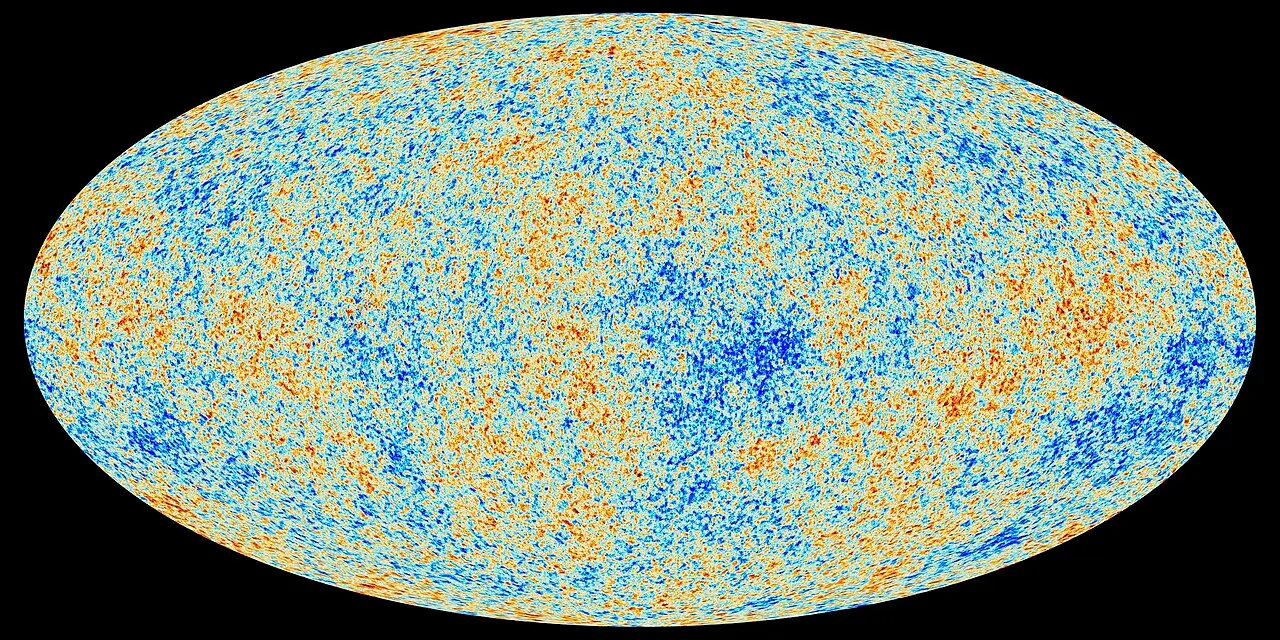
Those faint hot and cold patches are the imprint of slightly denser and thinner regions in the early universe. Gravity worked on them for billions of years, and the denser regions grew into the galaxies and clusters seen today. COBE could only make out broad blotches. NASA's WMAP, launched in June 2001 and observing until August 2010, sharpened the map and put the age of the universe at 13.77 billion years. ESA's Planck satellite, launched on May 14, 2009, scanned the sky in nine frequency bands until October 2013 and produced the most detailed map yet. Fitting the statistics of those spots to the standard cosmological model turns them into a recipe. Planck's first results, in 2013, found that dark energy accounts for 68.3% of the cosmos and dark matter for 26.8%, leaving the ordinary matter of stars, planets and people with just 4.9%. They also put the age of the universe at about 13.8 billion years. Planck's final analysis, released in 2018, pinned five of the model's six basic parameters to better than 1%. That precision has also exposed a crack. Read through the standard model, Planck's map implies the universe is expanding today at about 67 kilometers per second per megaparsec. Measurements built on nearby Cepheid stars and supernovae give about 73. The gap, known as the Hubble tension, has not closed. It may turn out to be a subtle measurement problem or a sign of new physics, and it adds to the open questions surrounding dark energy. The hiss that Penzias and Wilson tried to scrub out of a horn antenna turned out to be a photograph of the universe at 380,000 years old. Six decades later, the same faint glow fixes the age of the cosmos, its mix of matter and energy, and the starting pattern from which every galaxy grew. It also holds one of cosmology's biggest unsolved arguments, written in spots whose temperatures differ by a few tens of millionths of a degree.
Frequently asked questions
Who discovered the cosmic microwave background?
Arno Penzias and Robert Wilson of Bell Labs detected it in 1964 and 1965 with a horn antenna in Holmdel, New Jersey. A Princeton group led by Robert Dicke explained the signal as radiation left over from the Big Bang.
Why is the Big Bang's light now in microwaves?
The light left the young universe when it was around 3,000 K. The expansion of space has stretched its waves ever since, so today it matches a temperature of just 2.725 K, which puts its glow in the microwave band.
Did pigeons cause the mysterious noise?
No. Pigeons nesting in the antenna had coated it with droppings, which Penzias called white dielectric material, but evicting the birds and scrubbing the horn left the hiss almost unchanged. It was coming from space.
What do the hot and cold spots in the CMB show?
They mark slightly denser and thinner regions of the early universe, differing by about one part in 100,000. Gravity grew the denser regions into galaxies and clusters, and the statistics of the spots let Planck measure what the universe is made of.
Sources
- Press release: The 1978 Nobel Prize in Physics, Nobel Prize
- Murmur of a Bang (Cosmic Times), NASA
- Cosmic background explorer, Scholarpedia (by COBE PI John C. Mather)
- Planck 2018 results. I. Overview, and the cosmological legacy of Planck, European Space Agency
- Planck's new cosmic recipe, European Space Agency
- Press release: The Nobel Prize in Physics 2019, Nobel Prize