The Haskell Free Library: One Building, Two Countries
The Haskell Free Library was built deliberately across the US-Canada border: front door in Vermont, books in Quebec, stage in Canada, seats in America.
Key takeaways
- The Haskell Free Library and Opera House straddles the Canada-US border between Stanstead, Quebec, and Derby Line, Vermont, by deliberate design.
- The front door is in the United States, while the circulation desk and all the books are in Canada; the reading room is international.
- Upstairs, the 500-seat opera house has its stage in Canada and most of its audience seats in the United States.
- It was a 1901-1904 gift from Martha Stewart Haskell and her son, built for about $50,000 to serve both border communities.
- Canada designated it a national historic site in 1985; it is also listed on the US National Register of Historic Places.
The Haskell Free Library and Opera House was built deliberately across the Canada-United States border, and it has been confusing border officials and delighting visitors ever since. The front door is in Derby Line, Vermont; the books are in Stanstead, Quebec; upstairs, the opera house stage sits in Canada while most of the audience sits in America. It is the only building of its kind in the world.
- It was constructed deliberately astride the boundary line separating Canada from the United States, and is classified a historic site by the governments of Canada, the United States, Quebec, and Vermont. (Haskell Free Library & Opera House)
- The gift of Martha Stewart Haskell and her son, Colonel Horace Stewart Haskell, it was dedicated to Martha's late husband Carlos, a prominent merchant. (Haskell Free Library & Opera House)
- The cornerstone was laid on October 15, 1901; the building was designed by Stanstead architect James Ball and his partner Gilbert Smith of Boston, and completed in 1904 at an estimated cost of $50,000. (Haskell Free Library & Opera House)
- There was one condition on the gift: the building must serve people living on both sides of the Canada-United States border. (Parks Canada)
- The front door is in the US, the circulation desk and all of the books are in Canada, and the reading room is international; upstairs, most of the audience sits in the US watching a show on a stage in Canada. (Haskell Free Library & Opera House)
- The Government of Canada recognized it as a national historic site on November 15, 1985; the American portion is listed on the US National Register of Historic Places. (Parks Canada)
Who built a library on a border, and why?
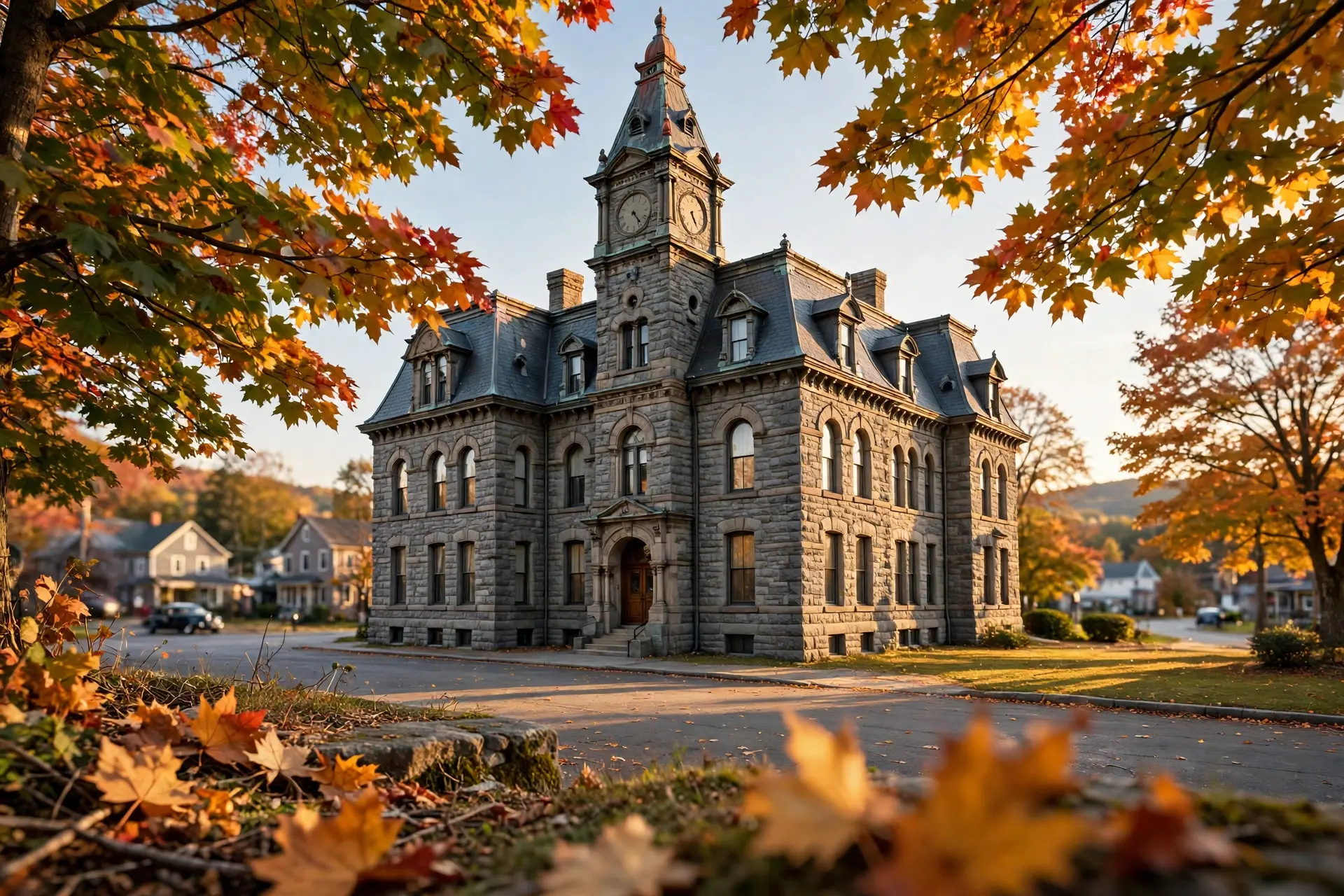
Martha M. Stewart was born in Beebe Plain, Quebec, in 1831, married Carlos Freeman Haskell, a merchant from Rock Island, in 1851, and moved to Vermont. She held dual citizenship and lived in Derby Line until her death in 1906. She and her son Colonel Horace Stewart Haskell wanted to give the border communities a center for learning and cultural enrichment, and they chose the site precisely because it straddled the boundary: no town could claim it, so both would share it. Construction ran from October 1901 to June 1904 under contractor Nathan Beach of Georgeville, Quebec. The reported cost, about $50,000, was a princely sum at the time. The building is Queen Anne Revival in style, with Stanstead grey granite outside and stained glass, mosaics, tin ceilings, and rare native woods inside. A persistent rumor says it is a scale replica of the Boston Opera House; the Haskell's own historians say that is quite untrue, and the building is in fact unique.
Which side is what?
| Part of the building | Country |
|---|---|
| Front door | United States (Vermont) |
| Circulation desk and all the books | Canada (Quebec) |
| Reading room | International, split by a black line on the floor |
| Opera house stage | Canada |
| Most of the 500 audience seats | United States |
| Back facade | Georgian/neo-Classical, facing both nations equally |
| The border itself, the 45th parallel, is marked by a thick black line running diagonally across the public spaces, under the stacks and the circulation desk. Outside, a small granite marker reads "UNITED STATES" on one side and "CANADA" on the other. But the building is not a border crossing, and it does not function as one: you cannot walk in from Vermont and stroll out into Quebec. Officials on both sides keep an eye on the place, which is why the library advises visitors to carry identification. | |
| The opera house was never just decoration. The original charter, dated 1908, required it to be "forever managed and used for the support and maintenance" of the library downstairs. Ticket sales were supposed to keep the books open. It never made the money the Haskells intended, but it did make history. |
What has happened on that split stage?
Opening night was June 7, 1904, and the Haskell's own history is candid about what that meant in 1904: the Columbian Minstrels performed an old-fashioned black-face routine, followed by the musical comedy "The Isle of Rock." Over the century that followed, the stage hosted William Jennings Bryan, Arctic explorer Vilhjalmur Stefansson, and the Mohawk poet E. Pauline Johnson; vaudeville troupes, jazz and bluegrass bands, the Vermont Symphony Orchestra, and I Musici de Montreal all played to audiences sitting in America watching performers standing in Canada. The drop curtain, scenery, props, and stage machinery are all original and form one of the most complete surviving sets of their kind anywhere. The painted scenery, shipped in by train, is believed to be the only surviving work of the Boston artist Erwin LaMoss. The building nearly lost its stage in the 1990s. From 1993 to 1997 the opera house closed to meet government requirements for handicapped access and fire safety. A year of construction added sprinklers, an elevator, and a fire escape tower, all designed to respect the historic character, and the opera house reopened amid much fanfare. Since 1997 it has run a full schedule of shows each season, from spring through fall, with everything from the Vermont Symphony Orchestra to the Montreal West Operatic Society's Gilbert and Sullivan productions playing to sell-out crowds.
Why does it still matter?
Because borders are supposed to divide, and this one was built to unite. The Haskell survived the arrival of film, radio, and television, which were all supposed to make small-town opera houses obsolete. It closed from 1993 to 1997 to meet accessibility and fire-safety rules, reopened with sprinklers, an elevator, and a fire escape tower that respected its historic character, and now runs a full season of shows from spring through fall. Enclaves and border oddities usually arise by accident, like the Belgian and Dutch counters of Baarle or the triple points where three countries shake hands. The Haskell is the rare border anomaly built on purpose, with a border drawn through the reading room by people who refused to pick a side. How we made this article: FactSpire researched and drafted it with AI assistance and checked every fact against the sources listed above.
Frequently asked questions
Can you cross the border inside the Haskell Library?
No. The building is not a border crossing. A thick black line runs across the hardwood floor marking the Canada-US border, but you cannot enter one country and exit the other through the library. Visitors are encouraged to bring personal identification in case Canadian or American authorities question them.
Why was the Haskell built on the border?
On purpose. Martha Stewart Haskell, who was born in Quebec, married a Vermonter, and held dual citizenship, and her son wanted the building to serve the residents of both countries equally. Selecting a site that straddled the boundary between Derby Line and Stanstead was how they guaranteed it. The gift came with one condition: it must serve people on both sides.
Which parts of the Haskell are in which country?
The front door is in the United States. The circulation desk, all the books, and the reading room's Canadian half are in Canada. Upstairs, the opera house stage is in Canada while most of the 500 audience seats are in the United States, which is why it is sometimes called the only opera house in America with no stage.
Is the Haskell still open?
Yes. It remains a working library and a performance venue hosting concerts, theater, and lectures each season from spring through fall. It closed from 1993 to 1997 for accessibility and fire-safety upgrades, including sprinklers, an elevator, and a fire escape tower, then reopened with its historic character intact.
Sources
- Our Story - HASKELL FREE LIBRARY & OPERA HOUSE, Haskell Free Library & Opera House
- The Haskell Free Library and Opera House, Parks Canada
- National Register of Historic Places nomination: Haskell Free Library and Opera House, National Park Service