DNA: The Double Helix That Holds the Code of Life
DNA stores life's instructions in a four-letter chemical code. Learn how cells read and copy it, who solved its structure, and how it might archive our data.
Key takeaways
- DNA writes genetic information in four chemical letters, A, C, G and T, and A always pairs with T and C with G, so each strand of the double helix mirrors the other.
- One set of human chromosomes holds about 3 billion letters, yet the protein-coding parts of its roughly 20,000 genes make up only about 1 percent of that sequence.
- Cells copy a gene into messenger RNA, then ribosomes read it three letters at a time: 61 of the 64 possible codons specify amino acids and 3 mean stop.
- Rosalind Franklin and Raymond Gosling's X-ray image, Photograph 51, fed the double-helix model Watson and Crick published in Nature on 25 April 1953.
- In 2013 researchers stored 739 kilobytes, including all 154 Shakespeare sonnets, in synthetic DNA and read it back with 100% accuracy.
DNA is a long, two-stranded molecule that stores information as a sequence of four chemical letters: A, C, G and T. The order of those letters spells out instructions, much as the order of ones and zeros encodes a computer file, and cells read them three at a time to build proteins. One set of human chromosomes carries about 3 billion of these letters, copied faithfully every time a cell divides.
How can four letters store so much information?
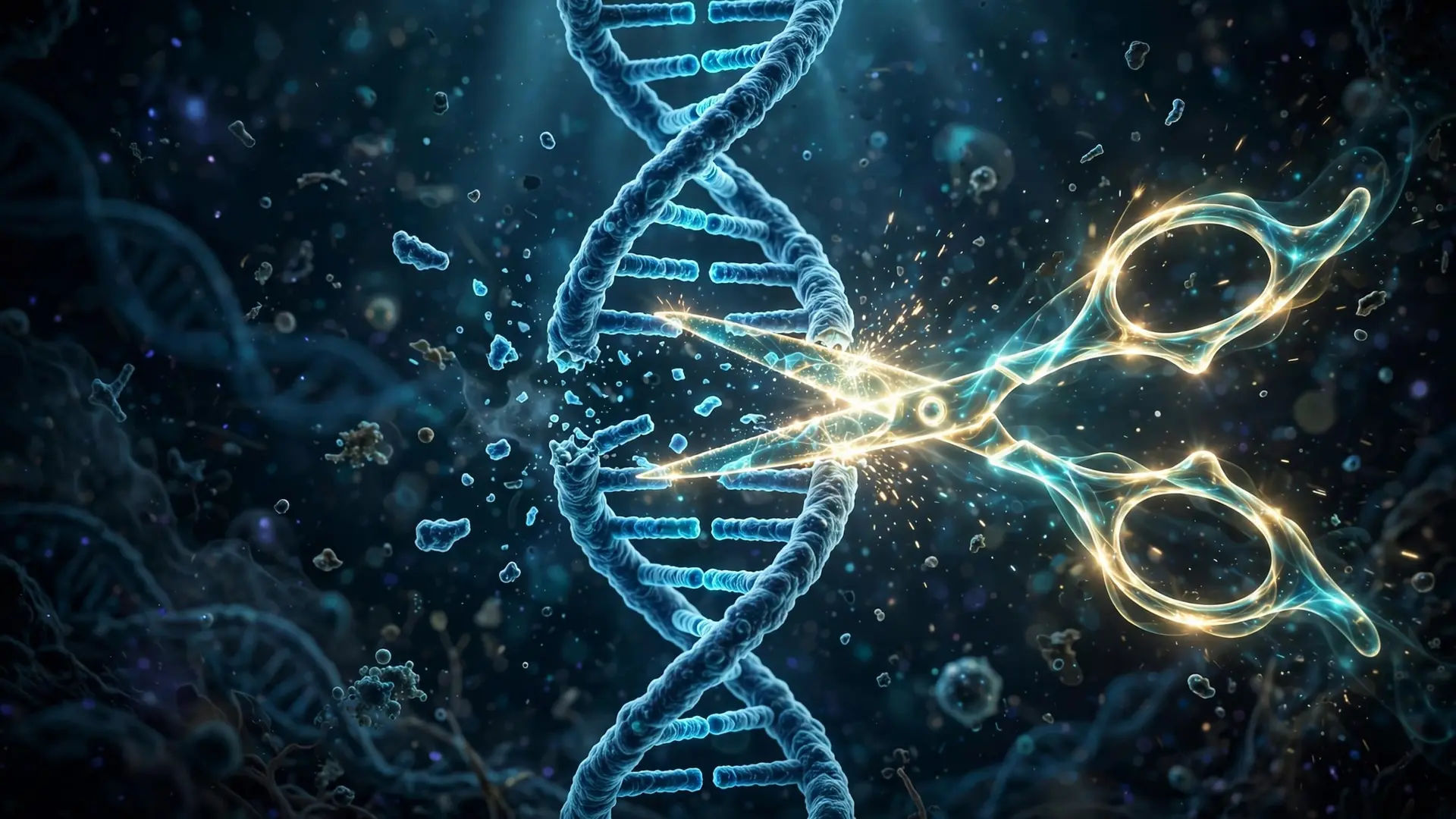
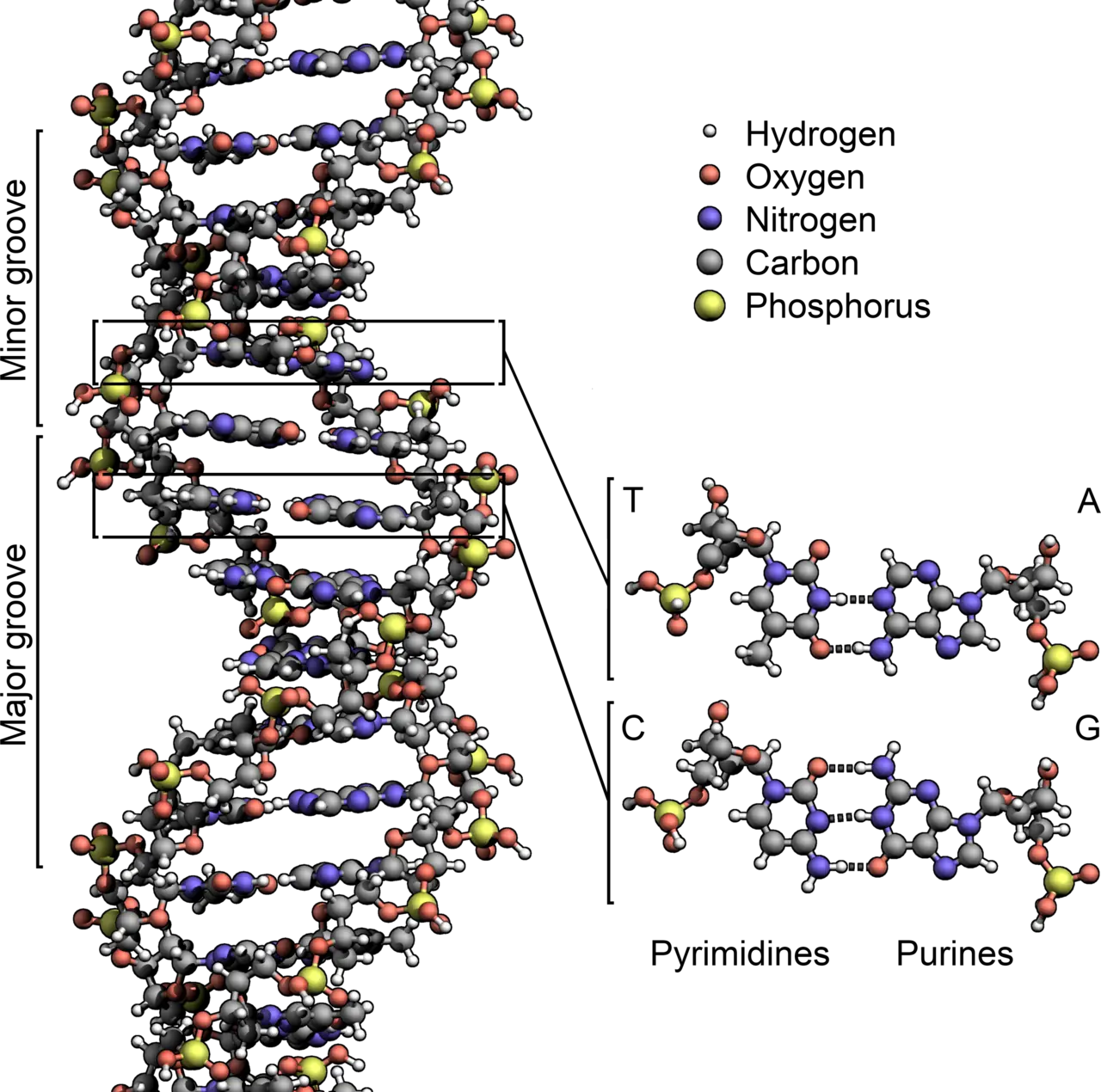
Each letter is carried by a nucleotide, a small unit built from a phosphate, the sugar deoxyribose and one of four bases: adenine (A), thymine (T), guanine (G) or cytosine (C). Sugars and phosphates link up to form a backbone, and two of these strands wind around each other into the famous double helix, which looks like a twisted ladder. The rungs are pairs of bases held together by hydrogen bonds. The pairing follows strict rules. A always sits opposite T, and C always sits opposite G. That simple chemistry has a powerful consequence: if you know the sequence of one strand, you automatically know the other. Every DNA molecule carries its own backup copy, and its own template for making more. In information terms, each position holds one of four possible letters, which is worth two bits. Three billion letters therefore come to about 6 billion bits, or roughly 750 megabytes, and most cells hold two copies, one from each parent, inside a nucleus far too small to see. That text is split into 23 chromosomes and contains about 20,000 genes, the stretches that code for proteins. Surprisingly, the protein-coding parts of those genes account for only about 1 percent of the sequence. Some of the rest helps control when, where and how strongly genes are switched on. Because the message is just a sequence, changing even one letter can change its meaning. That is the property gene-editing tools such as CRISPR exploit when they rewrite a chosen stretch of the code.
How does a gene become a protein?
A cell never builds proteins directly from its DNA. First it makes a working copy. In a step called transcription, the cell copies a gene's sequence into messenger RNA (mRNA), a single-stranded cousin of DNA that uses the letter U, for uracil, where DNA uses T. In human cells the mRNA then travels out of the nucleus into the surrounding cytoplasm.
There, ribosomes take over in a step called translation. They read the mRNA in three-letter words called codons, adding one amino acid to a growing chain for each word. Four letters taken three at a time give 64 possible codons. According to the US National Human Genome Research Institute, 61 of them specify amino acids and 3 act as stop signals. Since proteins are built from just 20 amino acids, most amino acids have several codons, a redundancy that softens the impact of some copying errors. The finished chain folds into a working protein: an enzyme, a hormone, a strand of muscle. This reading machinery is exactly what mRNA vaccines put to work. They deliver a message, and the cell's own ribosomes build the protein it describes. Copying the whole text is simpler still. Before a cell divides, the double helix unzips into two single strands, and each one serves as a template for a new partner: A is added opposite every T, C opposite every G. The result is two DNA molecules, each a copy of the original. When James Watson and Francis Crick unveiled the double helix, they remarked, with famous understatement, that it had "not escaped our notice" that the pairing hinted at how genetic material could be copied.
Who worked out the structure of DNA?
The molecule was found long before anyone knew what it did. In 1869, the Swiss chemist Friedrich Miescher isolated a substance he called "nuclein" from the nuclei of white blood cells, which he collected from pus-soaked surgical bandages. Early chemistry undersold it. In 1919 Phoebus Levene proposed that nucleic acids are chains of nucleotide units, but his "tetranucleotide" model, in which the bases always repeated in the same order, turned out to be far too simple. The decisive experiment came in 1944. Oswald Avery, Colin MacLeod and Maclyn McCarty at the Rockefeller Institute showed that the substance able to transform one type of pneumococcus bacterium into another consisted "principally, if not solely" of DNA. Six years later, Erwin Chargaff reported that the amounts of A and T in DNA roughly match, as do the amounts of G and C, a clue to the pairing. The structure itself emerged in 1953. At King's College London, Rosalind Franklin and her graduate student Raymond Gosling had taken a remarkably clear X-ray image of DNA in 1952, later known as Photograph 51. In early 1953 Maurice Wilkins, Franklin's colleague at King's, showed it to Watson; Gosling, by then working under Wilkins, had handed the image to his new supervisor. Crick's supervisor Max Perutz also handed the pair a lab report that included Franklin's data. Watson and Crick's model appeared in Nature on 25 April 1953, alongside papers by Wilkins's group and by Franklin and Gosling.
Crick, Watson and Wilkins received the Nobel Prize for physiology or medicine in 1962. Franklin had died of ovarian cancer in 1958, aged 37. Her story is often told as one of stolen data, but in 2023 Matthew Cobb and Nathaniel Comfort, drawing on a forgotten letter and a 1953 news article that never ran, argued in Nature that she was "an equal contributor" to solving the structure.
How much of the human genome have we read?
The Human Genome Project, run from 1990 to 2003 by 20 universities and research centers in six countries, announced an essentially complete sequence in April 2003. In fact it covered about 92 percent of the genome, with fewer than 400 gaps. Much of what was missing sat in repetitive DNA near the ends and centers of chromosomes, regions earlier methods struggled to read. Filling them took almost two more decades. On 31 March 2022, the Telomere-to-Telomere (T2T) consortium published the first truly complete, gapless human sequence in Science. A finished Y chromosome, missing from that genome, followed in 2023. Its secret was long-read technology: Oxford Nanopore machines that read up to a million letters at a stretch, and PacBio instruments reading about 20,000 letters with near-perfect accuracy.
Could DNA store our digital data?
If DNA can archive a genome, why not a hard drive? In 2012, George Church and colleagues at Harvard's Wyss Institute encoded an entire book, Regenesis, including its images, in 54,898 short DNA sequences, each holding 96 bits of data and a 19-bit address. They estimated a storage density of 5.5 petabits per cubic millimeter. Early the next year, a team at the European Bioinformatics Institute went further. Nick Goldman and colleagues encoded 739 kilobytes of files: all 154 of Shakespeare's sonnets, a 26-second audio clip of Martin Luther King Jr.'s "I Have a Dream" speech, a photograph and, fittingly, a PDF of Watson and Crick's 1953 paper. The DNA was synthesized in California, shipped to the researchers at the European Bioinformatics Institute in England, then sequenced and decoded with 100% accuracy. The appeal is density and stability; the 2013 paper's title promised "high-capacity, low-maintenance" storage. The catch is speed and cost. Writing DNA remains slow and expensive, so the technology is aimed at archives that are rarely opened rather than at the photos on your phone. DNA's power lies in its simplicity: four letters, two pairing rules and a cell that reads three letters at a time. That small alphabet builds every protein in your body, preserved and copied across billions of cell divisions. Scientists are now borrowing the same code to keep our own records, proof that the oldest information technology on Earth may also be one of the most advanced.
Frequently asked questions
What does DNA actually do?
It stores the instructions for building proteins. The order of its four chemical letters spells out each gene, which the cell copies into messenger RNA and then translates into a chain of amino acids.
How many genes do humans have?
About 20,000. Their protein-coding parts make up only about 1 percent of the roughly 3 billion letters in one set of human chromosomes; some of the rest helps control when and how strongly genes are used.
Who discovered the structure of DNA?
James Watson and Francis Crick published the double-helix model in 1953, but it rested on X-ray work at King's College London by Rosalind Franklin, her student Raymond Gosling and Maurice Wilkins.
Can DNA be used to store computer data?
Yes, in research labs. Teams have encoded a whole book, Shakespeare's sonnets and an audio clip in synthetic DNA and recovered the files, although writing DNA is still too slow and costly for everyday use.
Sources
- Human Genome Project, National Human Genome Research Institute
- Discovery of DNA Double Helix: Watson and Crick | Learn Science at Scitable, Nature Education
- Researchers generate the first complete, gapless sequence of a human genome, National Institutes of Health
- Synthetic double-helix faithfully stores Shakespeare's sonnets, BioEd Online / Nature News
- What Rosalind Franklin truly contributed to the discovery of the structure of DNA, phys.org
- Nobel Prize in Physiology or Medicine 1962 (Speed read), NobelPrize.org