The Discovery of CRISPR: From Salt Marsh to Nobel Prize
Nobody invented CRISPR. Odd DNA repeats in a salt-marsh microbe and a yogurt-culture firm's virus problem led to the 2012 gene editor that won a Nobel Prize.
Key takeaways
- CRISPR was not invented — it was discovered as a bacterial immune system, first spotted by Yoshizumi Ishino in 1987 and recognized as a defense mechanism by Francisco Mojica in 2003.
- In 2007, Rodolphe Barrangou and Philippe Horvath proved experimentally that bacteria use CRISPR to fight off viruses by storing pieces of viral DNA.
- In June 2012, Jennifer Doudna and Emmanuelle Charpentier showed the bacterial system could be reprogrammed to cut any DNA sequence using a short guide RNA.
- Lithuanian biochemist Virginijus Šikšnys independently showed Cas9 could be programmed to cut DNA; his paper appeared in PNAS in September 2012.
- Doudna and Charpentier received the 2020 Nobel Prize in Chemistry, only eight years after their discovery was published.
CRISPR was not invented — it was found. In the early 1990s, Spanish microbiologist Francisco Mojica was studying how a salt-loving microbe survived in the salt marshes of Santa Pola when he noticed strange, regularly repeating sequences in its DNA. Those repeats turned out to be part of a microbial immune system — a filing cabinet of viral mugshots — and by 2012 scientists had converted it into a tool that can rewrite the DNA of any living thing. No one in 1993 was looking for a gene editor. That is precisely why the story matters.
How did a salt-loving microbe reveal a hidden immune system?
Mojica was not hunting for biotechnology's next revolution. In 1989 he joined the microbiology group at the University of Alicante on a contract to measure water quality along the region's beaches, and his PhD research focused on Haloferax mediterranei, a microbe his doctoral advisor had isolated from the Santa Pola salt marshes. He was trying to understand how the organism adapted to changing salt concentrations. But in its genome he found something the scientific literature could not explain: short sequences of DNA repeating at perfectly regular intervals, palindromic and bizarre. Intrigued but without the means to pursue it, he set the mystery aside until the mid-1990s, when his own lab was running. He was not even the first to see the pattern — Japanese researcher Yoshizumi Ishino had spotted similar repeats in E. coli in 1987 — but Mojica was the one who became obsessed with what they were for. His hunch came from database searches. Using the bioinformatics tool BLAST, Mojica found that the "spacer" sequences sitting between the repeats matched DNA from viruses that infect bacteria. Why would viral DNA end up inside a bacterium's own genome? He hypothesized that the repeats were an adaptive immune system: bacteria were filing away fragments of past attackers. In 2001, Dutch scientist Ruud Jansen gave the phenomenon its now-famous name — CRISPR, for Clustered Regularly Interspaced Short Palindromic Repeats — and named the enzymes flanking them Cas, for CRISPR-associated. Mojica's key insight arrived in 2003: CRISPR was bacterial immunity.
How does a bacterium "remember" a virus?
The mechanism is almost embarrassingly clever. When a virus infects a bacterium and the bacterium survives, it snips out a fragment of the viral DNA and slots it into its CRISPR array as a new spacer — a genetic mugshot. On the next encounter, the bacterium transcribes those stored fragments into small RNA guides. These guide RNAs steer Cas cutting proteins to any matching viral DNA and slice it apart before the infection can take hold. It took years to prove this in the lab. The decisive experiment came in 2007, when Rodolphe Barrangou and Philippe Horvath — researchers at Danisco, a company that supplies bacteria for yogurt — demonstrated that the system genuinely protected bacteria against viral attack. Yogurt-making was at stake: viruses called phages routinely devastate bacterial cultures used in fermentation, and Barrangou and Horvath showed that CRISPR-armed bacteria remembered and destroyed the phages. Around 2008, Luciano Marraffini and Erik Sontheimer clarified that the target of the system was DNA itself, not RNA interference as some had assumed. So by the end of the 2000s, science had a complete picture of a microscopic immune system that could find a chosen DNA sequence and cut it. It took one more leap to see the system as a tool rather than a curiosity.
When did the immune system become an editing tool?
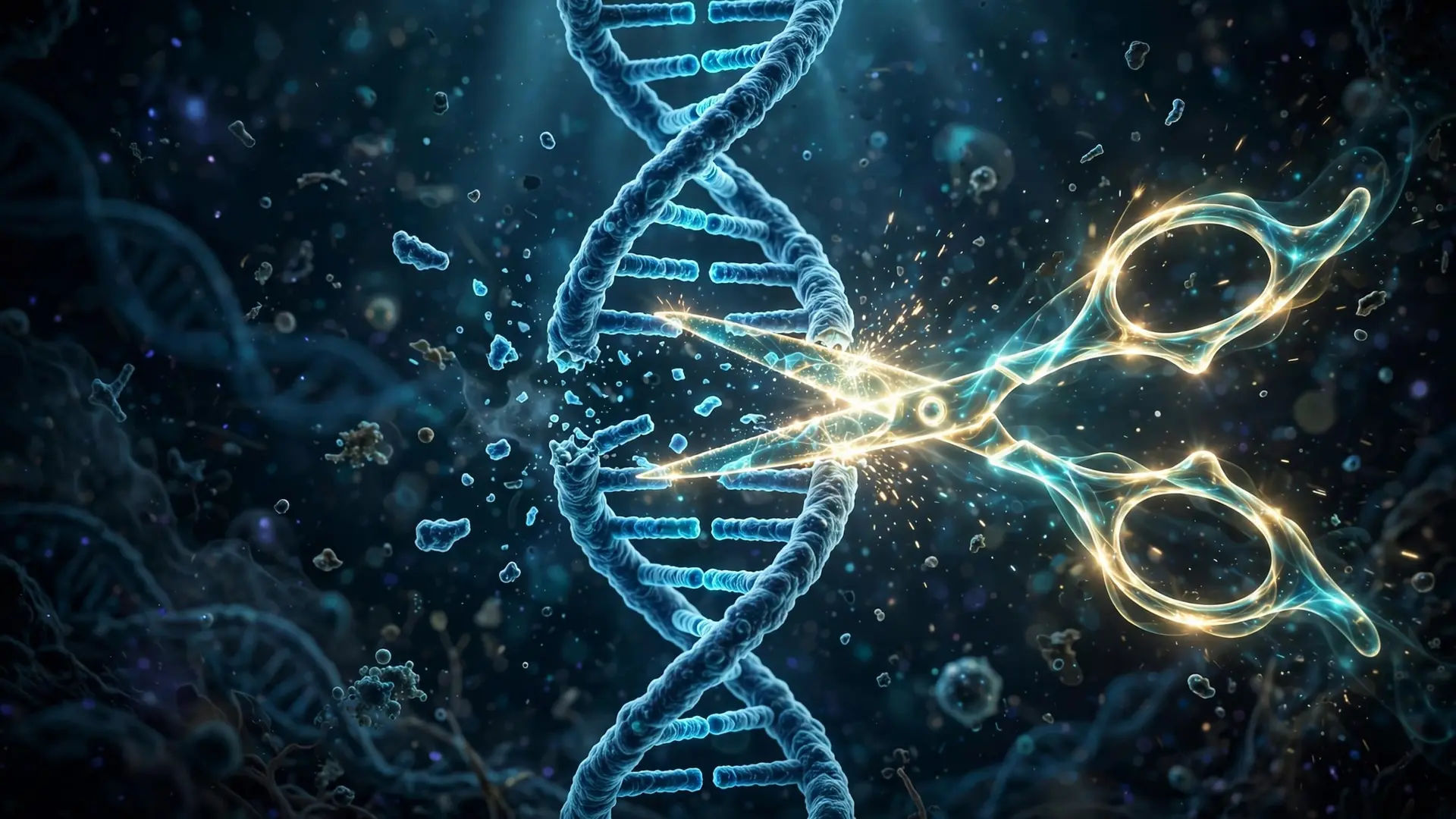
That leap came from Emmanuelle Charpentier and Jennifer Doudna. In 2011, Charpentier discovered the last essential component of the machinery: tracrRNA, a small RNA that partners with the CRISPR guide to activate Cas9, the cutting protein. She and Doudna then did something elegant — they fused the two RNA components into a single guide RNA, a programmable "address" of about 20 nucleotides. In June 2012, their paper in Science showed that Cas9, loaded with this synthetic guide, could be aimed at any DNA sequence a researcher chose.
The implications were immediate because the economics were absurd. Older editing methods required custom-building a protein for every target — weeks of specialist work and thousands of dollars per edit. CRISPR needed only a short RNA, designed on a computer in minutes and synthesized cheaply, that could be delivered to cells in days. Editing a gene dropped in cost and complexity by roughly a hundredfold overnight. In January 2013, Feng Zhang at the Broad Institute independently demonstrated that the system worked in human cells, and a fierce patent dispute between the Berkeley and Broad teams followed. It outlasted the Nobel: in May 2025 a US appeals court sent the question of who invented first back to the patent board, which in March 2026 again sided with the Broad. Doudna and Charpentier were not alone in 2012, either. In Vilnius, the Lithuanian biochemist Virginijus Šikšnys had reached the same conclusion — that Cas9, guided by RNA, could be programmed to cut DNA at a chosen site. A leading journal turned his manuscript away in April 2012 without sending it out for review, and it finally appeared in PNAS that September, about three months after the Doudna-Charpentier paper. The 2018 Kavli Prize in Nanoscience later went to Charpentier, Doudna and Šikšnys together, a belated nod to how close the race had been. On October 7, 2020, the Royal Swedish Academy of Sciences awarded the Nobel Prize in Chemistry to Charpentier and Doudna — for the first time in history, two women shared the prize alone. Just eight years separated their 2012 paper from the highest honor in science, one of the fastest Nobel recognitions ever.
How quickly did the discovery reach patients?
The jump from journal pages to patients took just eleven more years. In November 2023, the UK medicines regulator approved Casgevy, developed by Vertex Pharmaceuticals and CRISPR Therapeutics, and on December 8, 2023, the U.S. Food and Drug Administration followed — the first CRISPR-based gene-editing therapy ever approved, for sickle cell disease and transfusion-dependent beta-thalassemia. How that one-time treatment rewires a patient's blood cells, and what CRISPR still cannot do, is the subject of our plain-language guide to how CRISPR edits DNA. There is a quiet poetry in the timing. Sickle cell disease was dubbed "the first molecular disease" by Linus Pauling nearly 75 years ago — and it is now the first disease treated by the molecule found in a salt-marsh microbe. Questions of cost, access, and long-term safety remain, and editing the DNA of reproductive cells is off-limits worldwide. But the pipeline that opened in 2012 is now treating people. CRISPR belongs to the same family of revelations as the radium pioneers who turned radioactivity into medicine: nobody funds the search for the unknown on a spreadsheet. It began with someone staring at a pattern that looked like noise until it resolved into meaning. The most powerful medical technology of this century was hiding inside bacteria for billions of years, waiting for someone to ask what the repeats were for.
Frequently asked questions
What does CRISPR actually stand for?
CRISPR stands for Clustered Regularly Interspaced Short Palindromic Repeats — the pattern of repeating DNA sequences bacteria use to store pieces of viral DNA. Dutch researcher Ruud Jansen coined the term in 2001, along with the name Cas for the CRISPR-associated cutting proteins.
How was CRISPR discovered?
Japanese scientist Yoshizumi Ishino first noticed the unusual repeating DNA sequences in 1987, and Spanish microbiologist Francisco Mojica recognized them as a bacterial immune system in the early 2000s. The antiviral function was proven experimentally in 2007 by Rodolphe Barrangou and Philippe Horvath.
Who turned CRISPR into a gene-editing tool?
Emmanuelle Charpentier and Jennifer Doudna demonstrated in June 2012 that the bacterial system could be reprogrammed with a single guide RNA to cut any chosen DNA sequence. They received the 2020 Nobel Prize in Chemistry for the breakthrough.
Who else helped turn CRISPR into a tool?
Virginijus Šikšnys of Vilnius University independently showed in 2012 that Cas9 could be programmed to cut DNA, and he shared the 2018 Kavli Prize with Doudna and Charpentier. Feng Zhang at the Broad Institute showed the system working in human cells in early 2013.