How Did Constantinople Store Water for a Million People?
At its peak Constantinople held about 500,000 people, served by the ancient world's longest aqueduct and the 80,000-cubic-metre Basilica Cistern.
Key takeaways
- Constantinople never held a million people; the conventional 6th-century peak estimate is about 500,000, ranging from 400,000 to 750,000.
- The Basilica Cistern, rebuilt by Justinian after the Nika revolt of 532, holds roughly 80,000 cubic metres (21 million gallons) of water.
- The Valens aqueduct system stretched at least 426 km (265 miles) with 90 large bridges, the longest water line of the ancient world.
- Limescale evidence shows the Byzantines cleaned the aqueduct regularly for more than 700 years; a 50 km double channel allowed maintenance without shutdown.
- The cistern's 336 columns are spolia reused from older temples, including two upside-down Medusa heads as column bases.
Constantinople never held a million people; at its 6th-century peak it held perhaps half a million, fed by the longest aqueduct system of the ancient world and stored in underground cisterns. The most famous, the Basilica Cistern, holds about 80,000 cubic metres beneath 336 columns. The real marvel is the maintenance: the Byzantines kept the water flowing for 700 years.
Key facts
- The conventional estimate for Constantinople's mid-6th-century peak is around 500,000 people, though scholar Anthony Kaldellis notes estimates range from 400,000 to 750,000 (source).
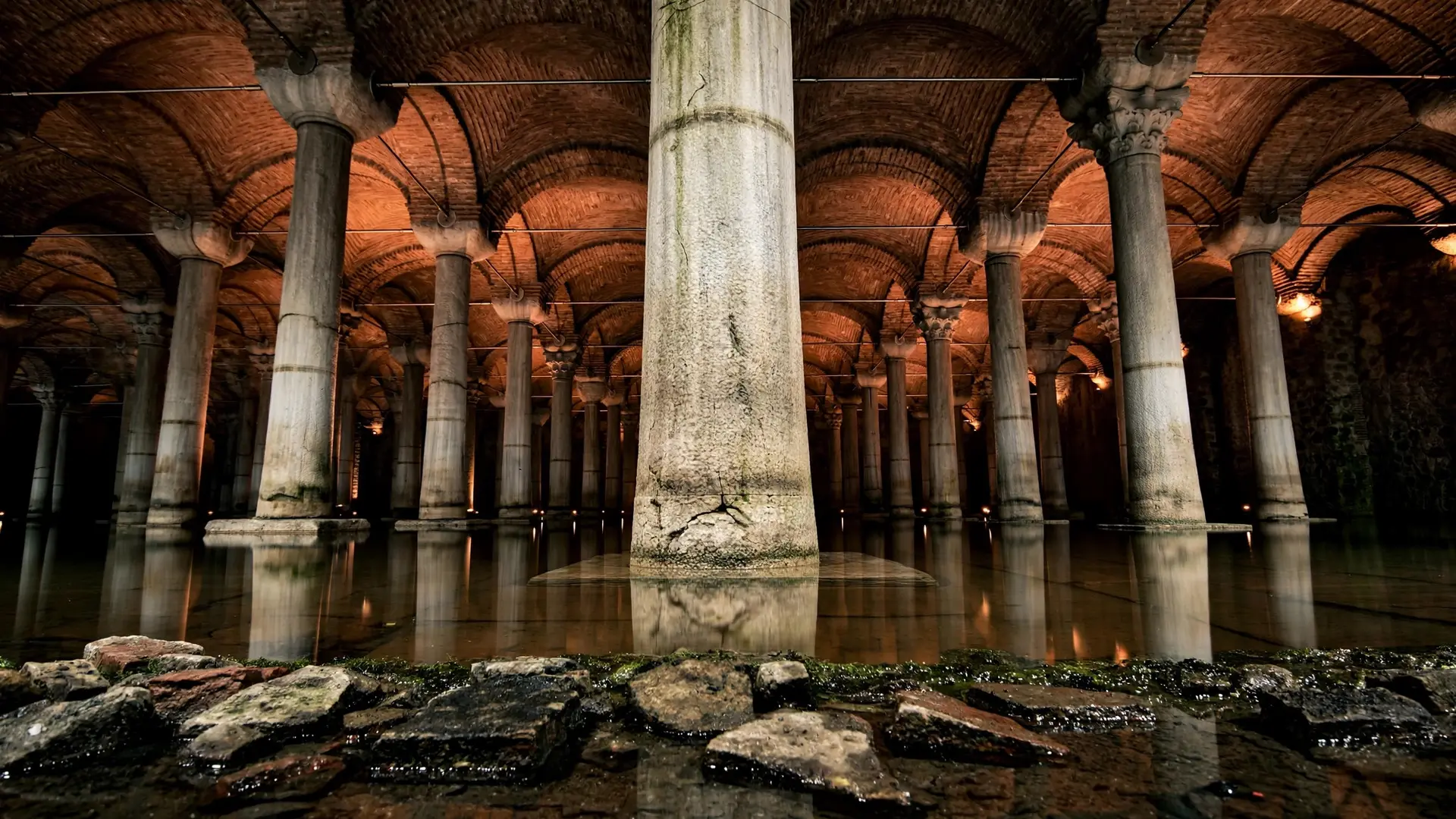
- Emperor Justinian rebuilt the Basilica Cistern after the Nika revolt of 532; its vaulted hall measures 138 by 65 metres, and its roof rests on twelve rows of twenty-eight marble columns about 9 metres high (source).
- The cistern's maximum capacity is about 80,000 cubic metres, some 21 million gallons, brought in from a source roughly 20 km away through a new aqueduct also built under Justinian (source).
- The full Valens aqueduct system reached at least 426 km (265 miles), making it the longest of the ancient world, with vaulted masonry channels "large enough to walk through," 90 large bridges and tunnels up to 5 km (3 miles) long (source).
- Geologists at Johannes Gutenberg University Mainz found only about 27 years of limescale inside channels that ran for more than 700 years, until at least the 12th century, proof of systematic, repeated cleaning (source).
- To allow that cleaning without cutting the city's water, the Byzantines built about 50 km (31 miles) of the central system as a double channel, one aqueduct above the other (source).
Was it really a million people?
No, and the question needs the correction up front. Constantinople under Justinian (r. 527-565) was one of the largest cities on earth, but the scholarly consensus puts its peak around 500,000 inhabitants. Paul Magdalino estimated 300,000 to 500,000, while Kaldellis reports the conventional high point of "half a million" in 541, derived from the grain shipments Egypt was contracted to send. For scale, the pre-Constantine town of Byzantium held perhaps 20,000; by the mid-5th century it had grown to roughly 350,000. Then came the plague. The bubonic plague of 541 cut through that population, and later centuries saw the city shrink dramatically, perhaps to 70,000 people in the troubled 7th century. The "million" in the question is a generous overshoot; the honest figure is half that. Still, half a million people on a hilly peninsula with no river and no great local springs is an enormous water problem, and the Romans solved it the way they solved everything: with infrastructure at a scale nobody had attempted before.
Where did the water come from?
From far away, and through stone. When Constantine refounded the city in AD 324, a new aqueduct drew water from springs about 60 km (37 miles) to the west. As the city grew, the system grew with it: in the 5th century it was pushed out to springs lying 120 km (75 miles) from the city in a straight line, and because the channels followed contours rather than crow-flies distances, the total came to at least 426 km (265 miles). Follow one day's water on its journey:
- Springs in the Istranja hills north of the city gathered into open channels.
- Vaulted masonry channels of stone and concrete, tall enough to walk through, carried the flow across ridges and valleys.
- Ninety large bridges spanned the gaps, some of them two-storey structures; tunnels up to 5 km (3 miles) bored through hillsides.
- Distribution centres outside the walls, such as Eğrikapı, divided the flow among city lines.
- Cisterns inside the city banked the surplus: winter and spring water stored against summer drought and siege. The system worked for over 700 years, into the 12th century. When the 7th-century crises finally starved it of maintenance, the population collapsed with it; Emperor Constantine V later repaired the Valens aqueduct after roughly 140 years of disuse, and the city revived.
How did the Basilica Cistern actually work?
Think of it as a battery for water. The cistern did not create supply; it smoothed it. Aqueduct water that would otherwise run to the sea in the wet months was banked underground for the dry ones, and for the days when a siege cut the lines. It served the Great Palace and the surrounding official buildings on the First Hill: the seat of imperial power, not the whole population. The engineering is straightforward Roman hydraulics at grand scale. The 4-metre (13 ft) perimeter walls are red brick bound with khorasan, a hydraulic mortar that stays waterproof for centuries. The vaulted brick ceiling rests directly on the columns. Later accounts credit more than 7,000 laborers with the construction. Above it ran one of the porticoes along the Mese, the city's main street — the cistern was literally the foundation of public life. Its columns are the famous detail: 336 of them, and no two alike. They were spolia, salvaged from older temples and monuments, in Corinthian, Ionic and Doric styles, some completely plain. In the northwest corner, two column bases are carved Medusa heads, one sideways and one upside down; their original site was probably a late Roman building, and nobody knows why the builders set them this way.
Why didn't the system clog and die?
This is the part modern engineers find most impressive. Moving water leaves limescale, and limescale strangles channels. The Mainz team, led by Dr. Gül Sürmelihindi, expected to find centuries of it. Instead they found carbonate deposits representing only about 27 years of use inside a system that demonstrably ran for more than 700. The conclusion is unavoidable: the entire 426 km network was cleaned of deposits, repeatedly, by organized maintenance crews, even shortly before it finally ceased working.
That explains the double channel. Cleaning a water line takes weeks or months, and a city of half a million cannot wait. The 50 km (31 mile) doubled section of the central line let engineers close one channel for descaling while the other carried the flow. As Professor Cees Passchier put it, it was "a costly but practical solution." The real secret of Constantinople's water was not concrete or arches; it was the bureaucracy that sent men into the channels with chisels, century after century.
What most people get wrong
First, the "million people" framing. The city peaked near half a million, and the Basilica Cistern served the palace district. The drinking water of the masses came from the same aqueduct network but through public fountains, baths and smaller cisterns across the hills. Second, the idea that the cistern vanished after the Byzantines. It was used under the Ottomans too, supplying Topkapi Palace for a time, and locals kept drawing water from it for centuries; a French traveler, Petrus Gyllius, was rowed between its columns in the 16th century and saw fish swimming in the dark below. It became a museum only in 1987. Third, the romance of the "lost" engineering. Nothing about this system was mysterious to the people who ran it. Carbonate layers, cleaning schedules, double channels, waterproof mortar: the Byzantines understood their waterworks the way a modern utility understands its grid. The ruins impress because the maintenance worked, not because the technology was magic.
| Date | Event |
|---|---|
| AD 324 | Constantine refounds Byzantium as Constantinople; first aqueduct taps springs 60 km west |
| AD 413 | Theodosian Walls completed; water infrastructure expands with the city |
| 5th century | Valens system extended to springs 120 km away; total length passes 426 km |
| 532 | Nika revolt destroys much of the city; Justinian orders the Basilica Cistern built |
| 541 | Plague strikes at the city's population peak of about 500,000 |
| 12th century | Aqueduct system ceases working after 700+ years |
| 16th century | Petrus Gyllius rediscovers the cistern, rowing between the columns |
| 1987 | Cistern opens to the public as a museum |
| One last check shows the ancient engineering in a single number. The cistern floor covers 138 by 65 metres, or 8,970 square metres. Divide the commonly cited capacity of 80,000 cubic metres by that floor area and the implied water depth is about 8.9 metres. The columns are about 9 metres high. The architecture and the arithmetic agree: Justinian's builders sized the hall so the columns stood in the water they were built to hold. | |
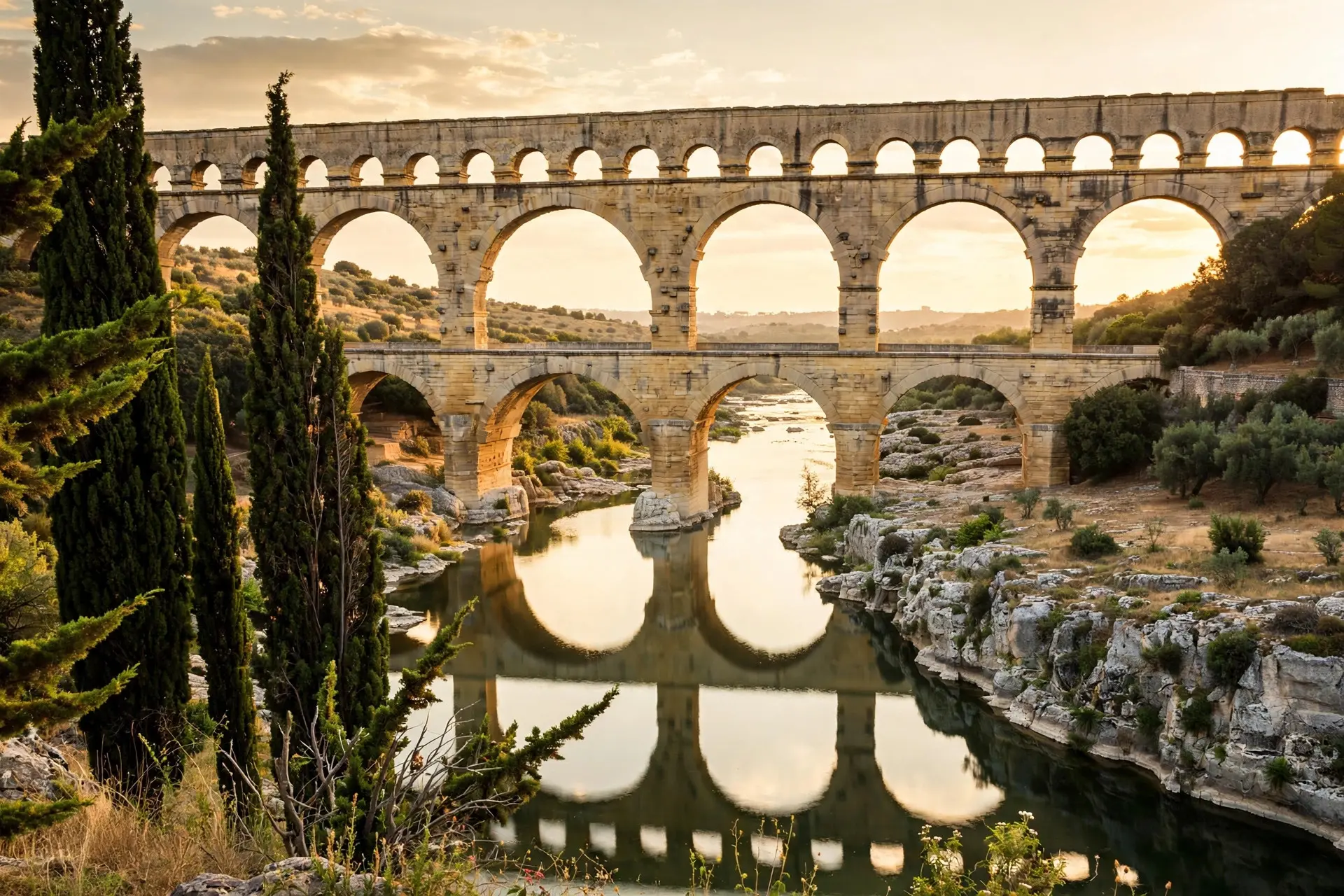
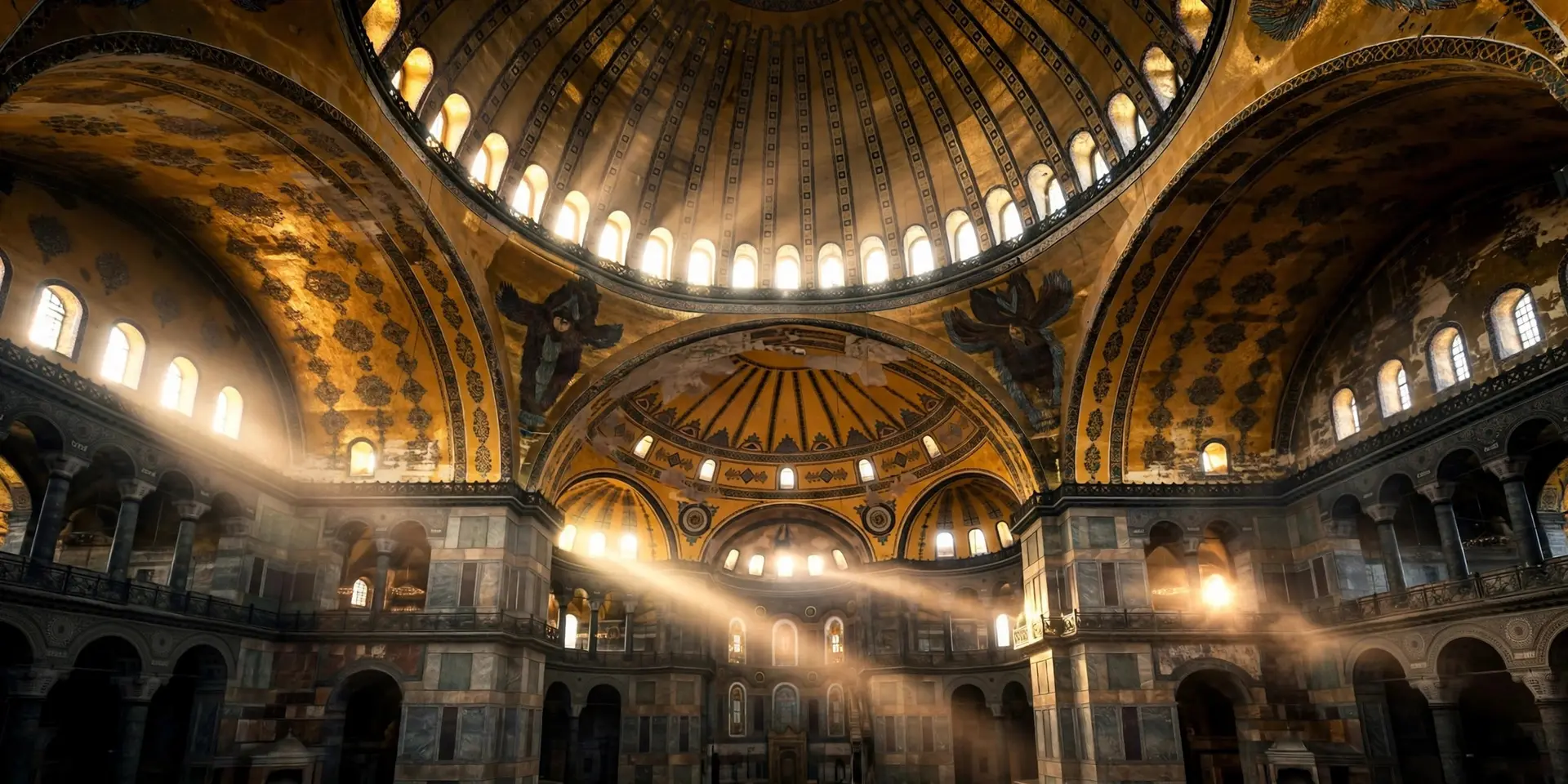
| Constantinople stored water the same way it stored everything else that mattered: massively, redundantly, and with a maintenance schedule. For the city's walls, see the Theodosian Walls; for an older answer to moving water across dry land, the qanats; for Justinian's other great engineering project, Hagia Sophia's dome; and for the Roman aqueduct tradition it built on, the Pont du Gard. | |
| How we made this article: FactSpire researched and drafted it with AI assistance and checked every fact against the sources listed above. |
Frequently asked questions
How much water did the Basilica Cistern hold?
Roughly 80,000 cubic metres, about 21 million gallons, in a vaulted hall 138 metres (453 ft) by 65 metres (213 ft). The roof rests on 336 marble columns, each about 9 metres (30 ft) high, arranged in 12 rows of 28. One reference work puts the theoretical maximum closer to 85,000 cubic metres.
Where did Constantinople's water come from?
Springs in the hills of Thrace, carried in by the Valens aqueduct system from as far as 120 km (75 miles) in a straight line. After the city's refounding in AD 324, a first line drew from springs 60 km (37 miles) west; a 5th-century expansion pushed the system to at least 426 km (265 miles) of channels, bridges and tunnels.
How did the aqueduct keep working for 700 years?
Constant maintenance. Geologists at Mainz University found only about 27 years of limescale inside a system that operated into the 12th century, meaning the Byzantines cleaned it repeatedly. They even built a 50 km (31 mile) double channel so one line could be serviced while the other carried water.
Did the Basilica Cistern serve the whole city?
No. It supplied the Great Palace and the surrounding buildings on the First Hill, not a million residents. Constantinople held perhaps 500,000 people at its 6th-century peak, and the city relied on the aqueduct network plus many other cisterns — the Basilica was simply the largest covered one.
Sources
- Constantinople, Basilica Cistern, Livius
- The Aqueduct of Constantinople: Managing the longest water channel of the ancient world, ScienceDaily
- POPULATION OF CONSTANTINOPLE, Shadows of Constantinople
- The Development of Constantinople, AD 324-565, History Cooperative
- Basilica Cistern Istanbul: What It Is, Where, How to Visit, thehagiasophia.com