Why Does Rain Smell So Good After a Dry Spell?
Rain itself has almost no scent. The smell after a dry spell comes from soil microbes, plant oils and storm ozone, launched into the air by falling drops.
Key takeaways
- Petrichor is the scent released when rain falls on dry ground, a blend of plant oils, a soil-microbe compound called geosmin, and sometimes ozone.
- Falling drops trap tiny air bubbles in porous soil, and those bubbles burst upward as a fine mist of scent-carrying aerosols.
- Light or moderate rain on dry sandy or clay soil produces the most aerosols, while heavy rain on soaked ground produces far fewer.
- Humans can detect geosmin at concentrations measured in parts per trillion, an extreme sensitivity that may once have helped our ancestors find water.
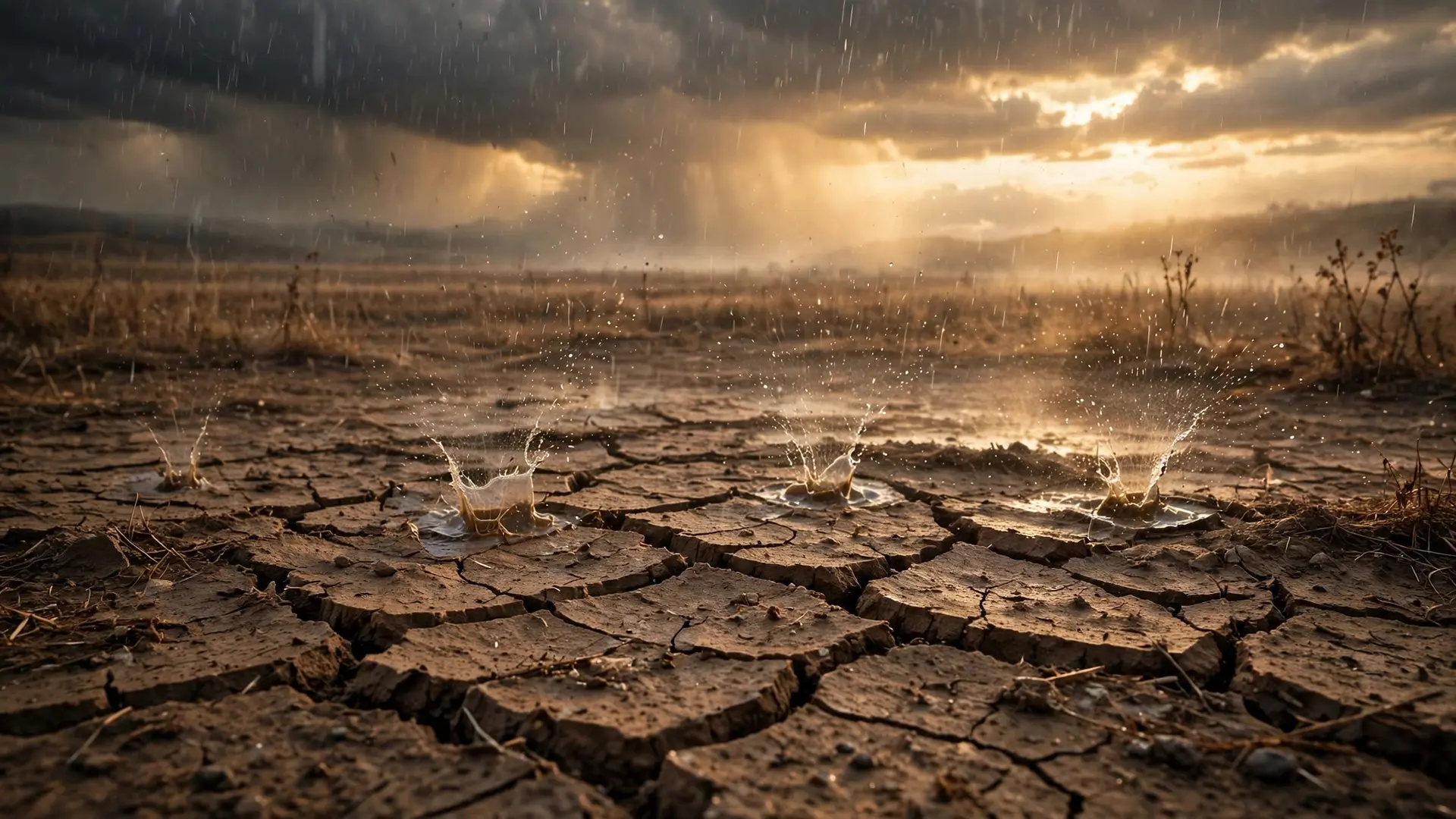
Step outside just as the first drops of a long-awaited shower begin to fall, and the air itself seems to change. The scent is earthy, fresh and oddly comforting, and it arrives before anything looks properly wet. That smell has a name, petrichor, and it is not the smell of water at all. It is the smell of the ground answering the rain: a mixture of plant oils and microbe-made compounds stored in dry soil, lifted into the air by the physics of falling drops, with a sharp note of storm-made ozone riding along.
What exactly is petrichor?
Petrichor is the scent produced when rain falls on dry ground, strongest after a dry spell and during light rain. The word was coined in 1964 by two Australian researchers, Isabel Joy Bear and Richard Thomas, who built it from Greek roots: petra, meaning stone, and ichor, the fluid said to flow through the veins of the gods. They were studying what they called the argillaceous odor, the clay-like smell of rain on dry earth, and they wanted a general name for it. The name stuck because it captures something real: the scent is not one chemical but a blend. Its main ingredients come from three very different places. Plants contribute oils. Soil microbes contribute a compound called geosmin. Thunderstorms contribute ozone. And the raindrop itself contributes the delivery mechanism, a burst of microscopic spray that carries the whole mixture to your nose.
Where do the ingredients come from?
During dry weather, plants release oils that settle into the pores of soil and onto rock surfaces. These include fatty compounds such as stearic and palmitic acids, which accumulate slowly while the ground stays dry. The longer the dry spell, the larger the store of scent waiting in the ground. This is one reason the first shower after weeks without rain smells so much stronger than rain in an already wet season.
The second ingredient comes from life underground. Soil is full of filamentous bacteria known as actinomycetes, including members of the Streptomyces group. As these microbes grow and break down organic matter, they produce geosmin, a carbon-based compound whose name literally means earth smell. Geosmin is the deep, musty note at the heart of petrichor, and it is also what gives beets their earthy flavor. The human nose is extraordinarily tuned to it, detecting geosmin at concentrations measured in parts per trillion, far below what most scents require. One idea for why we are so sensitive is that, for our ancestors, smelling rain from a distance could have meant finding drinking water and fresh growth, a matter of survival in dry country. The third ingredient arrives from the sky. Lightning's electric discharge splits oxygen and nitrogen molecules in the air, creating ozone, and storm downdrafts can carry that ozone down to ground level. Ozone has a sharp, clean, faintly metallic scent, and it is largely what people notice just before a storm breaks, while petrichor itself follows once drops start hitting the ground. Together, the three ingredients explain why the smell of rain changes with the weather: a storm with much lightning smells sharper at first, while a gentle shower on parched soil smells deeper and earthier.
How do raindrops launch the smell into the air?
For decades, the missing piece of the puzzle was the launch mechanism. It was clear that scent compounds sat in the soil, but nobody had watched how they got airborne. That changed in 2015, when researchers at the Massachusetts Institute of Technology filmed individual water drops striking porous surfaces with high-speed cameras. Across roughly 600 experiments on 28 surfaces, including 16 soil samples, they caught a mechanism nobody had documented on soil before. When a drop hits a porous surface, it flattens faster than the ground can absorb it, and air from the soil pores gets trapped beneath the water as tiny bubbles. Those bubbles rise through the drop and burst at its surface, throwing up a fizz of microscopic aerosol droplets. Each aerosol carries whatever was dissolved or resting at the surface: plant oils, geosmin and even soil microbes. It works much like the bubbles in a glass of sparkling drink, except that the fizz happens on dirt, and the spray rises into the breeze.
The details matter. The MIT team found that light and moderate rain produced the most aerosols, especially on sandy or clay soils, while heavy rain produced far fewer. A fast, heavy drop simply does not give bubbles enough time to form and burst, and once the ground is soaked, there are fewer trapped air pockets to launch. That is why a soft first shower on dry earth smells so vivid, and why the scent fades as a downpour soaks in: the store of surface compounds is spent, and the launch mechanism quiets down. The same falling water that smells so alive on dry ground becomes, on wet ground, just wet.
Why does the smell vary from place to place?
Because petrichor is a local recipe, not a single bottled scent. The oils depend on which plants grow nearby, the microbes depend on the soil, and the surface itself matters: clay, sand, leaf litter, stone and pavement each release a different mix. A shower on a pine forest floor smells resinous and green, while rain on hot city pavement smells dusty and mineral. The sky's contribution varies too, since ozone shows up most with lightning and strong downdrafts. Even the rain's strength changes the result, as light drops launch more aerosols than a hammering storm. Animals read the same signal. Camels in desert country are highly sensitive to geosmin and can use it to locate water from many miles away, a useful talent where a missed water source can be fatal. Tiny soil animals called springtails are drawn to the scent as well, feeding on the microbes that make it and carrying their spores onward. For humans, the signal is less practical now, but the wiring remains: smell travels to brain regions tied closely to memory and emotion, which is why a whiff of rain can summon a childhood summer more vividly than a photograph. That is the quiet wonder of petrichor. It is not the rain you are smelling but the land, the plants and the microbes beneath your feet, briefly made airborne. The next time a dry spell breaks, pause at the first drops. The scent is a small weather report in itself: dry ground, patient chemistry and a sky finally giving way. Like no two snowflakes are ever exactly alike, each shower's scent is shaped by its own ground and sky, and it will not smell quite the same way twice.
Frequently asked questions
Does rain itself actually have a smell?
Almost none. Pure water has no scent of its own. What you notice is petrichor: compounds stored in dry soil and plants, plus ozone carried down by storms, released into the air when drops strike the ground.
Why is the smell strongest after a long dry spell?
Dry weather lets plant oils and microbe-made compounds build up in soil and on rock surfaces. The first rain disturbs that store all at once, and light or moderate drops on dry ground launch the most scent-carrying aerosols.
What is geosmin?
Geosmin is an earthy-smelling compound made by soil microbes, including bacteria in the Streptomyces group. It gives freshly turned soil its distinctive scent, flavors beets, and can be detected by the human nose at extraordinarily low concentrations.
Sources
- Weekly "What is it?": Petrichor, UF/IFAS Extension Escambia County
- Rainfall can release aerosols, study finds, EurekAlert!
- High-Speed Video Shows When The Smell of Rain Begins, Smithsonian Magazine