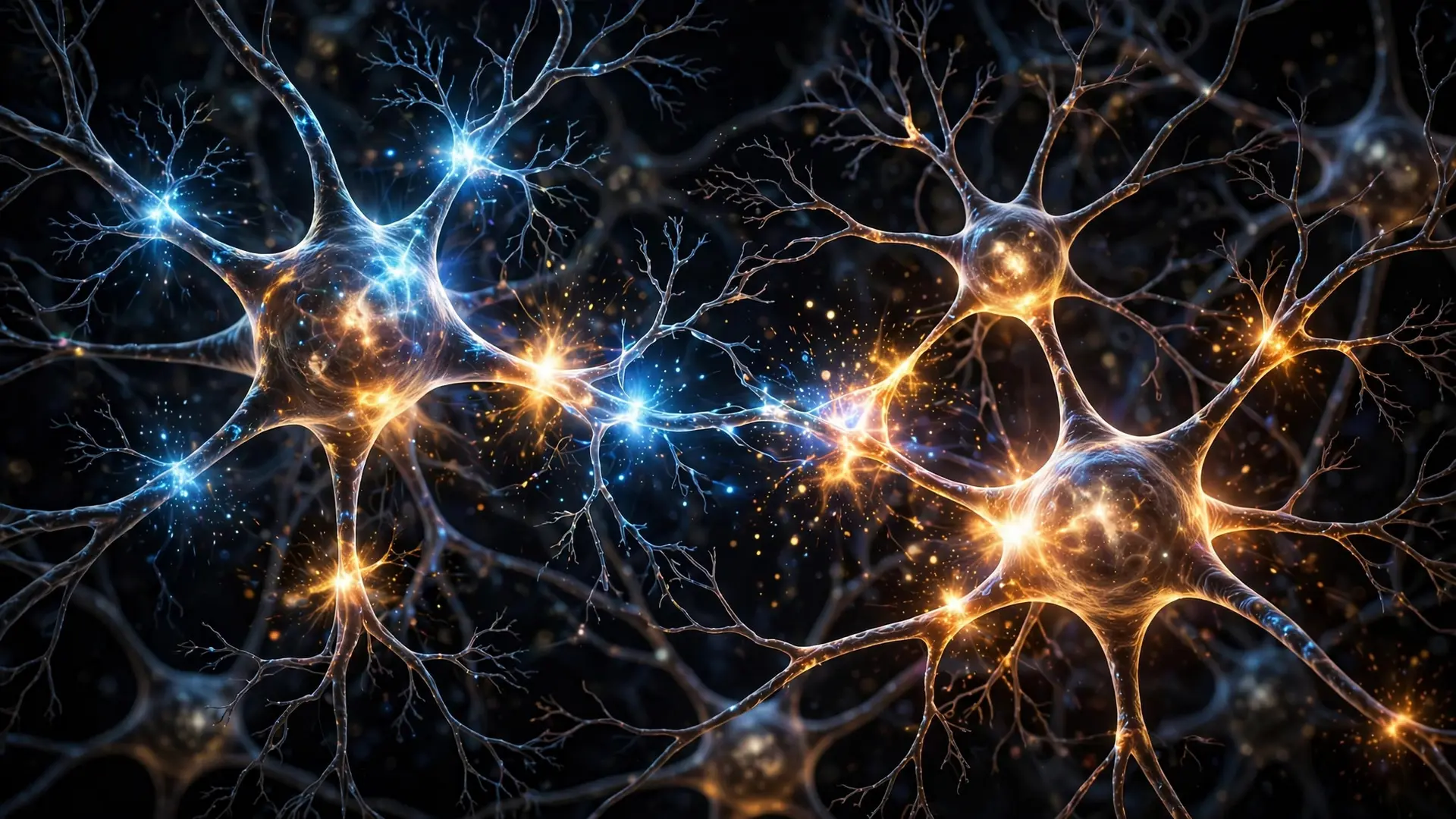
How Neural Networks Learn: The Basics Explained
Neural networks learn by nudging millions of tiny weights to shrink their mistakes. Here is how backpropagation and gradient descent turn error into skill.

Key takeaways
- A neural network learns by adjusting its weights — the strengths of connections between neurons — to reduce its prediction errors.
- Backpropagation uses the chain rule from calculus to work out how much each weight contributed to a mistake, layer by layer.
- Gradient descent then nudges every weight downhill on the loss surface; repeating this over many epochs is what we call training.
- The 1986 backpropagation paper by Rumelhart, Hinton, and Williams revived the field after the 1969 perceptron critique caused an AI winter.
A neural network learns the way you learned to ride a bike: by wobbling, measuring how far off balance it was, and adjusting. The difference is that a neural network turns every wobble into a number, traces that number backward through its own wiring, and nudges millions of tiny dials — called weights — a fraction at a time. Repeat that loop across thousands or millions of examples, and the wobbling stops. That loop has a name: backpropagation, and it is the single mechanism behind nearly everything modern AI can do.
What actually changes when a neural network learns?
Strip away the mystique and a neural network is a stack of simple units called neurons, organized in layers. Each connection between two neurons has a weight: a number that says how strongly one neuron's signal influences the next. Learning means changing those weights — nothing more, nothing less. When training begins, the weights are set to small random values, so the network's first guesses are essentially noise. Each neuron does a humble job: it multiplies its inputs by their weights, adds them up, and passes the total through an activation function that decides how loudly the neuron "fires." That signal flows forward through the layers until the final layer produces a prediction — a label on a photo, the next word in a sentence, a number. This one-way trip from input to prediction is the forward pass. At the start, with random weights, the prediction is almost always wrong. And that is exactly the plan, because the error is the teacher.
How does the network measure its mistakes?
To learn from errors, the network needs a precise way to score them. That is the job of the loss function, a formula that turns "how wrong was I?" into a single number. A common one for simple predictions is the squared error: take the true answer y, subtract the network's guess ŷ, and square the difference. If the true label is 1 and the untrained network guesses 0, the loss is (1 − 0)² = 1 — maximally wrong. The entire goal of training is to drive that number toward zero.
The loss is more than a report card; it is a landscape. Every possible combination of weights produces a different loss, so you can picture training as standing on a hilly terrain in thick fog, trying to find the lowest valley by feel alone. The fog is real: a modern network has millions or billions of weights, and nobody can see the whole landscape. Learning is the art of descending it blindfolded, one small step at a time.
What is backpropagation, exactly?
Here is the crux of the whole story. Once the network makes a prediction and the loss is computed, the error must be assigned to the weights that caused it — but a weight in an early layer influenced the output only indirectly, through every layer after it. How much blame does each weight deserve? Backpropagation answers that with calculus. Using the chain rule — the rule for differentiating a function of a function — the network works out, for every single weight, exactly how much a tiny change in that weight would change the loss. The error is propagated backward from the output layer toward the input layer, with each layer passing along its share of the blame. The result is a gradient for every weight: a number saying "increase me" or "decrease me," and by how much. This was the breakthrough published in 1986 by David Rumelhart, Geoffrey Hinton, and Ronald Williams. It finally gave multi-layer networks an efficient way to learn, something no one had managed for decades — and it quietly restarted the entire field of AI.
How does gradient descent decide how far to nudge each weight?
Knowing the gradient is only half the battle; the network still has to move. Gradient descent is the update rule: each weight shifts by a small step in the direction that reduces the loss. In symbols, w_new = w_old − η × ∂L/∂w, where η (eta) is the learning rate — a knob that controls step size. The learning rate is a genuine balancing act. Set it too high and the network leaps over the valley and bounces around chaotically, never settling. Set it too low and training crawls, potentially getting stuck in a shallow dip. Modern optimizers like Adam — which adapts the step size for each weight individually based on recent gradients — take much of the guesswork out, and they power much of today's deep learning, from language models to vision systems. The full cycle — forward pass, loss calculation, backpropagation, weight update — is then repeated over the entire dataset, often dozens or hundreds of times. Each full repetition is called an epoch, and with every epoch the loss inches downward.
It is worth noting that the same loop powers everyday tools: the prediction engine behind how autocorrect guesses your next word, the vision systems in modern digital cameras, and the adaptive filters inside noise-cancelling headphones all trace back to networks trained this way.
Why did it take scientists nearly 50 years to crack this?
The idea is old. In 1943, Warren McCulloch and Walter Pitts published the first mathematical model of an artificial neuron. In 1958, psychologist Frank Rosenblatt built the Perceptron — the first machine that learned from its mistakes, initially simulated on an IBM 704 and later realized as room-sized hardware, the Mark I Perceptron, with photocells for eyes and motor-driven knobs for weights. His learning rule was elegant: when the machine misclassified an image, strengthen the connections that would have given the right answer and weaken the ones that gave the wrong one. It could learn to recognize simple shapes, and the press went wild. Then came the reckoning. In 1969, Marvin Minsky and Seymour Papert proved that a single-layer perceptron could not even learn the simple XOR logic function — a devastating limitation that collapsed funding and interest in a period now called the AI winter. The tragedy was that the fix was hiding in plain sight: stack neurons in layers with a nonlinearity between them. But nobody knew how to train such a network until backpropagation arrived in 1986. Two years later, Yann LeCun showed the first convolutional neural network reading handwritten characters, and the modern era began. There is one nuance the pioneers understood and we still wrestle with: a network that drives its training loss to zero has not necessarily learned anything useful. If it memorizes the training data — every quirk and typo — it will stumble on anything new. The real goal is generalization: capturing the underlying pattern so the weights work on data the network has never seen. That is why training involves held-out test data, regularization tricks like dropout, and constant vigilance against overfitting. In the end, learning in a neural network is not magic and not memorization. It is a relentless, mechanical conversation between error and adjustment: guess, measure the miss, trace the blame, nudge the dials, repeat. Everything from a spam filter to a chatbot is that loop, run at a scale Rosenblatt could never have imagined — a room-sized machine of photocells grown into billions of weights, all still learning the same way: from being wrong.
Frequently asked questions
Do neural networks memorize their training data?
No — a trained network stores patterns in its weights, not the training examples themselves. That is why it can make reasonable predictions about inputs it has never seen, though it can also overfit and memorize too much.
Why are they called 'neural' networks?
They were loosely inspired by biological neurons. An artificial neuron sums up weighted inputs and passes the result through an activation function, a distant cousin of how a brain cell fires.
How long does it take a neural network to learn?
Anywhere from minutes for a small model to months for the largest ones. Training time depends on the model's size, the volume of training data, and the computing power available.