How Far Away Can You Hear Thunder? The Real Limit
How far away can you hear thunder? Usually about 10 miles, but still nights, warm air layers and open ground can stretch that range much farther.

Key takeaways
- Thunder is usually audible to about 10 miles (16 km), and under ideal conditions it can carry as far as 25 miles (40 km).
- Count the seconds between flash and thunder, then divide by 5 for miles or by 3 for kilometers to estimate the distance.
- Thunder rumbles because sound from different parts of a long lightning channel reaches your ears at different times.
- A temperature inversion can trap thunder near the ground, making distant strikes sound loud and close.
- If you can hear thunder at all, you are within striking distance of the storm, so head indoors.
How far away can you hear thunder? Most nights, about 10 miles (16 km), though on a still night the sound can carry as far as 25 miles (40 km). What sets the limit is less the power of the strike than the air itself: warm layers, wind and hills decide whether the sound reaches you at all.
- The US National Weather Service puts the usual hearing range at about 10 miles (16 km) from the strike, while the American Meteorological Society gives 25 miles (40 km) as the approximate upper limit. (National Weather Service, American Meteorological Society)
- Sound moves through air at about 343 meters per second (1,125 feet per second) at 20°C (68°F), and slows to 331 meters per second at 0°C (32°F). (OpenStax)
- Lightning heats the air in its channel to around 30,000°C (54,000°F), hotter than the surface of the Sun, and the sudden expansion of that air is what makes thunder. (Australian Bureau of Meteorology)
- The UK Met Office says thunder is rarely heard more than 20 km (12 miles) away, and that dividing the seconds between flash and thunder by 3 gives the distance in kilometers. (Met Office)
- Lightning strikes the United States about 25 million times a year and kills about 20 people there each year. (National Weather Service)
How far away can you hear thunder?
The short answer is about 10 miles (16 km) on an ordinary night, with 25 miles (40 km) as the rough outer edge. The American Meteorological Society calls 10 miles a fairly typical value and says thunder is seldom heard beyond 15 miles (24 km), while the Met Office says it is rarely heard more than 20 km (12 miles) away. Ten miles is normal, twenty is unusual, and twenty-five is about as far as it ever gets. Why does the sound give up at all? A lightning channel heats the air around it to around 30,000°C (54,000°F) in a few tens of microseconds, and that air expands so fast that it launches a shock wave. Close to the strike the wave is violent. As it spreads outward it weakens, and the air strips away its high frequencies first, so after ten miles only a low rumble is left, and soon after that nothing at all.
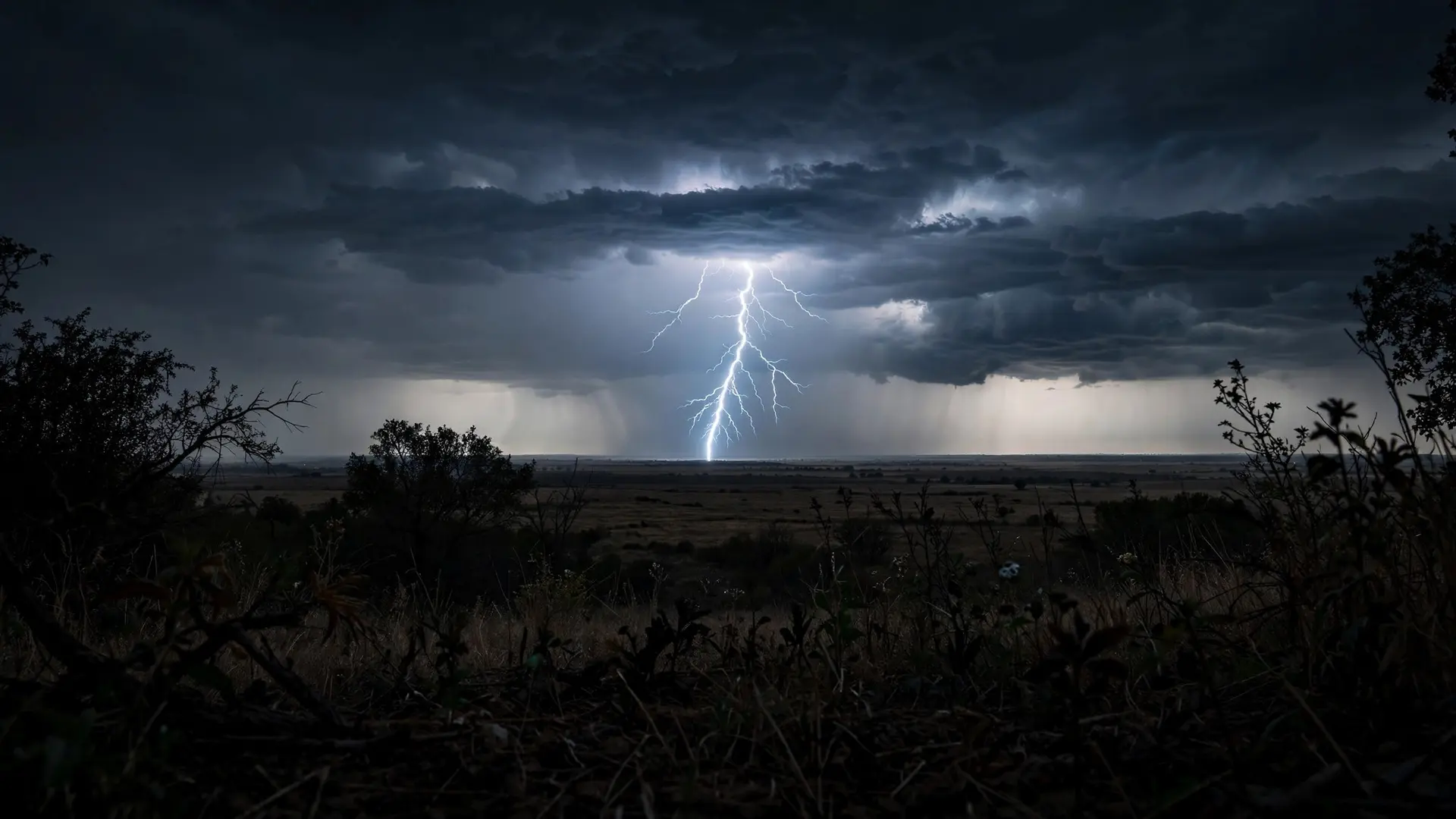
The night itself matters as much as the strike. A still, quiet night in open country carries sound the farthest, which is how the Australian Bureau of Meteorology explains thunder heard as far as 25 km (16 miles) away, while city noise shortens the range. Flashes with no thunder on a summer evening usually mean the storm sits beyond the hearing range: its light reaches you, because light travels at around 300,000 km (186,000 miles) per second, while its sound never does.
Why does thunder rumble instead of cracking?
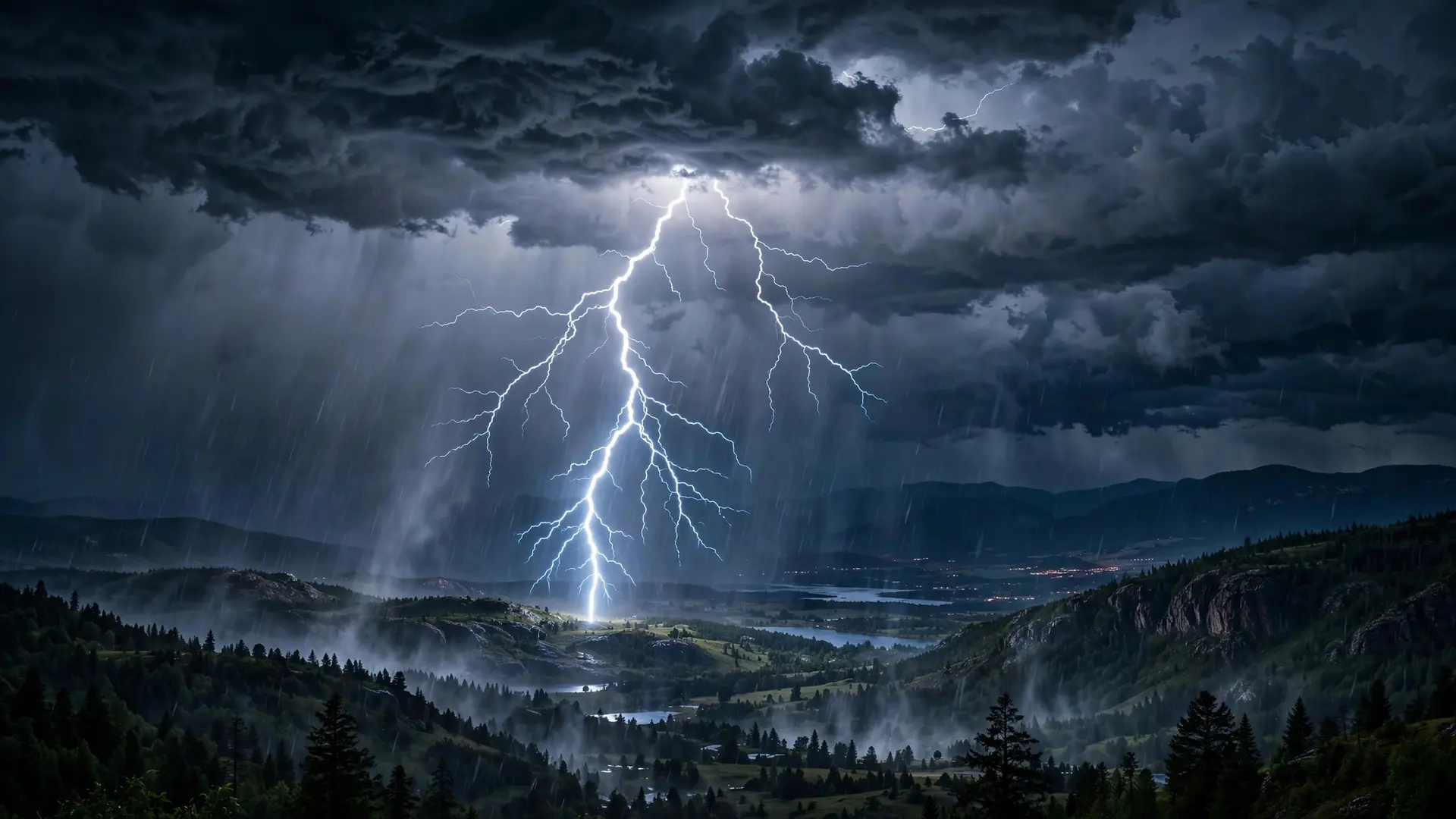
A lightning bolt is not a point. It is a long, crooked channel that can stretch for miles through the sky, and every part of it makes noise at nearly the same instant. Sound from the nearest part reaches you first, and sound from the farther parts arrives later, so one flash is stretched into a rolling sound that can last several seconds. The American Meteorological Society says the rumbling comes chiefly from those varying arrival times, with echoes and repeated strokes adding to the effect. The forks in a bolt add to the rumble. A strike can branch in many directions, creating a series of shock waves that reach your ear as one continuous sound, and sound also bounces off trees, buildings and hills. Close by, there is little time for those reflections, so the sound is a sharp crack; farther off, it arrives as a rumble. The National Weather Service draws the same line: a sharp crack or click means the channel passed nearby, a rumble means the lightning was at least several miles away, and the loud boom you sometimes hear comes from the main channel as it reaches the ground. Distance also changes the pitch. High-frequency sound fades faster than low-frequency sound, so the sharp edge of the crack wears away as thunder travels, leaving only the deep growl. Lightning takes stranger forms too, and the most famous is ball lightning, a glowing sphere reported during storms for centuries.
How do temperature, wind and terrain change the range?
Temperature decides which way sound bends. Air temperature normally falls with height, and sound travels faster in warm air, so the top of a thunder wave moves a little slower than the bottom. That difference bends the wave upward, away from the ground, so the sound escapes into the sky instead of reaching listeners farther out. On a normal afternoon this bending is one reason the hearing range stops near ten miles. A temperature inversion flips the picture. When cool air sits near the ground beneath warmer air, the sound is trapped under a lid, usually less than 1 km (0.6 miles) above the surface, and cannot spread upward as it normally would. Instead it travels sideways along the ground, staying loud much farther than ordinary thunder. The Australian Bureau of Meteorology calls this inversion thunder, and notes that it has even been mistaken for a minor earthquake.
Wind pushes the sound in the same way. A wind blowing from the storm toward you carries the wave along and stretches the range, while a wind blowing against it weakens the sound quickly. Wind itself follows large-scale turning patterns, the same kind that steers hurricanes through the Coriolis effect. Hills can block the direct path while reflecting another around it, and a valley can funnel a rumble farther than flat ground. Air that bends light bends sound too, and the same restless atmosphere that makes stars twinkle while planets hold steady is constantly bending thunder in one direction or another.
How can you measure the distance yourself?
Count the seconds between the flash and the first sound of thunder, then divide by 5 for miles or by 3 for kilometers. The rule works because light arrives almost instantly while sound moves at about 343 meters per second (1,125 feet per second) at 20°C (68°F). The National Weather Service teaches the same rule: 5 seconds means 1 mile (1.6 km), 15 seconds means 3 miles (4.8 km), and 0 seconds means the strike was very close.
| Seconds between flash and thunder | Distance | What you are likely to hear |
|---|---|---|
| 5 | About 1 mile (1.6 km) | Sharp crack |
| 15 | About 3 miles (4.8 km) | Loud boom |
| 30 | About 6 miles (9.7 km) | Rolling rumble |
| 50 | About 10 miles (16 km) | Faint rumble, if anything |
| The distances are calculated from the speed of sound at 20°C (68°F), 343 meters per second, and rounded to the nearest whole mile. In cold air the sound moves a little slower, 331 meters per second at 0°C (32°F), so the count runs a touch long, but the change is under 4 percent. The count is an estimate, and it only works when you can match a flash to its own thunder. | ||
| The count also carries a safety message. The National Weather Service warns that if you can hear thunder, chances are you are within striking distance of the storm, and you should get to a safe place at once. A fifty-second gap may feel like a comfortable margin, but it still means the strike was only about ten miles away. |
What do most people get wrong about thunder?
The first mistake is about what makes the sound. Thunder is not clouds crashing together. It is air heated to around 30,000°C (54,000°F) by the lightning channel, expanding so fast that it launches a shock wave. The National Weather Service describes exactly that cycle of rapid expansion and contraction as the source of the sound wave we hear. The second mistake is reading a faint rumble as a sign of safety. A distant-sounding rumble can come from a strike many miles away, but inversion thunder can make a far-off strike sound loud and close, and any thunder you can hear means the storm is within striking distance. The third mistake is treating the flash-to-bang count as exact. It is a good estimate, and it is the rule weather services teach, but the speed of sound shifts with temperature, wind bends the path, and a long, forked channel means different parts of the same flash sit at different distances from you. Thunder is a measuring tool as much as a sound: five seconds puts the strike a mile away, fifty seconds puts it at the edge of hearing, and the rumble itself carries news about the bolt and the air overhead. How we made this article: FactSpire researched and drafted it with AI assistance and checked every fact against the sources listed above.
Frequently asked questions
How far away can you hear thunder?
Usually about 10 miles (16 km). The American Meteorological Society gives 25 miles (40 km) as the approximate upper limit, reached only on still, quiet nights. The UK Met Office puts the practical limit lower, at about 20 km (12 miles), so most of the time the answer sits close to 10 miles.
Why can I see lightning but hear no thunder?
The storm is almost certainly beyond the hearing range. Light crosses the distance instantly, while sound fades as it spreads and loses its high frequencies. Flashes with no thunder on a summer evening are ordinary lightning from a storm too far away for its sound to reach you.
Does thunder sound louder on some nights?
Yes. During a temperature inversion, a layer of warm air sits above cooler surface air and traps the sound near the ground, so it travels farther and stays loud. This inversion thunder has even been mistaken for a minor earthquake.
Is it safe to stay outside if the thunder sounds far away?
No. The National Weather Service warns that if you can hear thunder, you are probably within striking distance of the storm. A faint rumble is not a sign of safety, and the only reliable move is to get inside a solid building or a hard-topped vehicle.
Sources
- Understanding Lightning: Thunder, National Weather Service
- Explainer: what is thunder?, Australian Bureau of Meteorology
- thunder - Glossary of Meteorology, American Meteorological Society
- Thunderstorms, Met Office
- 17.2: Speed of Sound – University Physics Volume 1, OpenStax
- Lightning Safety Tips and Resources, National Weather Service