Eurasian Pole: What Is the Most Remote Place on Land?
The most remote place on land sits in China's Xinjiang desert, more than 2,500 km from any ocean. Learn why its exact spot is still debated.
Key takeaways
- The Eurasian pole of inaccessibility is the point on land farthest from any ocean: conventionally 46°17′N 86°40′E in Xinjiang, China, about 2,645 km from the sea.
- A 2007 study by Daniel Garcia-Castellanos and Umberto Lombardo found the accepted spot was off by 156 to 435 km, and proposed two alternatives, EPIA1 and EPIA2.
- The dispute turns on Russia's Gulf of Ob: treating the up-to-80-km-wide bay as ocean instead of river shifts the pole south and east.
- The pole is not marked, and it is not empty wilderness — the settlement of Suluk lies only about 10 km east of the conventional point.
The most remote place on land is the Eurasian pole of inaccessibility, a point in China's Xinjiang region roughly 2,645 km (1,644 miles) from the nearest ocean. Here is the surprise: geographers now say the famous coordinates may be off by up to 435 km, and three separate points claim the title. Key facts
- The conventional Eurasian pole sits at 46°17′N 86°40′E, about 2,645 km from the nearest coast, in the Dzoosotoyn Elisen Desert roughly 320 km north of the city of Ürümqi. (Fantastic Routes)
- A 2007 recalculation by Daniel Garcia-Castellanos and Umberto Lombardo, published in the Scottish Geographical Journal, proposed two alternatives, EPIA1 and EPIA2, roughly 2,510 km and 2,514 km from the ocean. (poles of inaccessibility)
- The dispute hinges on Russia's Gulf of Ob: a 10 to 12 m deep bay, up to 80 km wide, that reaches about 600 miles inland. Count it as ocean, and the pole moves. (poles of inaccessibility, Atlas Obscura)
- The closest settlement, Suluk, is only about 10 km east of the conventional pole. Hoxtolgay Town lies about 50 km to the northwest and Xazgat Township about 20 km to the west. (Fantastic Routes)
- The tourist "center of Asia" monument in Ürümqi County stands at 43°40′52″N 87°19′52″E, hundreds of kilometres from any calculated pole. (Fantastic Routes)
What exactly is a pole of inaccessibility?
A pole of inaccessibility is the point on a landmass (or ocean) farthest from the nearest coastline. One way to picture it: draw the largest circle you can fit entirely inside a continent without touching the coast, and the pole is the circle's center. Because the answer depends on which coastline you count, the location can shift as maps improve or definitions change.
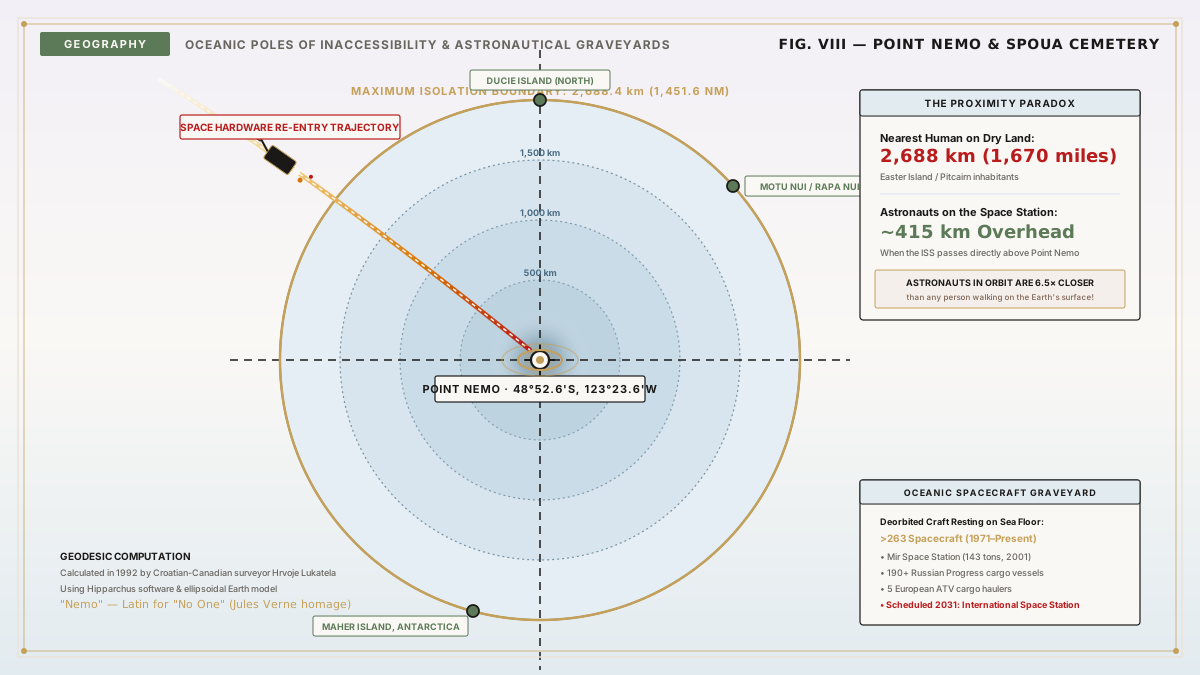
The concept was introduced in 1920 by the Canadian explorer Vilhjalmur Stefansson, who wanted to distinguish the North Pole from the most difficult-to-reach place in the Arctic. Since then, geographers have calculated one for nearly every continent, and the ocean has its own version: Point Nemo, the spot farthest from any land. On land, though, Eurasia wins by a wide margin, because Europe and Asia form the largest continuous landmass on the planet. For comparison, the most remote island on Earth, Tristan da Cunha, is the mirror image: land farthest from other land.
Where is the Eurasian pole of inaccessibility?
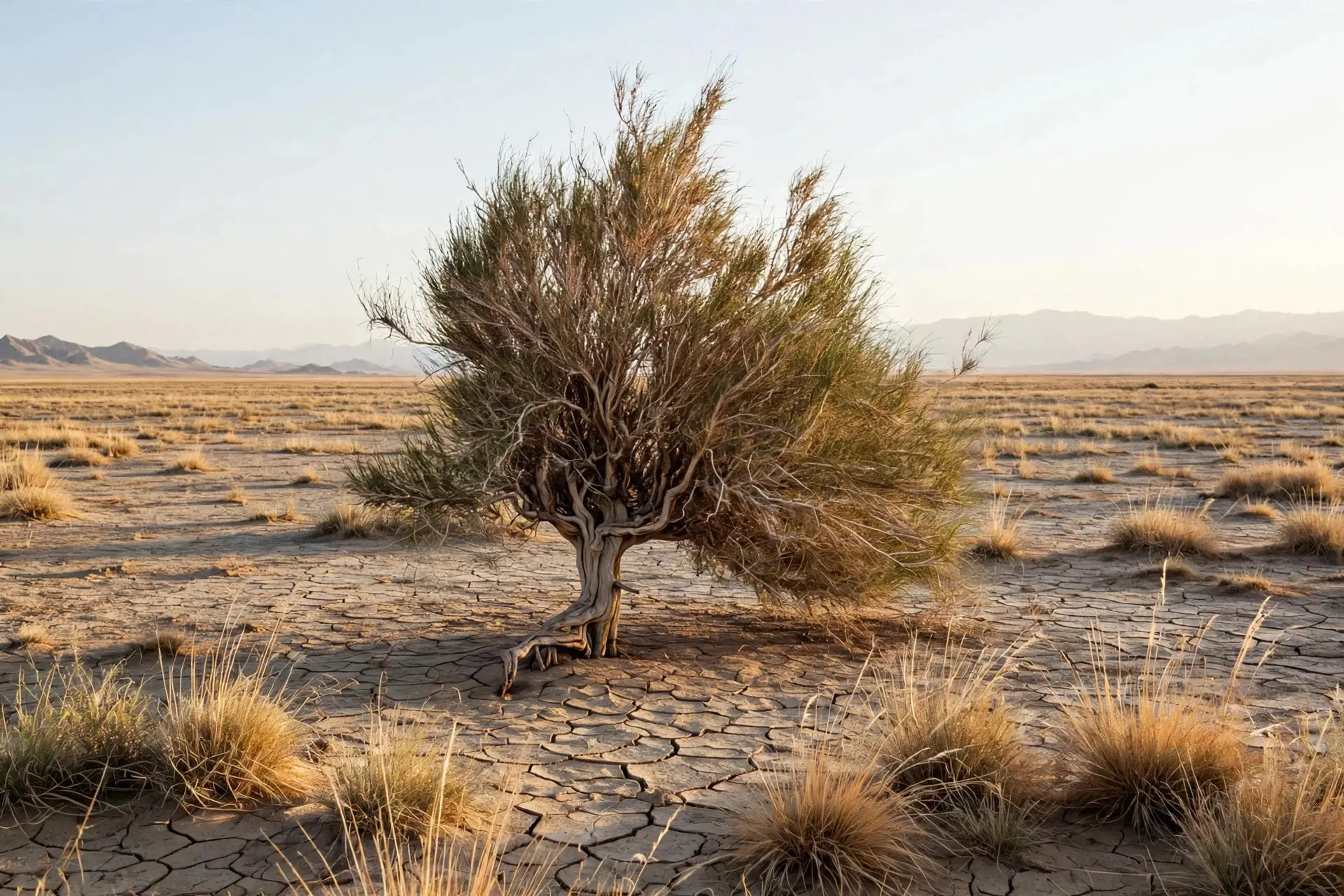
By the older, widely quoted calculation, it lies in northwestern China near the Kazakhstan border, in the Xinjiang Autonomous Region. The coordinates are 46°17′N 86°40′E, in a desert known as the Dzoosotoyn Elisen (also spelled Gurbantünggüt) Desert, roughly 320 km (200 miles) north of Ürümqi. The surrounding region is part of the world's largest endorheic basin, a drainage system with no river connection to the sea. That isolation is not an accident of the map: the area gets only 200 to 350 mm of rain a year, and the dryness helped keep this corner of Central Asia cut off from the coasts for centuries. The ancient Silk Road passed a few hundred kilometres away, close enough to leave a faint trace in history, far enough that the pole's neighborhood stayed thinly populated. The only documented expedition to the pole was made by two British explorers, Nicholas and Richard Crane, in 1986. The 2007 study questioned whether they actually reached the true spot, which means even the visitor log for the most remote place on land is uncertain.
Why do three different points claim the title?
Here is the crux of the dispute, laid out as the numbers currently stand:
| Candidate | Coordinates | Distance to ocean | What the calculation assumes |
|---|---|---|---|
| Conventional (pre-2007) | 46°17′N 86°40′E | about 2,645 km (1,644 miles) | The Gulf of Ob is a river, not the ocean |
| EPIA1 | 44.29°N 82.19°E | 2,510 ± 10 km (1,560 miles) | The Gulf of Ob counts as ocean; nearest coasts are the Gulf of Ob, the Gulf of Bengal and the Arabian Sea |
| EPIA2 | 45.28°N 88.14°E | 2,514 ± 7 km (1,562 miles) | The Gulf of Ob counts as ocean; nearest coasts are the Gulf of Ob, the Gulf of Bengal and the Gulf of Bohai |
| All three points sit in or around the Gurbantünggüt Desert, and every one of them is more than 1,500 miles into the interior of the continent. EPIA1 lies near Kokirqin Shan, a 3,698 m mountain, in rugged terrain above 2,000 m near China's borders with Kazakhstan and Kyrgyzstan, 435 km from the conventional spot. EPIA2 sits at 710 m altitude, 174 km north-northeast of Ürümqi, 156 km from the conventional spot. | |||
| Notice how close the new figures are to the ocean's own record: the radius from EPIA1 and EPIA2 to the sea is only about 178 km less than the distance from Point Nemo to the nearest land. Land and sea are almost equally extreme in their remoteness. |
What most people get wrong about the most remote place on land
First, people assume it is empty wilderness. It is not. Suluk is about 10 km to the east, and the pole can be approached by road from nearby villages. Remoteness from the ocean is a mathematical property, not a guarantee of solitude. Second, people assume there is a monument or marker. There is not. The much-visited "center of Asia" monument near Ürümqi is a 1990s tourist attraction that has nothing to do with the pole's coordinates. None of the three candidate points carries any marker at all. Third, people assume the answer is settled science. It is not. The pole exists only for a given definition of the coastline, and the Gulf of Ob question has no final answer. Until geographers agree on where the ocean ends and the river begins, the most remote place on land will keep three addresses.
The takeaway
The most remote place on land is less a place than a question: how far can you get from the sea, and how do you measure the shore? Whether the true point is the conventional one in the Dzoosotoyn Elisen Desert or one of the two newer candidates, all three answers point to the same patch of Xinjiang, more than 2,500 km from salt water in every direction. That is the real fact worth keeping: on the largest landmass on Earth, the middle is still farther from the ocean than almost anyone imagines. How we made this article: FactSpire researched and drafted it with AI assistance and checked every fact against the sources listed above.
Frequently asked questions
Can you actually visit the Eurasian pole of inaccessibility?
In principle, yes. The conventional point sits in desert terrain about 10 km west of the settlement of Suluk, and roads reach nearby villages. The only documented expedition, by two British explorers in 1986, has been questioned by later researchers, so even the visitor count is debated.
Why is the exact location of the pole disputed?
It comes down to how you define the coastline. Early calculations treated Russia's Gulf of Ob as a river. A 2007 study counted the 600-mile-long bay as ocean, which moved the farthest point. The result is three candidate spots, 156 to 435 km apart, with no settled winner.
Is the pole the same as the center of Asia?
No. The pole is the point farthest from any ocean; the 'center of Asia' is a geometric idea that shifts with your map's edges. The 'center of Asia' monument in Ürümqi County stands at 43°40′52″N 87°19′52″E, hundreds of kilometres from every calculated pole.
Which continent's pole of inaccessibility is the second farthest from the sea?
Africa's, at 5.65°N 26.17°E in the Central African Republic near Obo, is 1,814 km from the nearest coast. North America's sits in South Dakota, 1,650 km from the ocean, and Australia's is only about 920 km inland.
Sources
- poles of inaccessibility, Daniel Garcia-Castellanos
- Have Fun Trying to Reach the Poles of Inaccessibility, Atlas Obscura
- Pole of inaccessibility, Fantastic Routes