The Columbian Exchange: Crops That Changed the World
Crosby's Columbian Exchange rebuilt global diets: potatoes and maize fueled Europe's growth, sugar and wheat conquered the Americas — at devastating human cost.
Key takeaways
- The term 'Columbian Exchange' was coined by historian Alfred W. Crosby in his 1972 book on the biological consequences of 1492.
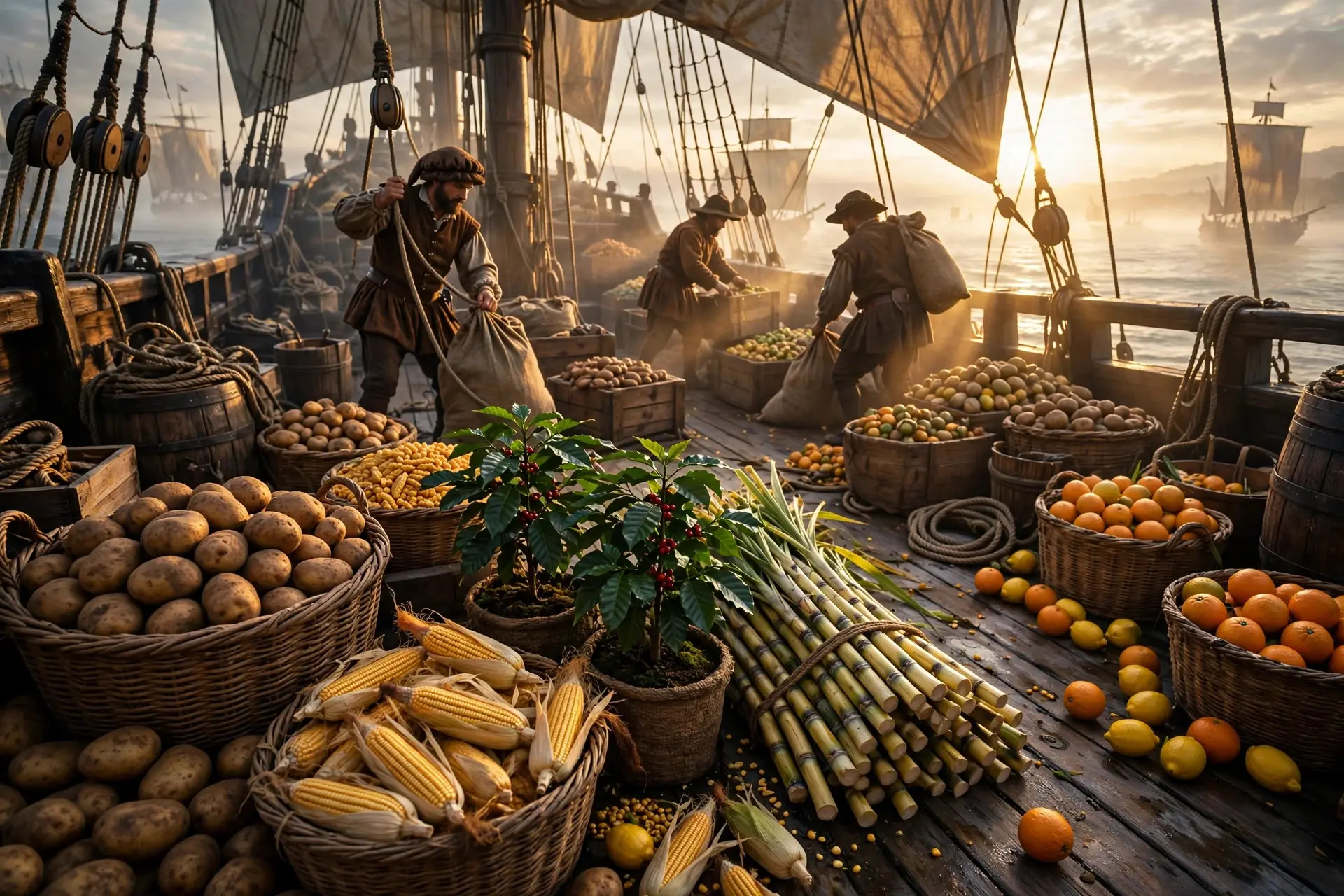
- The potato, maize, tomato, cacao, cassava, and tobacco left the Americas; wheat, rice, sugarcane, coffee, citrus, and bananas arrived in return.
- The potato's calorie yield helped fuel Europe's population boom — and Ireland's fatal dependence led to the 1845–1852 famine.
- Old World diseases like smallpox devastated Indigenous American populations, with literature estimating losses of 50–90% in the first century after contact.
- Sugarcane plantations built on enslaved African labor show the exchange remade economies, not just diets.
It is easy to think of 1492 as a political event — flags planted, empires declared. But the historian Alfred W. Crosby saw something deeper, and in his 1972 book he gave it a name: the Columbian Exchange. What crossed the Atlantic was not just soldiers and settlers, but seeds, spores, animals, and microbes. Within a few generations, the ecological map of the planet was rewritten — and the crops were the part of the story that fed billions.
What Exactly Was the Columbian Exchange?
After Columbus's voyages, the Old World and the New World — which had been ecologically separated for tens of thousands of years — were suddenly stitched together. Plants that had evolved in isolation on one side of the ocean were carried to the other, where they met new soils, new pests, and new climates. Some died. Others exploded across continents with an invasiveness that reshaped economies, diets, and entire populations. Crosby's insight was that this biological transfer mattered as much as conquest. Guns and ships decided who ruled, but crops decided who ate — and who starved. The exchange ran in both directions, and both sides of the Atlantic were transformed beyond recognition. Even earlier, the Norse had touched North America at Vinland, but that contact left no ecological trace. The post-1492 exchange was permanent.
Which Crops Crossed the Atlantic — and Which Way?
The traffic out of the Americas reads like a grocery list of modern global staples. The potato, domesticated in the Andes, crossed with the Spanish in the 16th century and eventually became one of the world's most important food crops. Maize spread through Africa, Europe, and Asia, becoming a pillar of diets on three continents. The tomato, once an obscure Andean fruit, revolutionized Mediterranean cooking — it is hard to picture Italian cuisine without it. Cacao gave the world chocolate. Cassava became a famine-resistant staple across tropical Africa. Tobacco and chili peppers spread just as widely, though with very different consequences.
The return cargo was equally momentous. Wheat, the foundation of Old World agriculture, took root in the Americas. Rice, sugarcane, coffee, citrus fruits, and bananas all crossed east to west — many of them, like sugarcane, finding in tropical America climates far more favorable than their native lands. Animals came too: horses, cattle, pigs, and sheep, which would remake American landscapes and Indigenous lifeways. Few plants show the exchange's double edge better than sugarcane. Native to the tropics of the Old World, it flourished in the Caribbean and Brazil so spectacularly that it created an entirely new economic system: the sugar plantation, worked by enslaved Africans shipped across the ocean in a brutal triangular trade. A sweet crop became one of history's cruelest engines.
How Did the Potato Remake Europe?
The potato deserves its own chapter because its impact was demographic. Potatoes deliver far more calories per acre than grain, and they grow in poor soils and cold climates where wheat fails. For much of Europe's peasantry, the tuber meant the difference between subsistence and starvation — and it arrived just as populations were beginning to climb. The potato underwrote the population boom of the 18th and 19th centuries across northern Europe, from Ireland to Russia. But that same efficiency created a trap: dependence. By the early 1840s, much of Ireland's rural poor lived almost entirely on potatoes — a single crop, and worse, a handful of genetically near-identical varieties. In 1845, a water mold called Phytophthora infestans, itself a product of the Americas, arrived and began rotting potatoes in the ground. The blight returned in 1846 with devastating force, wiping out nearly the entire harvest.
The Great Irish Famine of 1845–1852 killed roughly a million people and drove another million to emigrate, mostly to the United States, Canada, and Britain. It was not only a natural disaster — tenant farmers on tiny rented plots, an inadequate relief response, and continued food exports all magnified the catastrophe — but its trigger was ecological: a continent's gamble on a single American tuber. Monocultures, whether of potatoes or any crop, remain a standing warning about food-system fragility, a theme that echoes in later shocks like the Year Without a Summer.
What Was the Human Cost on the American Side?
The exchange's grimmest ledger belongs to the Americas' Indigenous peoples, and it was written in microbes, not crops. Europeans carried smallpox, measles, influenza, and typhus — diseases that had co-evolved with dense Old World populations and their livestock for millennia. Indigenous Americans, separated from those disease pools since the Ice Age, had no acquired immunity. The result was catastrophic. The historical literature commonly estimates that Old World diseases killed roughly 50–90 percent of Indigenous populations in the affected regions within the first century after sustained contact — a demographic collapse on a scale that reshaped the hemisphere's societies, weakened resistance to colonization, and emptied lands that Europeans then claimed as "virgin wilderness." In that sense, disease did as much conquering as any army. Meanwhile, the Americas' own microbial contribution to the Old World was comparatively limited, and the human cargo flowing the other way — millions of enslaved Africans dragged into plantation labor — became a demographic force in its own right. As with the earlier spread of plagues along trade routes like the Silk Road, the pattern holds: connection moves biology, and biology moves history.
Why Did the Exchange Matter More Than Conquest?
Conquest drew the borders, but the Columbian Exchange wrote the menu of the modern world. Italian food without the tomato, Belgian fries without the potato, Swiss chocolate without cacao, Brazilian coffee — none of these exist without the biological reunification of the hemispheres. The crops that crossed the Atlantic fed the population booms that built the modern world. Yet the same exchange carried smallpox, slavery, and famine. Crosby's term endures because it forces us to see 1492 not as an adventure story but as an ecological event — the moment two halves of the planet's biosphere collided. The lesson of the Columbian Exchange is that moving a plant is never just moving a plant. It is moving a diet, an economy, and sometimes, an empire.
Frequently asked questions
What is the Columbian Exchange?
The large-scale transfer of plants, animals, diseases, and peoples between the Old World and the Americas after 1492, named by historian Alfred W. Crosby in 1972. It reshaped agriculture, diets, and demographics on both sides of the Atlantic.
Which crops came from the Americas to Europe?
The potato, maize, tomato, cacao, cassava, sweet potato, tobacco, and chili peppers all originated in the Americas and became global staples after the exchange.
How did the potato cause the Irish famine?
By the 1840s much of Ireland's rural poor depended almost entirely on potatoes for calories. When potato blight destroyed the crop from 1845 to 1852, roughly a million people died and another million emigrated.
Did the Americas receive anything in return?
Yes: wheat, rice, sugarcane, coffee, citrus fruits, bananas, plus horses, cattle, pigs, and sheep. Wheat and sugarcane thrived in the Americas, while plantation sugar drove the transatlantic slave trade.