Why Do We Blow Out Birthday Candles at All?
The candle-blowing ritual is well documented but surprisingly young: 18th-century Germany's Kinderfest, a Swiss folklore journal, and a Disney short explain it.
Key takeaways
- Blowing out birthday candles is a fairly recent, well-documented ritual — not an ancient one — traced to 18th-century Germany's Kinderfest, a children's birthday festival.
- The popular theory linking candles to ancient Greek moon cakes for Artemis has no support in the historical record, according to scholars.
- German Kinderfest used one candle per year of life plus an extra 'light of life'; the earliest written record of make-a-wish-and-blow-out appeared in a Swiss journal in 1881.
- The wish works because breath was long treated as life force or soul — blowing out candles while making a silent wish echoes votive prayer.
- German immigrants carried the ritual to the US in the 19th century; by the 1920s candles were mass-produced, and a 1931 Disney short locked in the cake-candles-song-wish template.
We do not blow out birthday candles because of some ancient law of celebration. The ritual is surprisingly young: a children's festival in 18th-century Germany put fire on a cake to mark another year of life, and generations of parents, immigrants, department stores, and one Disney cartoon turned it into a global script. The ancient-Greek-moon-cake story, tempting as it is, turns out to be folklore.
Did the Tradition Really Start in Ancient Greece?
Every article about birthday candles repeats the same story: ancient Greeks baked round honey cakes for Artemis, goddess of the moon, set lit tapers on top to mimic moonlight, and believed the smoke carried prayers skyward. It is a lovely origin — and historians say it is a dead end. The Greek moon cakes were real religious offerings, but there is no documented thread connecting them to the modern birthday. As Colgate historian Kwasi Konadu put it to Reader's Digest, the popular idea that the ritual began in ancient Greece or Rome "has no support in the historical record and thus remains folklore." Pop culture historian Marie Nicola agrees: the connection is plausible, just unproven. Between antiquity and the modern candle, the trail goes cold for nearly two thousand years. It goes cold for a reason. The Romans celebrated elite birthdays, but as offerings to a person's genius — a protective spirit thought to walk beside them through life — not with parties for children. Early Christianity then actively discouraged birthday celebrations as self-centered and pagan, even as candles themselves stayed central to church ritual, honoring saints and marking sacred moments. Cake, the candle's eventual partner, did not reappear as festive, nonreligious food until the late medieval period, mostly in wealthy homes. The birthday as we know it simply did not exist for most of human history.
Where Did the Modern Ritual Actually Come From?
The trail heats up in Nuremberg. In 1691, a scholar named Johann Christoph Wagenseil documented children's birthday cakes in his writings on the city — the earliest known reference to an actual birthday cake, though candles were not yet part of it.
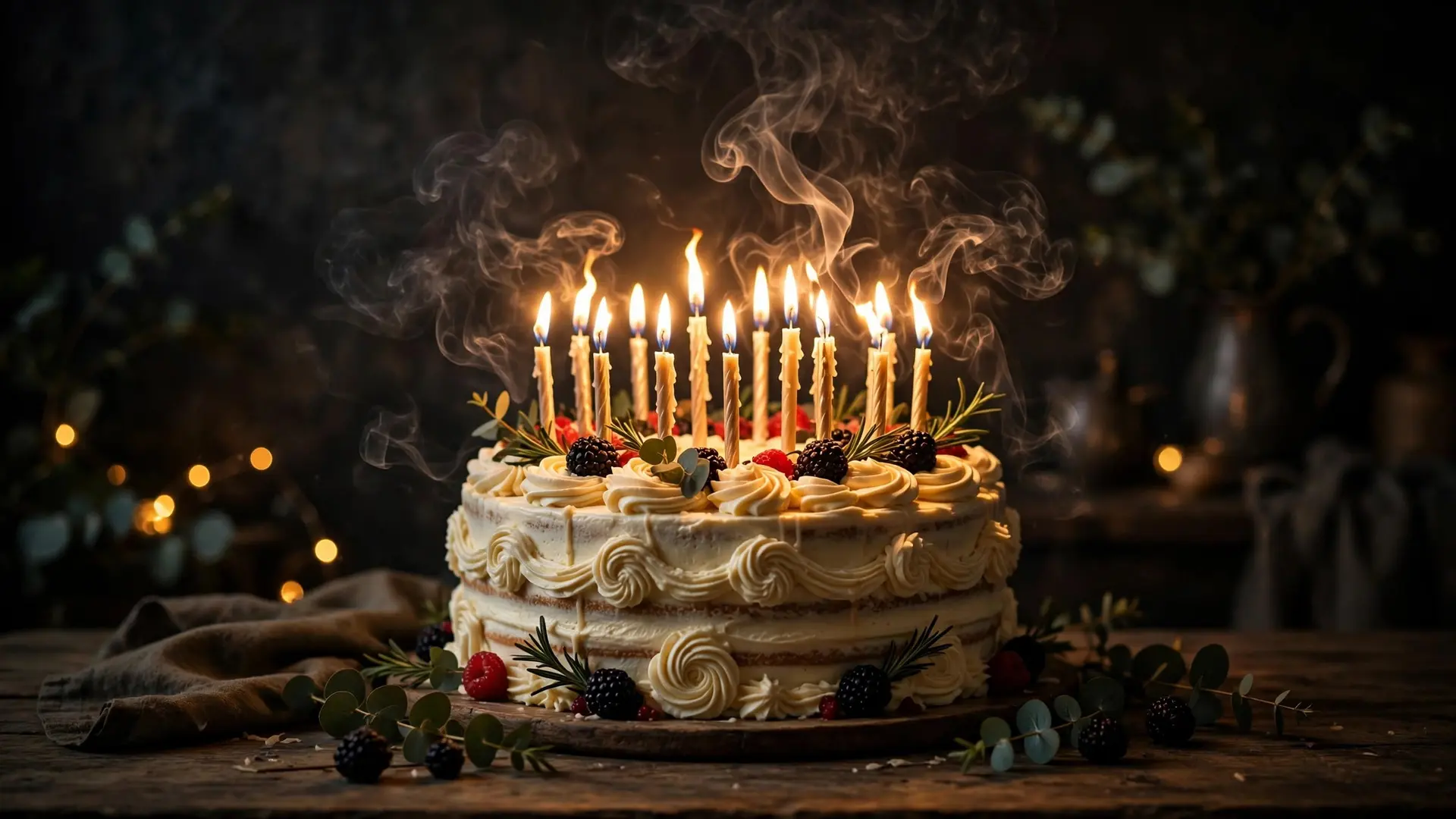
The candles arrived with Germany's Kinderfest, a children's birthday festival that took shape in the 1700s. Historian Marie Nicola dates the birthday candle's birth to somewhere between 1691 and 1740: the cake was already celebratory, the candle already meant life, the child already represented potential. In Kinderfest homes, the birthday cake carried one candle for each year of the child's life, plus an extra one — the "light of life," or Lebenslicht — for the year to come. The records are concrete. In 1746, Count Ludwig von Zinzendorf's birthday at Marienborn featured a cake as large as an oven could make, with candles stuck in for each year of his age and one in the middle, described in 1753 by Andrew Frey. Johann Wolfgang von Goethe's letter about his 50th birthday in the 1740s described a cake surrounded by lights "like an altar." These were not quick photo ops: Kinderfest candles were lit in the morning and kept burning all day — relit immediately if one went out — while adults gathered protectively around the child, since birthdays were believed to draw the attention of evil spirits. Only in the evening did the child blow them out, after the family feast. Kinderfest grew out of Pietism, a Protestant movement that treated the home as a place of moral training, and the ritual's meaning was earnest: each candle measured a year of inner growth, a small flame of a life unfolding.
Why Do We Make a Wish and Blow Them Out?
The wish is the heart of the act, and it has the shortest paper trail. The earliest written record of the full "make a wish and blow out the candles" ritual appears only in the late 19th century: in 1881, researchers for the Folk-lore Journal documented it among the Swiss middle class, candles blown out before the cake was eaten. Konadu notes that the Swiss tradition likely borrowed from the German practice of burning the candles all day for the birthday child's spiritual protection.
Why a silent wish, and why one breath? Across many belief systems, breath has been treated as the life force or soul itself. Blowing out candles while forming a silent intention carries echoes of votive prayer — a private, almost sacred act performed over frosting. The familiar superstitions follow naturally: the wish must be kept secret, and all the candles should go out in a single breath, or it will not come true. Keeping a wish unspoken is one of the oldest superstitions we live with, and it made itself at home in the birthday ritual.
How Did It Conquer the World?
A German ritual became a global one by way of immigrants and industry. In the 19th century, German immigrants brought Kinderfest to the United States, and German-language newspapers in cities like Philadelphia and Milwaukee advertised the celebrations throughout the 1800s. By 1900 to 1920, candles on cakes were a solid middle-class norm on both sides of the Atlantic. By the 1920s, the ritual had gone fully retail: candles were mass-produced and sold in age-appropriate sets, with their own little holders, by big department stores. Then came the moment that arguably fixed the tradition for good. In 1931, Disney released a short film centered on a birthday party — cake, candles, a song, and a wish, in that exact order — and it became the template millions of families would copy for the rest of the century. After World War II, American consumer culture exported that script worldwide, carried by tourism, children's media, and party-supply brands. Japan, for instance, had adopted the candle-blowing custom by the 1950s. Not everyone took the identical path. Plenty of cultures had their own birthday customs and simply adopted the German-American candle ritual when it went global. Ghana often opens the birthday with oto, a sweet-potato breakfast dish. Russians sometimes serve a personalized birthday pie with a greeting carved into the crust. In China, longevity is marked with a bowl of uncut "longevity noodles." Even Germany kept its own older form: many families still use a wooden "birthday wreath," lighting one candle for every year plus the taller light-of-life candle in the center, and letting them burn all day — a practice that continues for children through about age 12. And the hygiene question? In 2017, researchers at Clemson University found that blowing out the candles increased the bacteria on frosting by an average of 14 times. one of the researchers described it as "not a big health concern." Good — because nobody was ever going to stop. So make your wish. It does not come from ancient Greece, but from German living rooms where a candle stood for a year of life, from Swiss notebooks where a wish went on record, and from a 1931 cartoon that taught the world the script. Blow hard — one breath, no telling.
Frequently asked questions
Did birthday candles really start in ancient Greece?
No direct link exists. The story about lit moon cakes for the goddess Artemis is popular folklore with no documented connection to modern birthdays. The actual documented origin is 18th-century Germany's Kinderfest.
What does the extra birthday candle mean?
In the German Kinderfest tradition, the cake held one candle for each year of the child's life plus an extra one called the 'light of life' (Lebenslicht), symbolizing hope for another full year.
When did blowing out candles become a global custom?
German immigrants brought the ritual to the United States in the 19th century; it became a middle-class norm by 1900–1920, went mass-produced in the 1920s, and spread worldwide through American pop culture after World War II.
Is blowing out birthday candles unhygienic?
A 2017 Clemson University study found the act increased bacteria on frosting by an average of 14 times, but the lead researcher described it as not a big health concern.